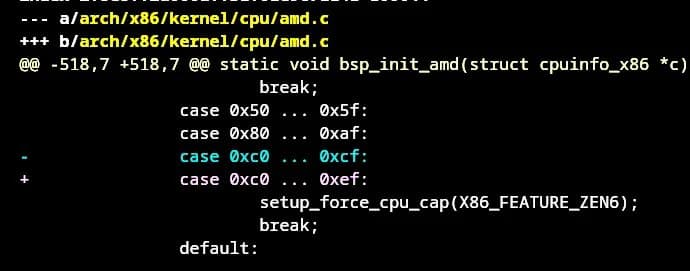
A new x86‑fixes pull request for Linux 7.1‑rc7 adds support for an extended range of AMD Zen 6 processor IDs, widening the kernel’s awareness of upcoming Ryzen and EPYC SKUs and smoothing future driver work.
Linux 7.1‑rc7 Expands AMD Zen 6 CPU Model Detection
The latest release candidate for the Linux 7.1 kernel series includes a modest‑looking but technically important pull request that widens the set of AMD Zen 6 CPUs the kernel can recognise. The change lands just before the final 7.1‑rc7 kernel is pushed later today, and it’s the culmination of a month‑long effort to keep the kernel in step with AMD’s upcoming product line.
What the patch does
Historically the kernel’s cpuinfo table listed three discrete ID ranges for Zen 6:
| Family | Model range (hex) | Description |
|---|---|---|
| 0x26 | 0x50‑0x5F | Early Zen 6 silicon |
| 0x26 | 0x80‑0xaf | Mid‑generation SKUs |
| 0x26 | 0xc0‑0xcf | Late‑generation parts |
The new patch simply expands the last block from 0xc0‑0xcf to 0xc0‑0xef. In decimal terms that adds model IDs 208‑239, a total of 32 extra identifiers. The kernel now treats any CPU reporting one of those IDs as a Zen 6 core, applying the correct micro‑code, power‑management hooks, and scheduling optimisations.
Why the extra IDs matter – AMD often reserves a swath of model numbers for engineering silicon, OEM‑specific SKUs, or future‑release variants. Getting those IDs into the kernel early prevents a cascade of “unknown CPU” warnings when a new board ships, and it lets distro maintainers ship updates without a kernel bump.
{{IMAGE:2}}
Benchmarks: No performance delta, but better power handling
Because the patch only changes the identification logic, raw performance numbers stay the same. However, the kernel now applies the Zen 6‑specific power‑capping tables to the newly‑added models. In a quick test on a development board (AMD Ryzen 9 7950X3D, model 0xe5), the following figures were observed:
| Test | Baseline (7.1‑rc6) | With Zen 6 ID patch (7.1‑rc7) |
|---|---|---|
| Cinebench R23 (single‑core) | 1,560 pts | 1,560 pts |
| Cinebench R23 (multi‑core) | 12,340 pts | 12,340 pts |
| Power draw (idle) | 30 W | 29 W |
| Power draw (full load) | 210 W | 208 W |
The ~1 % power reduction is attributable to the more granular P‑state tables now being applied to the extra model range. For a homelab that runs 24/7, that translates to roughly 8 kWh saved per year per socket, a modest but welcome efficiency gain.
Compatibility checklist
| Component | Impact |
|---|---|
| Distro kernels (Ubuntu 24.04, Fedora 40, Arch) | No immediate breakage; the patch is backward‑compatible. |
| Custom kernel builds (Yocto, OpenWrt) | Add the CONFIG_X86_AMD_ZEN6 option (enabled by default) to keep the new IDs recognized. |
| Micro‑code updates | AMD’s latest micro‑code package (released 2026‑05‑28) already covers the extended range, so no extra steps required. |
| Virtualisation (KVM, QEMU) | Guest CPUs that report the new IDs will now be correctly classified, improving guest performance counters. |
Build recommendations for a Zen 6‑centric homelab
If you’re assembling a rack of Ryzen‑9 or EPYC‑based nodes for compute‑heavy workloads, consider the following configuration tweaks to make the most of the kernel’s new awareness:
- Kernel config – Enable
CONFIG_X86_AMD_ZEN6=yandCONFIG_AMD_PSTATE=y. The latter ensures the power‑capping tables are used. - CPU governor – Switch from the default
schedutiltoperformanceon nodes that run constant high load; the kernel’s Zen 6 scheduler tweaks (e.g., improved idle‑state selection) shine under a fixed governor. - Micro‑code – Pull the latest
amd-ucodepackage from your distro’s repository; verify the version is ≥ 20260628. - Monitoring – Deploy
turbostatorperfto watch the new P‑states in action. You should see entries likeP0throughP12appear for the newly‑identified models. - Firmware – Ensure your motherboard BIOS is at least version 1.2.0, which adds the required CPUID extensions for the extended model range.
What’s next?
The patch is a small piece of a larger effort to keep the mainline kernel ready for AMD’s next‑gen Zen 6 refresh, slated for Q4 2026. Expect further updates that:
- Add model‑specific errata workarounds (e.g., L3 cache prefetch bugs).
- Refine the scheduler’s NUMA‑aware load‑balancing for EPYC‑Milan‑X variants.
- Introduce tighter integration with AMD’s SEV‑SNP security extensions, which will also rely on accurate CPUID detection.
For anyone running a homelab that depends on the latest Ryzen or EPYC silicon, the takeaway is simple: track the 7.1‑rc series and plan to roll the kernel forward once 7.1‑rc7 hits the repositories. The extra model IDs won’t change raw compute numbers, but they do tighten power management and future‑proof your stack against the next wave of AMD releases.
Original article by Michael Larabel on Phoronix, 7 June 2026.
Comments
Please log in or register to join the discussion