The IBM 604 Electronic Calculating Punch introduced pluggable vacuum‑tube modules in 1948, offering a compact, serviceable alternative to room‑filling computers. This article explains how the thyratron module works, why it mattered at the time, and what its practical limits are.
Powering Up an IBM 604 Thyratron Module – A Look at 1948’s Electronic Calculator
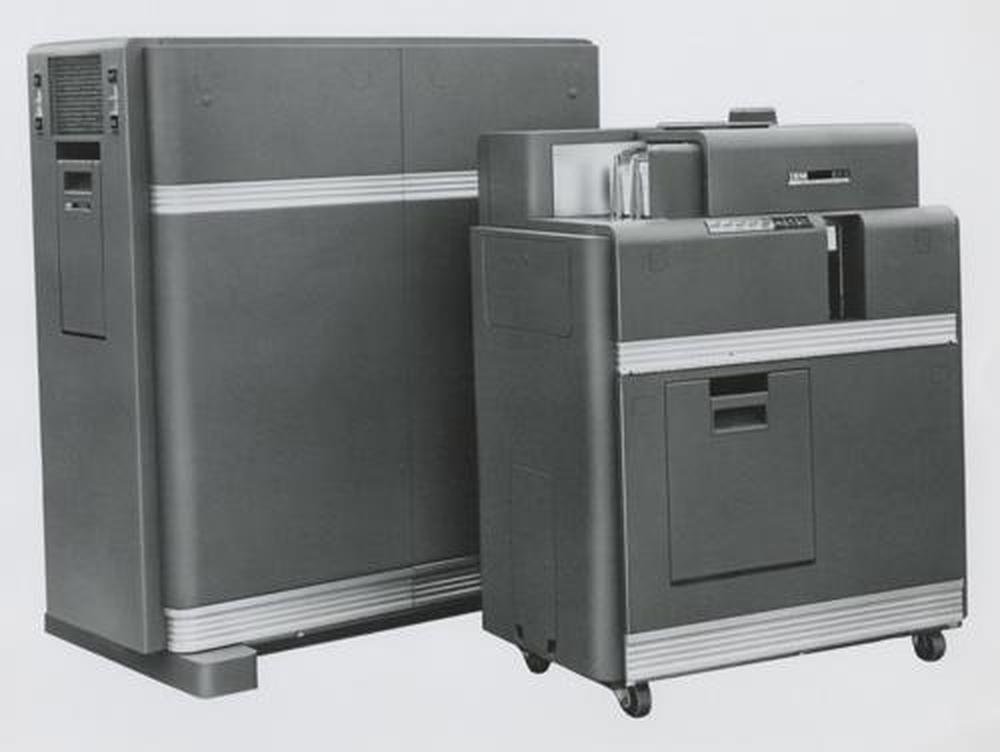 The IBM 604 Electronic Calculating Punch behind a Type 521 Card Reader/Punch. Photo from IBM.
What the marketing claimed
When IBM announced the 604 in 1948 it was billed as a “programmable calculator” that could perform up to 60 arithmetic operations per second, including multiplication and division. The brochure emphasized its small footprint – roughly the size of a double‑door refrigerator – and a rental price of $550 per month, which made electronic speed affordable for many businesses and university labs.
What was actually new
The real novelty lay in the pluggable module design. Each module packaged a single vacuum tube together with its bias resistors, coupling capacitors and wiring on an insulated carrier. Nine pins at the bottom of the carrier mated with a socket on the machine’s backplane, while the tube itself sat in a miniature socket on the module. A metal handle allowed a technician to pull a module out, replace a failed tube, or swap in a different type of tube without touching the rest of the chassis.
Why the module mattered
- Density – By stacking components three‑dimensionally the module fit more tubes into a given volume than the traditional chassis‑on‑top layout used in earlier tube equipment.
- Manufacturability – IBM could stamp the ceramic carriers, populate them with standard parts, and then assemble whole machines on a production line.
- Maintainability – Fault isolation became a matter of swapping modules until the offending one was found; a spare could be dropped in and the machine was back in operation within minutes.
The 604 used about 1 250 tubes, many of them thyratrons (type 2D21). A thyratron is a gas‑filled tube that acts as a high‑current switch. When a small trigger voltage is applied to its control grid, the xenon gas inside ionises, forming a plasma that conducts a large current. Unlike a triode, the plasma cannot be extinguished by the grid; the tube stays on until the anode‑cathode voltage is removed.
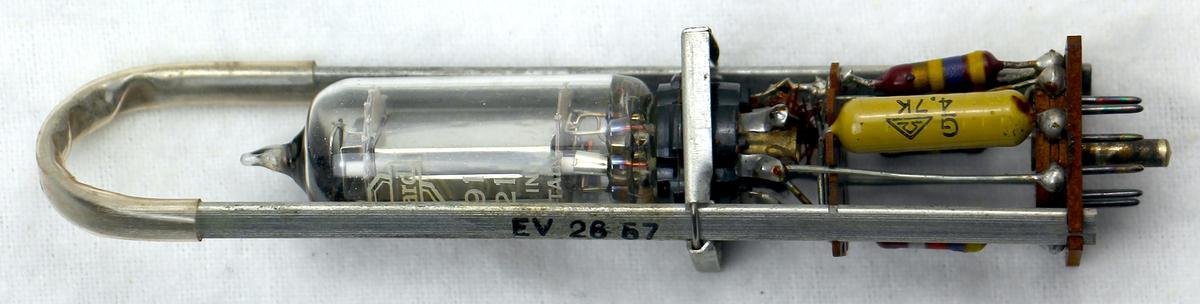 One of the thyratron modules used in the IBM 604. The insulated carrier holds the tube, resistors and capacitors.
Demonstration: turning a light bulb on and off
In a recent experiment a restored MD7A thyratron module was wired as follows:
- Pin 5 (plate) – supplied ~100 V DC.
- Pin 3 (control input) – received an 8 V pulse from a push‑button.
- Pin 4 (output) – pulled high when the tube fired and drove a small incandescent bulb.
- Pin 6 (ground) – common return.
Pressing the first button sent a trigger pulse to the grid, ionising the xenon and allowing the plate current to flow. The bulb lit instantly. Pressing the second button cut the plate voltage, the plasma collapsed in a few microseconds and the bulb went dark. The video attached to the original post shows exactly this behaviour.
Limitations of the thyratron approach
- Turn‑off latency – Because the tube remains conductive until power is removed, any circuit that needs rapid, repeated switching must include a mechanical or electronic means to break the plate supply. The 604 solved this with a cam‑operated microswitch driven by the card‑reader timing shaft.
- Power consumption – The heater filament alone draws about 3.75 W; the whole 604 system required roughly 5.5 kW, a substantial load for a 1940s office.
- No stored program – The calculator still relied on plugboards for control flow. There were no loops, conditional branches beyond the selector relays, or any form of RAM.
How the 604 fits into the broader timeline
The 604 sits between two eras:
- Electromechanical accounting machines such as the IBM 604’s predecessor, the 401, which used relays and rotating drums.
- Fully electronic stored‑program computers like the IBM 701 (1952) and the later 650, which introduced magnetic drum memory and a program stored in RAM.
Although the 604 could not run arbitrary programs, its speed and reliability made it attractive for scientific calculations at places like Los Alamos National Laboratory. IBM later extended the machine with a plug‑in card‑programmed controller (the “Card‑Programmed Electronic Calculator”) before moving on to the 650, the first mass‑produced computer that supported stored programs.
Take‑away
The IBM 604’s modular tube design was a pragmatic solution to the engineering challenges of the late 1940s. It provided a serviceable, relatively compact electronic calculator that bridged the gap between bulky relay machines and the first true computers. The thyratron module demonstrated a simple, high‑current switching primitive that foreshadowed later semiconductor devices such as the SCR (thyristor). Its limitations – inability to turn off without cutting power, high energy use, and lack of program memory – kept it from being a full computer, but the lessons learned fed directly into IBM’s vacuum‑tube and later transistor‑based systems.
For more technical details see the IBM 604 Operating Manual and the Customer Engineering Manual (both available through the IBM archives). The 2D21 thyratron datasheet can be found here.
Image credits: IBM historical archives.
Comments
Please log in or register to join the discussion