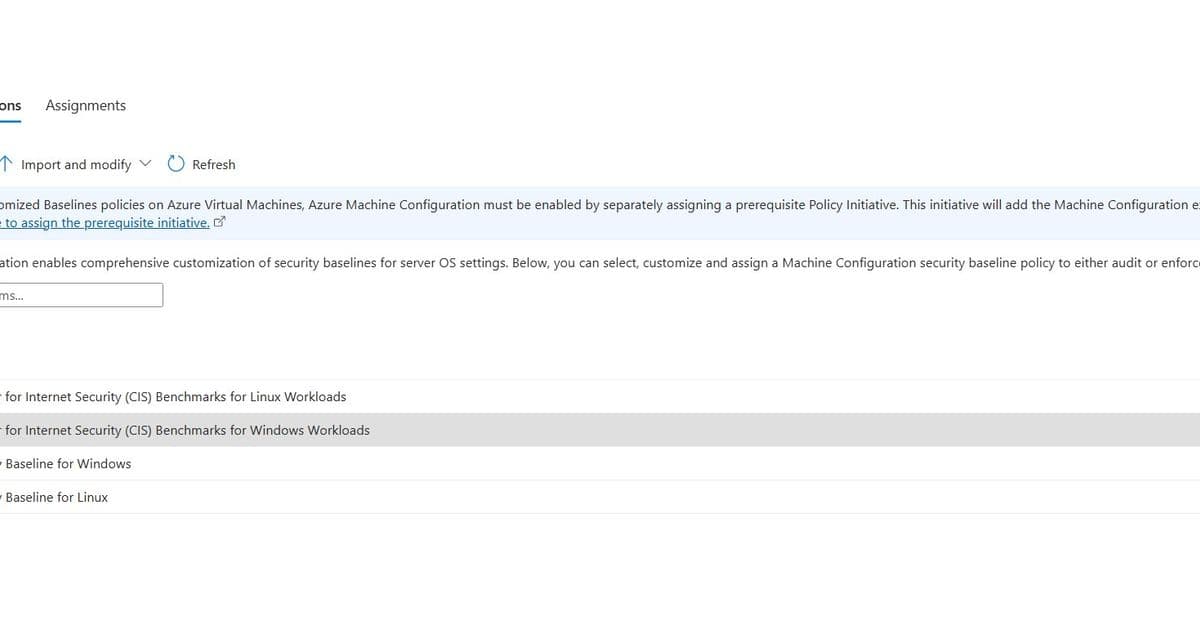
Microsoft extends its built-in CIS Benchmark capabilities to Windows Server, bringing parity with existing Linux offerings and enabling organizations to manage security compliance across heterogeneous environments through Azure Policy and Machine Configuration.
Azure Expands CIS Benchmark Support to Windows Server, Unifying Cross-Platform Compliance Management
Microsoft has announced the preview of CIS Benchmarks for Windows Server, extending its compliance management capabilities beyond Linux systems to provide a unified approach to security hardening across cloud and hybrid environments. This significant development addresses a long-standing request from customers who have benefited from the Linux implementation and now require similar functionality for Windows Server deployments.
What Changed: CIS Benchmarks Come to Windows Server
The announcement represents Microsoft's commitment to providing comprehensive security baselines for both major operating system families within its cloud ecosystem. Customers managing Azure Virtual Machines (VMs) and Arc-enabled machines can now leverage Center for Internet Security (CIS) benchmarks specifically tailored for Windows Server environments.
"For customers with machines managed by Azure (i.e., Arc-enabled machines and Azure VMs), last year we delivered built-in CIS Benchmarks for Linux. The feedback has been clear: 'Excellent, now do Windows.' Today we're announcing that built-in CIS Benchmarks for Windows Server are coming to Azure Policy and Machine Configuration as well," stated Microsoft in the announcement.
The initial preview supports Windows Server 2025 only, with additional Windows Server editions planned for future releases. This staged rollout approach allows Microsoft to refine the implementation based on early adopter feedback before expanding to broader OS version support.
Provider Comparison: Azure's Compliance Ecosystem
Azure's implementation of CIS Benchmarks positions it competitively against other cloud providers in the compliance management space. While AWS and Google Cloud offer various compliance tools and frameworks, Azure's integration of CIS Benchmarks directly into Azure Policy and Machine Configuration provides a more cohesive experience.
Unlike solutions that require third-party tools or manual configuration, Azure's approach embeds compliance management directly into its governance framework. This integration eliminates the need for separate compliance management systems and reduces the complexity of maintaining security baselines across mixed environments.
Key advantages of Azure's implementation include:
- Native integration with Azure's existing governance tools
- Consistent experience across Windows and Linux systems
- Support for both cloud VMs and edge/Arc-enabled machines
- Built-in flexibility for customization while maintaining compliance
Technical Implementation: Familiar Workflow with Windows-Specific Enhancements
Organizations already using CIS Benchmarks for Linux in Azure will find the Windows implementation familiar, with a consistent workflow and feature set. The new experience maintains full parity with official CIS Benchmarks content while providing Windows-specific optimizations.
Core Features
The Windows implementation shares several key features with its Linux counterpart:
- Full parity with official CIS Benchmarks: Precise translation from CIS formats to Machine Configuration formats ensures alignment with industry standards.
- Flexible configuration: Organizations can adjust parameters and exclude settings as needed to accommodate specific requirements.
- Compliance as code: Benchmark selections and customizations can be exported as JSON, enabling version control, approval workflows, and file-centric deployment patterns like GitOps.
- Cross-platform compatibility: Single policy/assignment works with both Azure VMs and Arc-enabled machines, eliminating the need for different management approaches.
- Audit-first approach: The preview begins in audit-only mode, allowing organizations to assess compliance impact before enabling enforcement.
Windows-Specific Optimizations
While maintaining consistency across platforms, Azure's implementation addresses Windows-specific nuances:
- Heterogeneous fleet handling: Automatically manages variations in CIS recommended settings across different Windows OS versions.
- Role-based configurations: Accounts for differences in CIS recommendations based on server roles (domain controller vs. member server).
- API versioning: Handles variations in management APIs across different Windows OS versions.
Business Impact: Enhanced Security Management and Operational Efficiency
The introduction of Windows Server CIS Benchmarks in Azure provides several business benefits for organizations managing hybrid and multi-cloud environments:
Simplified Compliance Management
Organizations can now apply consistent security baselines across both Windows and Linux systems through a single control plane. This unified approach reduces administrative overhead and minimizes the risk of configuration inconsistencies that can lead to security vulnerabilities.
For enterprises with mixed environments, this capability eliminates the need for separate compliance management tools or complex scripting solutions. The integration with Azure Policy ensures that compliance policies are automatically applied and consistently enforced across the environment.
Operational Efficiency Improvements
The "compliance as code" approach enables organizations to treat security configurations as version-controlled artifacts. This capability supports DevOps practices and automation pipelines, allowing compliance requirements to be integrated into the software development lifecycle.
Organizations can:
- Track changes to security configurations over time
- Implement approval workflows for compliance policy changes
- Deploy compliance configurations through CI/CD pipelines
- Maintain audit trails for compliance-related activities
Risk Reduction and Enhanced Security Posture
By providing direct access to CIS Benchmarks through Azure's management tools, organizations can more effectively implement security best practices. The audit-first approach allows for gradual implementation and validation, reducing the risk of disrupting production environments while improving security posture.
The granular control over individual benchmark rules enables organizations to prioritize critical security measures and implement changes in a controlled manner. This approach is particularly valuable for large enterprises with complex IT environments.
Future Roadmap: Expanding Capabilities and Coverage
Microsoft has outlined several enhancements planned for the CIS Benchmarks implementation in Azure:
Granular per-rule auto-remediation: Organizations will be able to enable enforcement on individual rules, allowing for gradual and controlled security improvements across their fleet.
Policy consolidation: Microsoft plans to retire overlapping policy definitions in Azure, such as unmaintained implementations of older CIS benchmarks, to streamline the compliance management experience.
Expanded baseline coverage: Beyond CIS Benchmarks, Azure will add STIG (Technical Implementation Guide) and other industry baseline coverage, enabling organizations to manage their end-to-end compliance posture through a single control plane.
Getting Started with Windows Server CIS Benchmarks
Organizations interested in previewing the Windows Server CIS Benchmarks can access the feature through Azure Policy > Authoring > Machine Configuration. The benchmarks will appear as a built-in option in the Machine Configuration catalog experience.
Microsoft has indicated that additional documentation and resources will be available at aka.ms/cis-windows-azure once the preview goes live. Organizations interested in the upcoming auto-remediation preview can also sign up through Microsoft's remediation preview form.
Conclusion
The extension of CIS Benchmarks to Windows Server represents a significant step forward in Azure's compliance management capabilities. By providing a unified approach to security hardening across both Windows and Linux systems, Microsoft is enabling organizations to simplify compliance management while maintaining robust security postures.
For enterprises with hybrid or multi-cloud strategies, this announcement further strengthens Azure's position as a comprehensive platform for governance, security, and compliance. The combination of native integration, flexible configuration options, and future enhancements positions Azure as a competitive choice for organizations seeking to streamline their compliance operations while maintaining security excellence.
Comments
Please log in or register to join the discussion