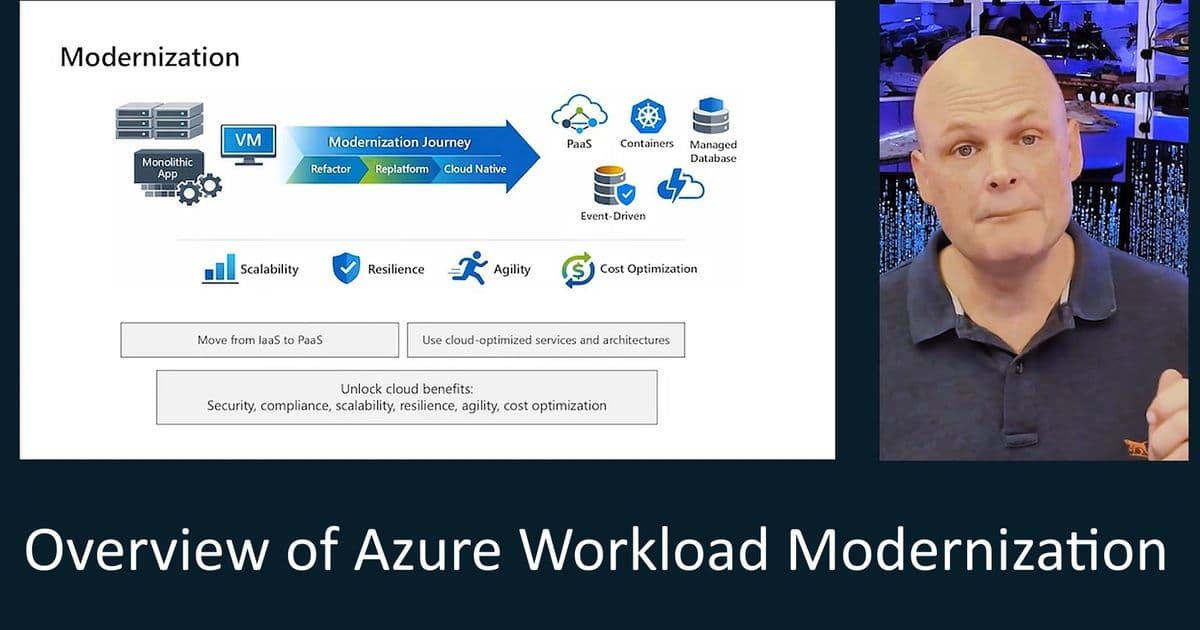
Modernizing Azure workloads means shifting from VM-based deployments to PaaS services, containers, and serverless architectures while leveraging built-in security, compliance, and DevOps capabilities.
Modernizing Azure workloads represents a fundamental shift in how organizations approach application deployment and management. Rather than maintaining traditional virtual machine-based architectures, workload modernization focuses on leveraging cloud-native services that offload infrastructure management to Azure while providing enhanced scalability, security, and operational efficiency.
The Shift from IaaS to PaaS and Cloud-Native Services
The journey begins with replatforming applications from virtual machines to Platform-as-a-Service offerings. For web applications, this means migrating from VM-hosted solutions to Azure App Service, which automatically handles scaling, patching, and high availability. Similarly, managed database services like Azure SQL Database eliminate the need for database administration tasks, while container platforms such as Azure Kubernetes Service (AKS) provide orchestration capabilities without the operational overhead.
This transition fundamentally changes the operational model. Azure assumes responsibility for infrastructure management, including operating system patches, security updates, and infrastructure scaling. Your development team can redirect focus toward building features and improving application functionality rather than managing servers. The economic benefits are equally compelling, as you only pay for actual compute resources consumed rather than maintaining idle capacity.
Leveraging Azure's Built-in Ecosystem
One of the most immediate benefits of modernization is access to Azure's comprehensive ecosystem of built-in capabilities. Without modifying application code, organizations can enable Azure Monitor for comprehensive telemetry and alerting, providing deep insights into application performance and health. Azure's extensive compliance certifications help organizations meet regulatory requirements across industries, from healthcare to financial services.
Governance controls become readily available, enabling organizations to implement policies for resource tagging, cost management, and security compliance. These capabilities were previously difficult or impossible to implement consistently across on-premises environments. The platform's global infrastructure also enables features like Azure Front Door for content delivery and DDoS protection, improving both performance and security for users worldwide.
Modernization as a Continuous Journey
Perhaps the most important mindset shift is viewing modernization as an ongoing process rather than a one-time project. Once workloads are on Azure, organizations should plan for iterative improvements as new services and best practices emerge. This continuous improvement approach ensures applications remain current with evolving technology and security standards.
Implementing DevOps pipelines through continuous integration and continuous delivery (CI/CD) becomes essential for this iterative approach. These pipelines enable regular, reliable deployments of updates and allow for gradual refactoring of system components. As Azure introduces new instance types, updated frameworks, or additional managed services, organizations can adopt these improvements with minimal disruption to operations.
Containerization and Event-Driven Architectures
Breaking apart monolithic applications into smaller, independent components represents a significant evolution in application architecture. Containerizing application components and deploying them to AKS enables independent scaling and updating of individual services. Each microservice runs in isolation, so updates to one component don't impact the entire system.
Event-driven architectures complement this approach by enabling serverless functions through Azure Functions. These functions execute only when triggered by specific events, providing automatic scaling and cost efficiency. Organizations pay only for actual execution time rather than maintaining idle resources. This model is particularly effective for background jobs, data processing, and API endpoints with variable traffic patterns.
The combination of containers and serverless functions creates highly modular applications that are easier to maintain and automatically scale to meet demand. This architectural approach also improves resilience, as failures in one component don't cascade throughout the system.
Modern Security and Identity Integration
Modernizing security posture is a critical component of workload modernization. Integrating applications with Microsoft Entra ID (formerly Azure Active Directory) replaces custom authentication mechanisms with enterprise-grade identity management. This provides immediate benefits including multi-factor authentication, token-based access, and centralized user management across cloud services.
Azure's global networking and security services offer capabilities that were previously available only to large enterprises with substantial security budgets. Azure Front Door not only improves global performance but also includes built-in Web Application Firewall protection against common web attacks and DDoS threats. Azure Key Vault centralizes secret and certificate management, eliminating the security risks associated with hardcoded credentials or poorly managed keys.
Microsoft Defender for Cloud provides continuous threat protection and vulnerability assessment across Azure resources. This comprehensive security approach significantly strengthens workload protection while reducing the operational burden on security teams.
Business Impact and Strategic Considerations
The business case for workload modernization extends beyond technical benefits. Organizations typically see reduced operational costs through eliminated infrastructure management overhead and improved resource utilization. Development velocity increases as teams spend less time on infrastructure tasks and more time on business features.
Modern architectures provide better scalability to handle traffic spikes without manual intervention. Enhanced security and compliance capabilities reduce risk and support regulatory requirements. The ability to adopt new Azure services as they become available ensures organizations remain competitive and can quickly respond to changing business needs.
However, successful modernization requires careful planning and execution. Organizations should start with a clear assessment of current workloads, identifying which applications are suitable for immediate modernization and which require additional preparation. A phased approach, beginning with less critical workloads, allows teams to build expertise and refine processes before tackling mission-critical applications.
Modernization also requires organizational change management. Development teams need training on new services and architectural patterns. Operations teams must adapt to new monitoring and management approaches. Security practices must evolve to leverage cloud-native capabilities effectively.
Getting Started with Modernization
The modernization journey typically begins with assessment and planning. Organizations should evaluate their current application portfolio, identifying candidates for modernization based on business value, technical feasibility, and risk tolerance. Azure provides assessment tools that analyze existing workloads and recommend modernization paths.
Initial modernization efforts often focus on straightforward migrations to PaaS services, such as moving web applications to App Service or databases to Azure SQL Database. These migrations provide quick wins with minimal code changes while delivering immediate benefits in terms of reduced management overhead and improved scalability.
As organizations gain experience, they can progress to more sophisticated modernization patterns, including containerization and microservices architectures. The key is maintaining momentum through continuous improvement while ensuring each step delivers tangible business value.
Modernizing Azure workloads represents a strategic investment in operational efficiency, security, and business agility. By embracing cloud-native services, continuous improvement practices, and modern architectural patterns, organizations can transform their application portfolio to better serve current needs while positioning themselves for future innovation.
For organizations beginning this journey, Microsoft provides extensive documentation and guidance through the Azure Architecture Center and App Modernization guidance. These resources offer detailed implementation patterns, best practices, and case studies to support successful modernization initiatives.
Comments
Please log in or register to join the discussion