
Broadcom's Taurus BCM83640 doubles optical lane throughput to 400G, enabling 1.6T and 3.2T transceivers for AI-scale data centers.
The AI revolution is pushing data center infrastructure to its limits. As AI clusters scale to 100,000-plus GPUs and XPUs, requiring gigawatt-scale power facilities, the optical networks connecting them have become the critical bottleneck. Enter Broadcom Taurus BCM83640, a 3nm 400G per lane optical PAM4 DSP, designed specifically to enable 1.6T transceivers and lay the groundwork for even faster 3.2T modules capable of supporting 204.8T switching fabrics.

What Is Taurus?
The Broadcom Taurus, or the Broadcom BCM83640, represents a significant leap in optical networking technology. Built on a 3nm process node, this monolithic PAM-4 DSP functions as an 8 to 4 gearbox PHY and driver. Broadcom says that this design choice delivers best-in-class performance in both bit error rate and power consumption. Taurus doubles the throughput per lane to enable the next generation of 3.2T optical modules. Broadcom says the device complies with current IEEE standards and interoperates with Broadcom 400G electro-absorption modulated laser and photodiode components.
Breaking Through the Bandwidth Ceiling
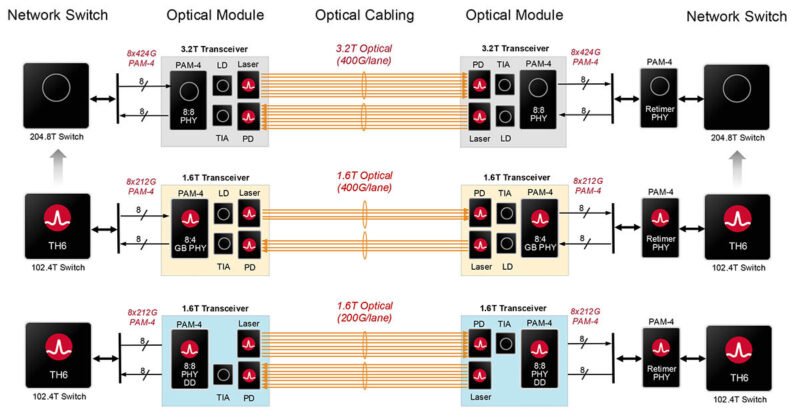
Currently, most high-end high-speed optical transceivers operate at 200G per lane. By doubling that to 400G per lane, Taurus increases bandwidth density. A single 1RU switch using 1.6T pluggable modules based on Taurus can deliver 102.4T of switching capacity. This effectively doubles what was possible with the previous generation 200G per lane technology.
If you saw our recent Substack piece, NVIDIA is already working on achieving higher density in this year's generation, as physical density matters. The implications go further. Next-generation 204.8T switches will adopt 400G per lane electrical interfaces, matched by 3.2T optical transceivers, using the same signaling rate. This one-to-one mapping between electrical and optical I/O speeds dramatically simplifies the 3.2T optical module design compared to earlier approaches that required retimers and complex gearboxing.
For more on the broader 1.6TbE ecosystem, see our coverage of Broadcom Tomahawk 6 launched for the 1.6TbE generation.
The Technical Architecture
The Taurus BCM83640's monolithic 3nm design represents a fundamental shift in how optical DSPs are constructed. By integrating the PAM-4 modulation, clock recovery, and driver functions onto a single die, Broadcom has eliminated the inter-die signaling delays and power overhead that plague multi-chip solutions.
The 8 to 4 gearbox architecture is particularly clever. It takes eight lanes of 100G electrical signaling and converts them to four lanes of 200G PAM-4 optical signaling. This gearbox functionality is essential because it bridges the gap between current electrical switch fabrics and next-generation optical interfaces without requiring a complete redesign of existing switch architectures.
Power and Performance Metrics
While Broadcom hasn't released full specifications, the 3nm process node provides significant advantages in both power efficiency and signal integrity. The reduced feature size allows for tighter control over signal paths and lower voltage swings, which directly translates to better bit error rates at higher speeds.
The power consumption improvements are particularly important for AI data centers where optical networking can consume up to 10% of total system power. Every watt saved in the optical interface translates to more compute capacity per rack or reduced cooling requirements.
Market Timing and Competition
The timing of Taurus's release is strategic. AI data centers are already planning their 2026-2027 buildouts, and optical component suppliers need to have their roadmaps aligned with switch vendors' deployment schedules. Broadcom's early sampling to key customers suggests they're trying to lock in design wins before competitors can respond.
The competitive landscape includes companies like Inphi (now part of Marvell), Broadcom's primary competitor in optical DSPs, and various startups working on alternative approaches like coherent optics for shorter reach applications. However, Broadcom's integrated approach and process technology lead give them a significant advantage.
Deployment Timeline and Ecosystem
Broadcom says it has already begun sampling the BCM83640 to early access customers and partners, with the official launch at OFC 2026 next week. Mass production and deployment in next-generation switch systems are expected by late 2026.
The ecosystem implications are substantial. Optical transceiver manufacturers will need to redesign their 1.6T and 3.2T modules around the Taurus platform. This includes companies like Cisco, Arista, and various white-box optical suppliers who will be integrating these components into their product lines.
Final Thoughts
The introduction of the Broadcom Taurus platform is significant for those building large-scale AI clusters. This is still a bit of a forward-looking technology for now, but the trajectory is clear: as AI models continue to grow in complexity and scale, the optical networks connecting them must evolve at an equally rapid pace.
Taurus represents not just an incremental improvement but a fundamental architectural shift that will enable the next generation of AI infrastructure. The combination of 3nm process technology, integrated design, and 400G per lane throughput positions Broadcom to capture a significant share of the optical DSP market as data centers transition to 1.6T and 3.2T networking.
Comments
Please log in or register to join the discussion