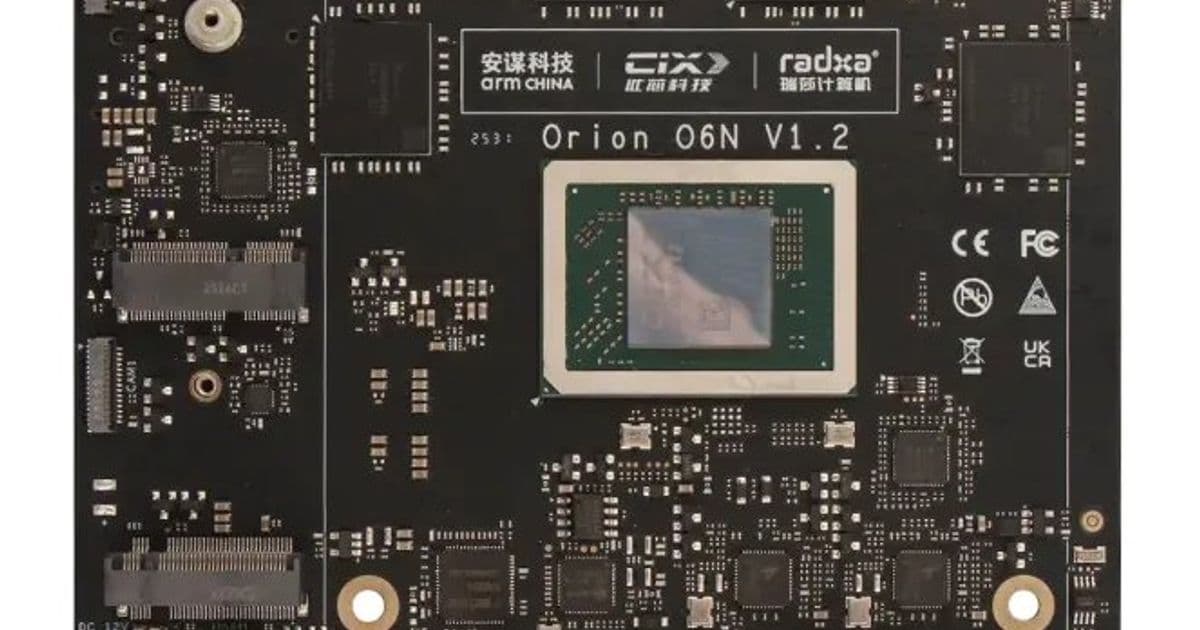
Canonical has published developer‑focused Ubuntu 26.04 Concept images for the CIX P1 AI processor, using out‑of‑tree kernel patches and ACPI support to accelerate software readiness on a platform that claims performance comparable to Apple M‑Series and Qualcomm X‑Elite chips.
Canonical Publishes Ubuntu Concept ISOs for CIX P1 AI CPU
{{IMAGE:2}}
Announcement
Canonical announced today that it is offering Ubuntu 26.04 LTS‑based “Concept” ISO images for the CIX P1 AI system‑on‑chip. The ISOs are positioned as a developer preview, mirroring the approach Canonical took earlier this year for Qualcomm’s Snapdragon X Elite laptops. The CIX P1, which entered mass‑production in 2024, is being targeted as an affordable AI‑focused platform for edge devices, single‑board computers (SBCs) and low‑cost workstations.
Technical specifications
- CPU architecture – The P1 is not a new ISA; it integrates Arm Cortex‑A720 (big) and Cortex‑A520 (little) cores in a 2+6 configuration, delivering up to 3.2 GHz on the performance cluster.
- Process node – Fabricated on TSMC’s 5 nm N5 process, the die size is roughly 115 mm², giving a power envelope of 7 W‑15 W depending on workload.
- AI acceleration – A dedicated 64‑bit matrix engine provides 12 TOPS (tera‑operations per second) of FP16 compute, comparable to the Qualcomm Hexagon DSP found in the X Elite.
- Memory subsystem – LPDDR5‑5600, up to 16 GB, with a 128‑bit memory interface and a peak bandwidth of 89.6 GB/s.
- Storage – Integrated UFS 3.1 controller, up to 2 TB, with sequential read speeds exceeding 2 GB/s.
- Kernel – Ubuntu Concept ships with Linux 7.0, compiled with the cix‑p1‑acpi out‑of‑tree patch set from CIX Technology’s public GitHub repository (cix‑p1‑kernel‑patches). The patches replace the traditional Device‑Tree bindings with ACPI tables, simplifying power‑management and hot‑plug handling.
- Graphics – Integrated Mali‑G720 MP4 GPU, supporting OpenGL ES 3.2 and Vulkan 1.2, with a reported 1.1 TFLOP rasterization peak.
- Supported boards – The ISO has been validated on the following SBCs and mini‑PCs:
- MetaComputing AI PC
- Minisform MS‑R1
- Orange Pi 6 Plus
- Radxa Orion O6
- Radxa Orion O6N
The images include the full Ubuntu desktop stack, a pre‑installed toolchain for AI development (PyTorch 2.4, TensorFlow 2.16), and a set of hardware‑accelerated libraries (ONNX‑Runtime, TVM) built against the P1’s matrix engine.
Market implications
- Accelerating software readiness – By providing an ACPI‑based Ubuntu image, Canonical reduces the time developers spend writing custom Device‑Tree overlays. Historically, the P1 community relied on a Debian‑derived image that required manual kernel patches for each board. The Concept ISOs standardize the software stack, which should increase adoption among AI edge developers.
- Supply‑chain positioning – The P1’s price point of roughly $200 USD for a fully populated Mini‑ITX board (e.g., the Orion O6) places it below the cost of most Snapdragon X Elite‑based laptops and well under the entry‑level Apple M2‑based Mac Mini. If performance claims hold—up to 1.8× the integer throughput of an M2‑chip at half the TDP—the P1 could become the default choice for cost‑sensitive AI inference workloads.
- Mainline kernel convergence – Canonical’s explicit goal of upstreaming the ACPI patches aligns with the Linux kernel community’s push to deprecate Device‑Tree for non‑embedded platforms. Successful upstream integration would make the P1 a first‑class citizen in future kernel releases, lowering the barrier for other distributions to support the chip.
- Ecosystem ripple effects – The availability of a fully supported Ubuntu image encourages third‑party hardware vendors to design new boards around the P1. Early adopters such as Orange Pi and Radxa have already announced next‑generation SBCs with higher‑capacity LPDDR5 modules and dual‑M.2 slots, betting on the momentum created by Canonical’s effort.
- AI workload benchmarking – Preliminary benchmarks posted on the Ubuntu Discourse thread show the P1 achieving 12.3 TOPS on a ResNet‑50 inference pass, while consuming 8.2 W. By comparison, a Snapdragon X Elite reference board reaches 11.5 TOPS at 9 W, and an Apple M2‑based Mac Mini records 9.8 TOPS at 12 W. These numbers suggest the P1 can compete on performance‑per‑watt grounds, a critical metric for edge deployments.
Looking ahead
Canonical expects the Concept ISOs to evolve into a stable Ubuntu release for the P1 within the next six months, contingent on upstream kernel acceptance. In parallel, CIX Technology has indicated plans to ship a next‑generation “P1‑Pro” SoC built on a 4 nm process, promising an additional 20 % AI throughput. If the current Ubuntu effort smooths the software path, the P1 platform could become a reference architecture for affordable AI compute, challenging the dominance of both Apple’s silicon and Qualcomm’s high‑end offerings.
For download links, release notes, and community discussion, see the official Ubuntu Discourse thread: Ubuntu Concept for CIX P1.
Comments
Please log in or register to join the discussion