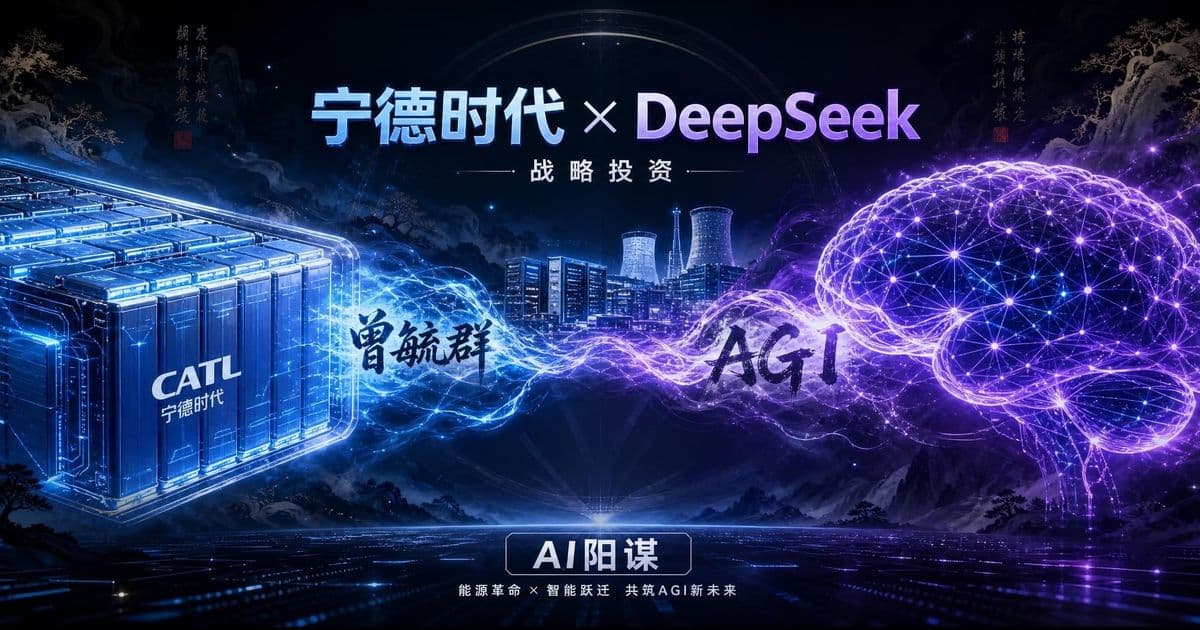
CATL, the world's largest EV battery manufacturer, joined DeepSeek's first funding round alongside Tencent and JD.com. The investment is less about AI models and more about who supplies the electricity to run them.
Contemporary Amperex Technology Co. Limited, better known as CATL, does not build language models. It builds lithium-ion cells, roughly a third of every EV battery sold worldwide. So its participation in DeepSeek's first external funding round, alongside Tencent, JD.com and IDG Capital, reads at first as a category error. The more you look at where CATL has been spending money over the past year, the less surprising it gets.
What's claimed
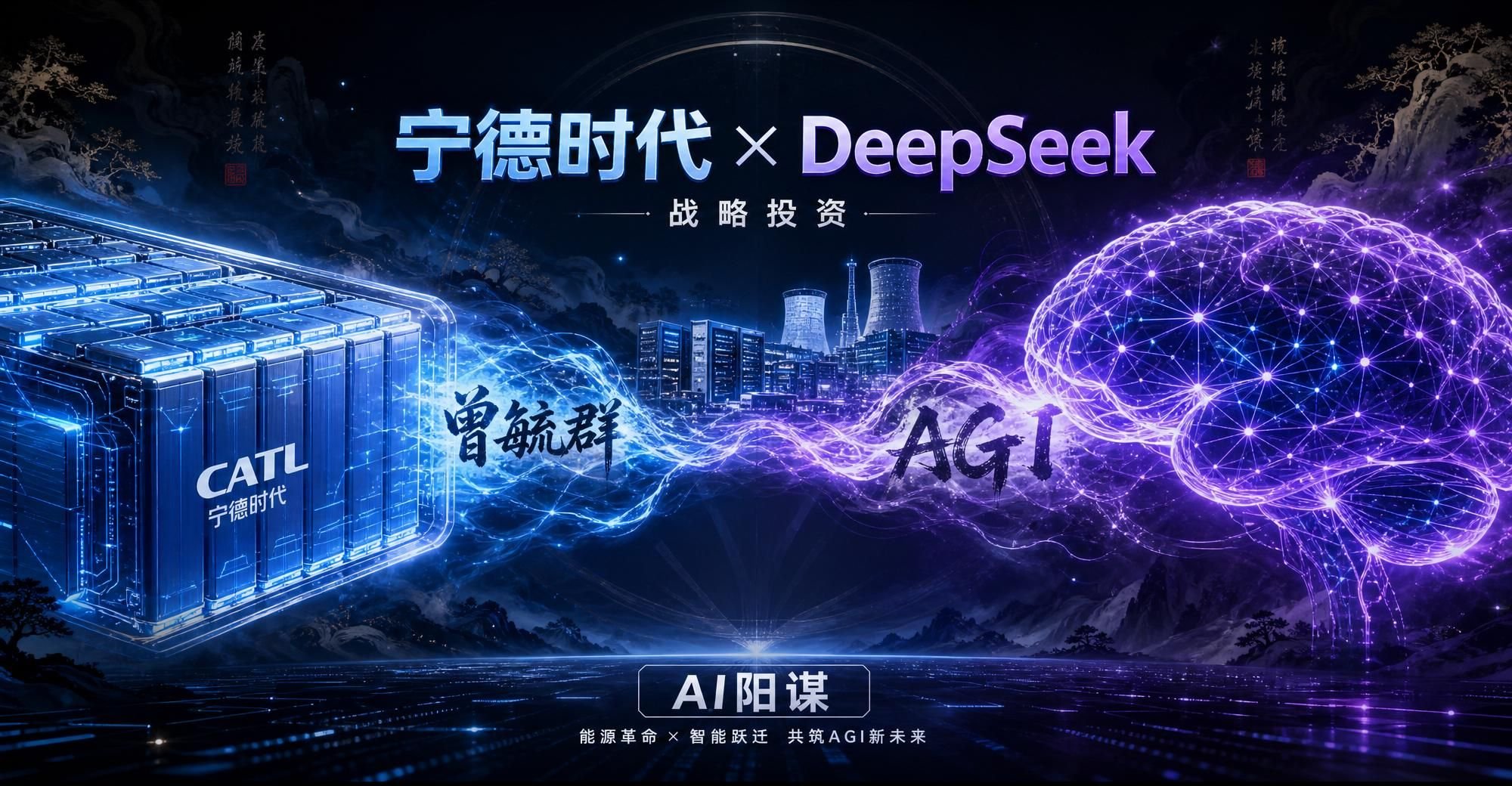
The headline framing, pushed by CATL chairman Zeng Yuqun, is that AI and energy are converging into a single business, and that CATL intends to sit at the junction. The company has reportedly deployed around $1 billion into AI data center (AIDC) infrastructure. Two deals anchor that figure: a 49% stake in Zhongheng Electric's high-voltage direct current (HVDC) business for 4.1 billion RMB, and a 38.1% stake in Chinese data center operator 21Vianet for $942 million. The DeepSeek investment is positioned as the software piece that ties the rest together.
Zeng's pitch is a closed loop. CATL sells the grid storage that smooths demand from power-hungry data centers, its HVDC and operator stakes capture margin along the power-delivery chain, and DeepSeek supplies models that make both CATL's factories and its energy-management systems more efficient. The company is describing this as a possible next trillion-dollar market.
What's actually new
Strip away the loop diagram and the substantive new fact is narrow but real: a battery manufacturer is now an equity holder in a frontier model lab. That is unusual. Most strategic money flowing into AI labs comes from cloud providers, chipmakers, or consumer internet companies that have an obvious distribution or compute relationship. CATL's interest is upstream of all of that. It is betting on electricity demand.
The demand thesis is the part worth taking seriously. Training and serving large models consumes real power, and the constraint on building more capacity has shifted, in several markets, from chip supply to grid interconnection and on-site power. HVDC distribution inside data centers reduces conversion losses compared to traditional AC distribution, which matters when a single facility draws tens of megawatts. A battery maker with grid-storage products and an HVDC stake is positioning against a bottleneck that is genuinely tightening. That is a defensible read of the market, independent of whether DeepSeek itself succeeds.
For DeepSeek, the news is mostly about validation and capital. The lab built its reputation on releasing competitive open-weight models at reported training costs well below those claimed by US labs, and it has done so without the kind of named backing that, say, Anthropic or OpenAI carry. A roster that now includes Tencent, JD.com and CATL gives it a domestic financial base. It does not tell us anything new about the models.
The numbers that deserve scrutiny
The most quotable claim in CATL's own telling concerns its Zhenjiang factory, where an AI-driven retrofit supposedly delivered a 320% efficiency improvement, a 33% cut in operating costs, and a drop in defect rate from 1 ppm to 1 ppb, described as a thousandfold quality improvement.
Treat these with the skepticism they earn. A "320% efficiency improvement" is meaningless without a defined baseline metric. Efficiency of what: throughput per worker, energy per cell, yield per line? Each gives a different number, and a figure above 100% usually signals that the denominator was chosen to flatter the result. The defect claim is more concrete but also harder to credit. Moving from one defective part per million to one per billion is an enormous manufacturing achievement that, if true, would be a story in its own right, not a bullet point in an investment announcement. Battery cell production at scale does not typically reach billion-unit defect resolution through a software retrofit alone. These read as vendor figures, not audited ones, and the press release format is exactly where such numbers go to avoid questions.
None of this means CATL is not using machine learning on its lines. Computer-vision defect detection and process optimization are standard in advanced manufacturing and do produce measurable gains. The specific multipliers are the problem, not the underlying practice.
Limitations and what to watch
The strategic logic has a gap at its center: there is no disclosed mechanism by which a DeepSeek equity stake translates into better energy-management software for CATL. Owning shares in a model lab is not the same as having a product integration, a co-development agreement, or even priority access. The "virtuous cycle" is currently a narrative connecting four separate transactions, and narratives connecting separate transactions are cheap to construct after the fact.
The demand bet also carries timing risk. AIDC buildout in China depends on chip availability under export controls, on domestic accelerator supply from firms like Huawei, and on power-grid policy. CATL is exposing itself to a chain it does not control end to end. The 21Vianet stake gives it operator exposure, but that company has its own balance-sheet history worth examining before treating the position as a pure AI-infrastructure play.
What makes the move coherent is not the DeepSeek logo. It is the recognition that the binding constraint on AI scaling is increasingly physical: megawatts, transmission, and storage. Companies that own those assets have a claim on AI's growth that does not depend on picking the winning model. CATL is making that claim explicitly. Whether the DeepSeek stake ends up as a strategic asset or a small financial position dressed up as strategy is the question the next year of integrations, or the absence of them, will answer.
Comments
Please log in or register to join the discussion