
Datastar’s guide is less a checklist than a theory of where responsibility should live in a web application: keep truth on the backend, let HTML remain central, and treat frontend state as a convenience rather than a second source of reality.
Thesis
The Tao of Datastar is a compact manifesto for building web applications that resist the drift toward duplicated state, client-side orchestration, and unnecessary control over browser behavior. Datastar, available at data-star.dev, positions itself not merely as a tool for patching HTML and signals over Server-Sent Events, but as an argument about software architecture: the backend should remain the source of truth, the browser should be trusted to perform the tasks it already performs well, and the frontend should be treated as an interactive surface rather than a parallel application runtime competing with the server.
That stance matters because much of modern web development has normalized a kind of architectural inflation. A simple interaction often becomes a chain of client state, cache invalidation, optimistic mutation, local reconciliation, route management, hydration, and background synchronization. Datastar’s guide asks developers to reconsider whether all of that machinery is always necessary. Its answer is not nostalgia for static pages, but a different synthesis: keep the web’s document model, keep HTTP, keep semantic HTML, then add a narrow reactive layer where it genuinely improves the user experience.
Key Arguments
The first and most important claim in the guide is that most application state belongs on the backend. This is both a security argument and a philosophical one. Since the frontend is visible to the user, modifiable by the user, and frequently disconnected from authoritative data, treating it as the primary home of state invites subtle errors. The backend already owns persistence, authorization, validation, business rules, and coordination among users. Datastar’s view is that UI should mostly reflect that backend truth, not attempt to maintain its own speculative copy of the world.
This is where Datastar’s model of patching elements and signals becomes central. Rather than asking the client to compute the next UI state from a complex local model, the backend can send HTML updates that patch the document directly. Datastar supports this through server-driven updates, commonly over SSE responses, where the server can send events that patch elements, patch signals, or execute scripts. The deeper idea is that rendering HTML is not a primitive task from an earlier web era, but a powerful way to express interface state in the same language the browser already understands.
The guide’s advice to use signals sparingly follows from the same principle. Signals are useful for user interactions, temporary visibility toggles, and sending form state back to the backend, but overusing them can indicate that too much application meaning has moved into the frontend. A menu open state or an input value is naturally local. An invoice status, permission boundary, collaborative document state, or payment result should not become frontend folklore. Datastar is not hostile to interactivity, but it wants interactivity to remain close to the user action rather than turning into a shadow database.
The doctrine of morphing is another key part of the argument. Datastar’s morphing approach allows the server to send larger chunks of DOM, even high-level portions of the page, while only the changed parts are updated in the browser. This is a practical answer to a common fear about server-rendered interfaces: that sending HTML must be inefficient or crude. Morphing changes that equation. Developers can write straightforward backend templates, generate meaningful HTML, and let the morphing process preserve relevant DOM state while updating what changed. The result is an architecture that favors coarse, understandable rendering units without necessarily paying the cost of crude full replacements.
That point connects naturally to backend templating. If the backend generates HTML, then the backend’s templating system becomes the place to remove duplication, share layout, and encode presentation rules. This is less glamorous than inventing a client-side state machine, but often more durable. A template has a direct relationship to what the user sees. It can be tested, cached, compressed, and inspected. It also means the same system that knows the domain can shape the interface, instead of serializing domain fragments to a client that must reconstruct meaning from pieces.
SSE responses give Datastar its live-update character. Server-Sent Events are a good fit for one-way streams from backend to browser because they are built on HTTP and have a simple event format. The guide’s preference for text/event-stream reinforces its larger pattern: use the web’s existing materials before inventing new ones. With Datastar SDKs handling the event formatting, an application can send zero or more updates in a response, allowing both ordinary interactions and longer-lived streams.
Compression then becomes an enabling detail rather than an afterthought. If the server can send sizable HTML fragments and streams of updates, response compression is the difference between an elegant model and a costly one. The guide points to very high compression ratios for Brotli-compressed streams, which makes intuitive sense because HTML often contains repeated tags, attributes, layout structures, and text patterns. In this architecture, verbosity at the semantic layer can be reduced at the transport layer. Developers can favor clear HTML and backend templates while allowing compression to handle repetition.
Datastar’s guidance on navigation and browser history is perhaps the most philosophically revealing section. Page navigation has not changed in its essential form: links identify resources, and browsers know how to visit them, store history, handle back and forward movement, and expose navigation behavior to users and assistive technologies. The guide argues for ordinary anchor elements for navigation and backend redirects for server-directed movement. For transitions, it points to the browser’s View Transition API, which improves visual continuity without replacing navigation itself.
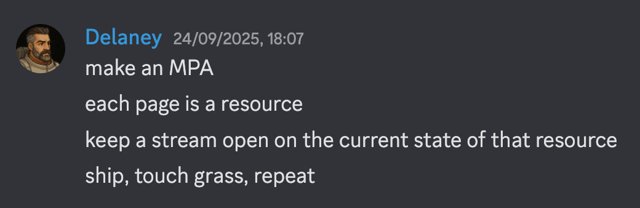
This is a critique of control as much as a technical recommendation. Many single-page applications reimplement browser history because they first move routing into JavaScript, then need to rebuild what the browser had already provided. Datastar’s position is that each page is a resource, and treating it that way reduces the need for artificial state management. The browser becomes a collaborator again.
The guide’s CQRS recommendation, command query responsibility segregation, gives the architecture a pattern for real-time applications. In Datastar’s framing, reads and writes can be separated so that a long-lived request receives updates from the backend while short-lived requests send commands. A user clicks a button, submits a form, or performs an action through a short request. Meanwhile, an SSE stream can carry the resulting read-side updates back to the UI. This pattern is especially compelling for collaboration, dashboards, notifications, and live operational views because it avoids forcing every interaction into a request-response page replacement while still keeping the server authoritative.
Loading indicators and optimistic updates reveal the ethical dimension of the guide. Datastar discourages optimistic UI because it can tell the user a comforting story before the system knows whether that story is true. The alternative is not a slower-feeling application by default, but a more honest one: show that work is in progress, then confirm success from the backend. This is a subtle but serious design argument. Interfaces are not only mechanisms for state display, they are systems of trust. When a UI claims an operation succeeded before validation, persistence, or coordination has happened, it may improve perceived speed while weakening the user’s confidence when failures appear later.
Accessibility completes the guide’s architecture with a reminder that Datastar does not remove the developer’s responsibility to build humane interfaces. Because Datastar works through HTML attributes and server-generated markup, it can fit naturally with semantic HTML, ARIA attributes, keyboard behavior, and screen reader support, but it does not automatically create those qualities. The guide’s example of toggling ARIA attributes through data-attr is small, yet it captures the principle: interactivity should enrich the document’s meaning rather than hide it behind inaccessible script behavior.

Implications
The practical implication of the Tao of Datastar is that a team can build highly interactive web applications without accepting the full burden of a client-first architecture. That does not mean rejecting JavaScript, live updates, or dynamic interfaces. It means narrowing the job of the frontend to the parts that are truly local to the user experience, while preserving backend authority over the durable facts of the system.
For small teams, this can reduce cognitive load. Instead of maintaining a backend API, frontend store, client cache, mutation layer, optimistic state, invalidation rules, and component tree, a team can often render HTML on the backend, patch it into place, and use signals only where immediate interaction needs them. The architecture becomes easier to reason about because there are fewer places where truth can hide.
For larger systems, the benefit may be less about simplicity in the small and more about consistency in the large. State duplication is expensive because every duplicated model eventually needs reconciliation. A permissions change, inventory update, moderation action, or workflow transition can become difficult when multiple clients hold their own assumptions. Server-led updates allow the system of record to speak directly into the interface, which can make complex multi-user workflows more coherent.
Datastar also reframes performance. In many frontend-heavy systems, performance is pursued through bundle reduction, hydration strategy, client cache tuning, and increasingly elaborate build pipelines. Datastar does not make those concerns vanish, but it changes their relative importance. If much of the UI is generated on the backend and streamed or patched as HTML, then server rendering speed, template structure, morphing behavior, network compression, and HTTP streaming become first-class performance tools.
There is also a maintenance implication. HTML produced by backend templates can often be read by developers across experience levels. A server endpoint that returns interface updates may be easier to trace than a chain of client-side effects and cache subscriptions. The Datastar approach asks teams to invest in the boring intelligibility of documents, resources, and requests. That sounds modest, but modest systems often survive longer because their operational shape remains visible.
The broader pattern is a rebalancing of web architecture after a decade of client-heavy defaults. Datastar belongs to the same family of ideas as HTML-over-the-wire, server-driven UI, and hypermedia-oriented application design, but its specific contribution is the combination of fine-grained reactivity, SSE streams, DOM morphing, and an explicit preference for backend truth. It does not merely say, render on the server. It says, let the backend govern the application’s meaning, then use the browser’s native strengths to express that meaning well.
Counter-Perspectives
The Datastar philosophy is not universally optimal. Applications with extensive offline requirements, such as local-first editors, field tools in unreliable network environments, or complex creative software, may need richer client-side state because the user’s work must continue when the backend is unreachable. In those cases, the frontend is not merely a display surface. It becomes a temporary authority that must later synchronize with the server.
Highly interactive graphical tools can also push against the model. A vector editor, audio workstation, 3D modeling interface, or spreadsheet-like environment may require dense local interaction loops where every pointer movement or keystroke cannot reasonably wait for server confirmation. Datastar can still participate in such applications, but the center of gravity may move toward client-side engines for parts of the experience.
There is also a scaling question around backend rendering. Server-led UI simplifies client complexity, but it may increase responsibility on backend services, especially when many users maintain long-lived SSE connections or when templates are expensive to render. Compression helps, morphing helps, and CQRS can create clean data flows, but engineering discipline is still required. A poorly structured backend can become just as tangled as a poorly structured frontend.
Another counterpoint is team familiarity. Many organizations have invested heavily in client frameworks, component libraries, and frontend state tools. Datastar’s way may feel conceptually simple, but adopting it can require a cultural shift. Developers must become comfortable treating HTML as the primary UI artifact again and viewing the browser as a capable runtime rather than a blank canvas for a JavaScript application.
The strongest reading of the Tao of Datastar, then, is not that every web app should be built the same way. It is that developers should be more skeptical of accidental complexity, especially complexity created by moving truth away from the systems that already own it. Datastar’s guide offers a disciplined alternative: keep state where it belongs, stream changes over ordinary web mechanisms, patch the document intelligently, preserve accessibility, and let the browser do the work it has spent decades learning how to do.
Comments
Please log in or register to join the discussion