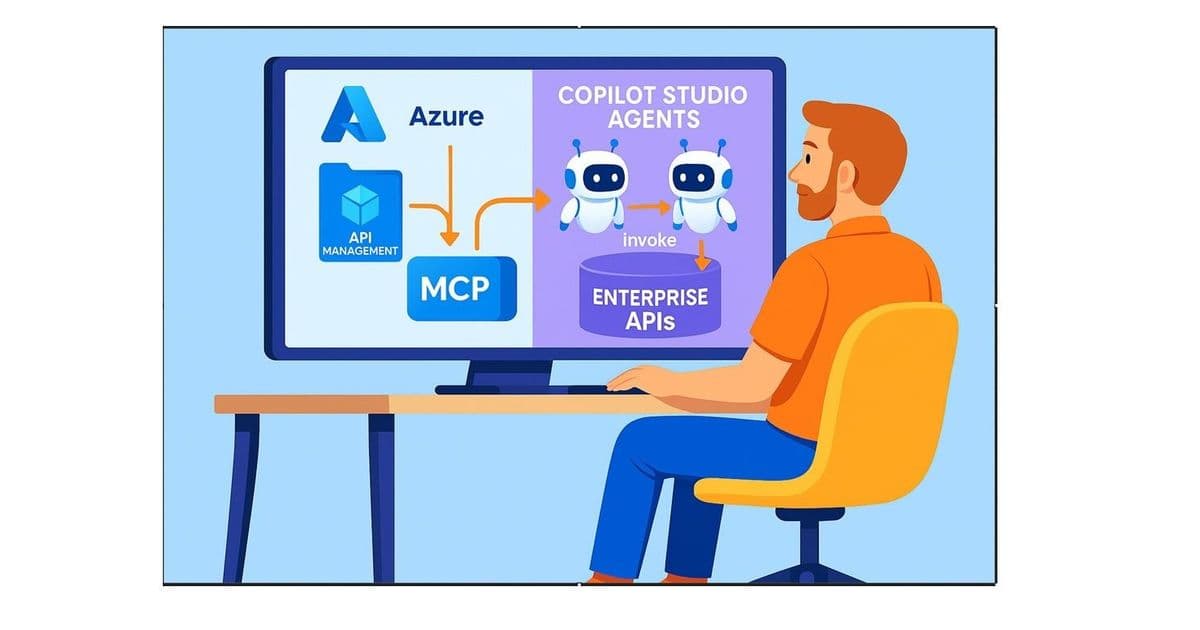
Microsoft's new approach addresses the complexity of AI agents consuming enterprise APIs directly by centralizing access through Azure API Management, shaping context via MCP servers, and integrating with Copilot Studio for secure, scalable agent architectures.
The Challenge of Direct API Consumption in Agent Architectures
When organizations implement AI agents or automation solutions, a common approach is configuring individual HTTP actions within each agent for every API endpoint. While functional for simple scenarios, this approach quickly becomes problematic as complexity grows. The challenges multiply when dealing with multiple APIs per business domain or when the same APIs are consumed by multiple agents.
This direct connection pattern leads to several enterprise concerns:
- Configuration duplication: Each agent requires identical API configuration
- Maintenance overhead: Changes must be propagated across all consuming agents
- Inconsistent behavior: Different agents may interpret API responses differently
- Governance risks: Difficult to enforce security policies and access controls uniformly
- Scalability limitations: Adding new agents requires repetitive integration work
The solution lies in centralizing and standardizing API access through a well-architected approach that groups APIs by business domain, shapes them for intelligent consumption, and exposes them through a standardized interface.
Azure API Management as the Enterprise API Control Plane
Azure API Management (APIM) serves as the critical control plane between enterprise systems and AI agents. A well-structured APIM implementation provides essential enterprise capabilities:
- API Organization: Group APIs by business capability (Customer, Orders, Billing) rather than technical layers
- Security Controls: Authentication, authorization, and threat protection
- Access Management: Products, subscriptions, and throttling policies
- Observability: Request logging, analytics, and monitoring
- Lifecycle Management: Versioning, deprecation, and staged deployments
- Developer Experience: Documentation, testing, and onboarding tools
For agent consumption specifically, APIM enables:
- Dedicated agent-facing API products with controlled access
- Independent lifecycle management for agent-specific APIs
- Rate limiting and throttling to prevent API abuse
- Centralized security policies applied consistently
- Analytics to monitor agent API usage patterns
The key design principle is organizing APIs by business capability rather than technical implementation details. This abstraction allows agents to consume business capabilities without being exposed to underlying system complexity.
The MCP Server: Bridging Enterprise APIs and AI Agents
While APIM provides governance and security, AI agents require an intent-level interface and model-friendly responses. This is where the Model Context Protocol (MCP) server serves as a critical mediator between Copilot Studio and APIM-exposed APIs.
What MCP Servers Do Well
MCP servers excel at adapting enterprise data for intelligent consumption:
- Orchestrate multiple API calls: Combine data from multiple sources to satisfy a single intent
- Filter irrelevant fields: Minimize payload size to only what's needed for the specific intent
- Enforce business rules: Apply consistent validation and transformation logic
- Enrich results: Add contextual information that helps the agent make better decisions
- Normalize responses: Convert varied API formats into stable, predictable JSON schemas
- Handle errors gracefully: Provide safe, descriptive error messages when issues occur
What MCP Servers Should Avoid
To maintain lightweight, scalable architecture:
- Complex transactional workflows: These belong in backend services
- Long-running processes: Keep MCP operations focused and fast
- UI-specific formatting: MCP should provide data, not presentation logic
- Business logic orchestration: Intent resolution should be handled by the agent runtime
By keeping MCP servers focused on context shaping rather than business logic, organizations maintain clear separation of concerns and ensure the solution remains scalable and maintainable.
Architectural Pattern: End-to-End Flow
The complete architectural pattern follows this flow:
- Backend services expose domain APIs through standardized interfaces
- Azure API Management groups and governs those APIs with products, policies, authentication, and throttling
- MCP server calls APIM, orchestrates multiple API calls when needed, filters responses, and returns concise, model-friendly outputs
- Copilot Studio connects to the MCP server and invokes a small set of predictable operations to satisfy user intents
This pattern creates several key advantages:
- Reduced complexity: Agents interact with a small number of well-defined operations rather than dozens of backend endpoints
- Consistent behavior: All agents consume the same API interface with consistent formatting
- Enhanced security: APIM provides centralized security controls without exposing backend systems directly
- Improved observability: Centralized logging and monitoring of all agent API interactions
- Easier maintenance: Changes to API interfaces are made in one place rather than across all agents
Implementation Steps
Step 1: Create an MCP Server in Azure API Management
- Navigate to your API Management instance in the Azure portal
- Create or select an API group for the business domain you want to expose (e.g., Orders, Customers)
- Add relevant APIs/operations to that API group
- Create an APIM product dedicated for agent usage with subscription requirements
- Create an MCP server in APIM and map it to the relevant API group
- Enable subscription key authentication (though for production, consider managed identities)
- Generate and store the subscription key for use in Copilot Studio
For production environments, Microsoft recommends using managed identities instead of subscription keys for better security and reduced operational overhead.
Step 2: Connect Copilot Studio to the MCP Server
- Sign in to Copilot Studio and create a new agent
- Add clear instructions describing when to use the MCP tool and how to present results
- Navigate to Tools > Add tool > Model Context Protocol > Create
- Enter the MCP server endpoint URL from your APIM configuration
- Configure authentication using the subscription key (or managed identity for production)
- Test the connection with domain-specific prompts to validate responses
Operational Best Practices
Security and Access Control
- Least privilege by default: Create separate APIM products and identities for each agent scenario
- Protect write operations: Require explicit parameters, validation, and approval flows
- Separate read and write tools: Keep potentially dangerous operations isolated
- Use managed identities: Eliminate secrets where possible and integrate with Microsoft Entra ID
- Regular key rotation: If using subscription keys, implement regular rotation policies
API Design for Agents
- Intent-level operations: Expose fewer, higher-level operations instead of many low-level endpoints
- Stable schemas: Return predictable JSON shapes and limit optional fields
- Minimal payloads: Return only the fields needed for the specific intent
- Error handling: Provide safe, descriptive error messages without exposing sensitive information
Governance and Maintenance
- Versioning: Implement proper versioning for both MCP operations and APIM APIs
- Deprecation: Establish clear processes for deprecating outdated operations
- Observability: Log requests/responses (with sensitive fields redacted) and monitor APIM analytics
- Alerting: Set up alerts for failures, throttling, and unusual usage patterns
Business Impact and Benefits
This centralized approach delivers significant business value:
- Reduced development time: New agents can be developed faster with pre-built, standardized API interfaces
- Lower maintenance costs: Changes to API interfaces require updates in one location rather than multiple agents
- Improved security posture: Centralized security controls reduce the attack surface and simplify compliance
- Better scalability: The architecture supports adding new agents without proportional increases in integration work
- Enhanced governance: Consistent API consumption patterns make it easier to enforce policies and standards
- Future-proof design: The abstraction layer allows backend systems to evolve without impacting agent implementations
Conclusion
As organizations scale agent-based and Copilot-driven solutions, directly exposing enterprise APIs to AI agents becomes increasingly complex and risky. The pattern of centralizing API access through Azure API Management, shaping agent-ready context via MCP servers, and consuming those capabilities through Copilot Studio establishes a clean, governable architecture.
This approach reduces duplication, enforces consistent security controls, and enables intent-driven API consumption without exposing unnecessary backend complexity. By combining domain-aligned API products, lightweight MCP operations, and proper identity-based access, enterprises can confidently scale AI agents while maintaining strong governance, observability, and operational control.
The result is a more sustainable architecture that supports both current AI implementations and future advancements in agent-based systems.
For more information on implementing this architecture, refer to the following resources:
Comments
Please log in or register to join the discussion