India's exports to China surged 20% in the last quarter, driven by electronics and marine products, as New Delhi pivots to offset the impact of Trump's 50% tariffs on key sectors. The shift marks a strategic recalibration in Asia's largest trade relationship.
India's exports to China jumped 20% year-on-year in the final quarter of 2025, reaching $12.7 billion, according to preliminary customs data. The surge, led by electronics components and frozen marine products, represents a significant shift in bilateral trade patterns as India seeks to diversify away from U.S. markets facing steep tariffs.
The timing is critical. Four months into President Trump's 50% tariff regime on Indian goods, shipments to the United States have declined only 1%, but analysts warn the full impact is yet to materialize. "The current numbers mask underlying structural pressures," says Rajiv Kumar, senior trade economist at the Indian Council for Research on International Economic Relations. "Electronics exports to China are largely re-exports of components assembled in India for Chinese final products. This is a narrow, volatile channel dependent on Chinese manufacturing cycles."
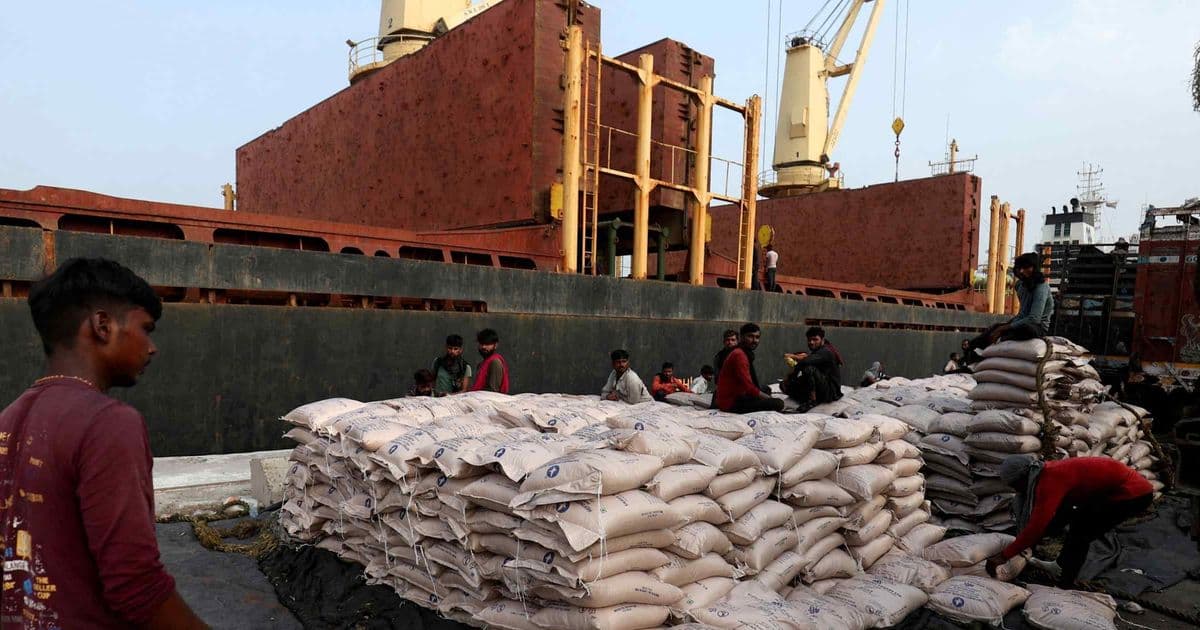
Marine products tell a different story. India's frozen shrimp and fish exports to China grew 45% in 2025, reaching $2.1 billion. This reflects China's domestic supply constraints and India's improved aquaculture productivity. The Deendayal Port in Kandla, Gujarat, now handles 30% more seafood containers bound for Chinese ports compared to 2024.
The electronics surge is more complex. India's electronics exports to China hit $3.8 billion in Q4 2025, up from $2.1 billion a year earlier. This includes smartphone components, display panels, and semiconductors assembled in Indian special economic zones. The growth aligns with China's "dual circulation" policy, which emphasizes domestic production but still requires certain imported components. India's PLI (Production Linked Incentive) scheme for electronics manufacturing has created capacity that Chinese firms are now utilizing.
However, trade experts caution against reading too much into the numbers. "This is a tactical adjustment, not a strategic realignment," notes Priya Singh, director of trade policy at the Federation of Indian Export Organizations. "China remains a difficult market for Indian manufacturers due to non-tariff barriers, complex certification requirements, and geopolitical tensions. The current gains are concentrated in a few sectors."
The broader context is India's aggressive trade diversification. Beyond China, India has recently signed trade agreements with the UAE, Australia, and is negotiating with the UK and EU. The goal is to reduce exposure to any single market. U.S. tariffs have accelerated this process. In 2025, India's total exports grew 4.2%, but exports to the U.S. declined 1.2% to $78 billion, while exports to China grew 15% to $28 billion.
The electronics sector reveals the limits of this strategy. While India exports components to China, it still imports finished electronics worth $62 billion annually, mostly from China. This creates a trade deficit that has widened to $101 billion with China in 2025, up from $92 billion in 2024. "We are essentially feeding Chinese manufacturing while our own consumer electronics industry struggles to compete," says Kumar.
Marine products offer a cleaner success story. India's aquaculture sector has invested $1.2 billion in modernization since 2022, improving yield and quality control. Chinese importers have responded by increasing orders, particularly for value-added products like ready-to-cook shrimp. The Indian government has facilitated this by negotiating sanitary and phytosanitary agreements with Chinese authorities.
The strategic implications are mixed. On one hand, the trade diversification is working as intended—India's export basket is becoming less dependent on the U.S. market. On the other hand, the new dependence on China carries its own risks. "China's economy is slowing, and its import demand is cyclical," warns Singh. "If Chinese domestic consumption weakens, Indian exports could collapse quickly."
The data suggests this is already happening. Electronics exports to China peaked in October 2025 at $1.4 billion but fell to $900 million in December. Marine products showed more stability, but analysts note that Chinese New Year demand creates seasonal spikes that may not be sustainable.
For Indian policymakers, the challenge is to convert temporary gains into lasting capacity. The government is considering expanding the PLI scheme to cover more electronics sub-sectors and has allocated $500 million for seafood processing infrastructure. The goal is to move up the value chain—exporting finished electronics rather than components, and processed seafood rather than raw materials.
The U.S. tariff situation remains fluid. Trump's administration has signaled that tariffs could be adjusted based on bilateral negotiations. Indian officials are pushing for a trade deal that would lower tariffs in exchange for market access concessions. Until then, the China channel provides crucial breathing room.
The numbers tell a story of adaptation. India's export engine is finding new routes, but the terrain remains challenging. Electronics exports to China are growing from a small base and remain vulnerable to Chinese economic cycles. Marine products show more promise but require sustained investment in quality and infrastructure. The diversification strategy is working, but its success depends on execution and the unpredictable nature of global trade politics.
What happens next will determine whether this is a temporary shift or the beginning of a new trade pattern. The next quarter's data will show if the gains hold or fade. For now, Indian exporters have found a helping hand in China, but they must walk carefully to avoid stumbling into new dependencies.
Comments
Please log in or register to join the discussion