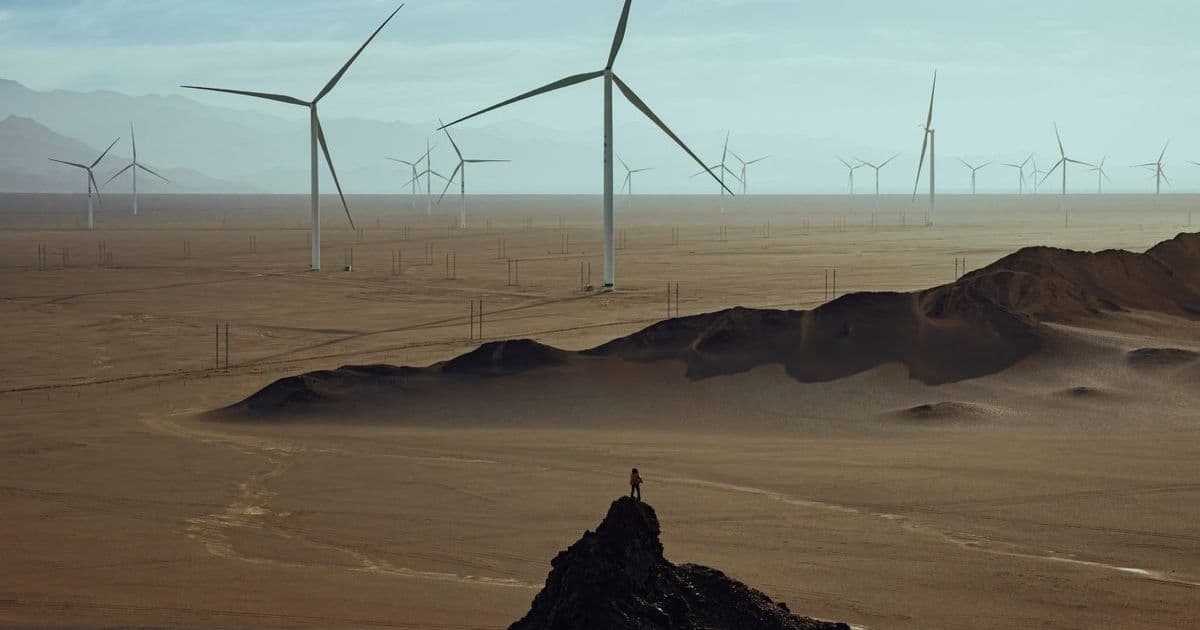
A three-year photographic project by Weimin Chu documents the staggering scale of China's wind and solar expansion, revealing how these installations are reshaping landscapes from urban rooftops to remote deserts. The work raises questions about the visual and environmental integration of massive renewable infrastructure.
China's renewable energy expansion has reached a scale that defies conventional photography. Last year, the country installed more than half of all new wind and solar capacity globally. In May 2024 alone, it added enough renewable energy to power Poland entirely, installing solar panels at a rate of roughly 100 every second. This isn't happening in isolated test sites but across the entire nation—from eastern cities where rooftop solar arrays now dominate skylines to western deserts where wind farms sprawl across the horizon.
Chinese photographer Weimin Chu has spent three years documenting this transformation using drones to capture the installations from overhead. "From the ground, it's hard to grasp the scale of these power plants," Chu told Yale E360. "But when you rise into the air, you can see the geometry, the rhythm—and their relationship with the mountains, the desert, the sea." His work, which draws visual inspiration from traditional Chinese ink paintings, was featured in an award-winning exhibition presented by Greenpeace last year.
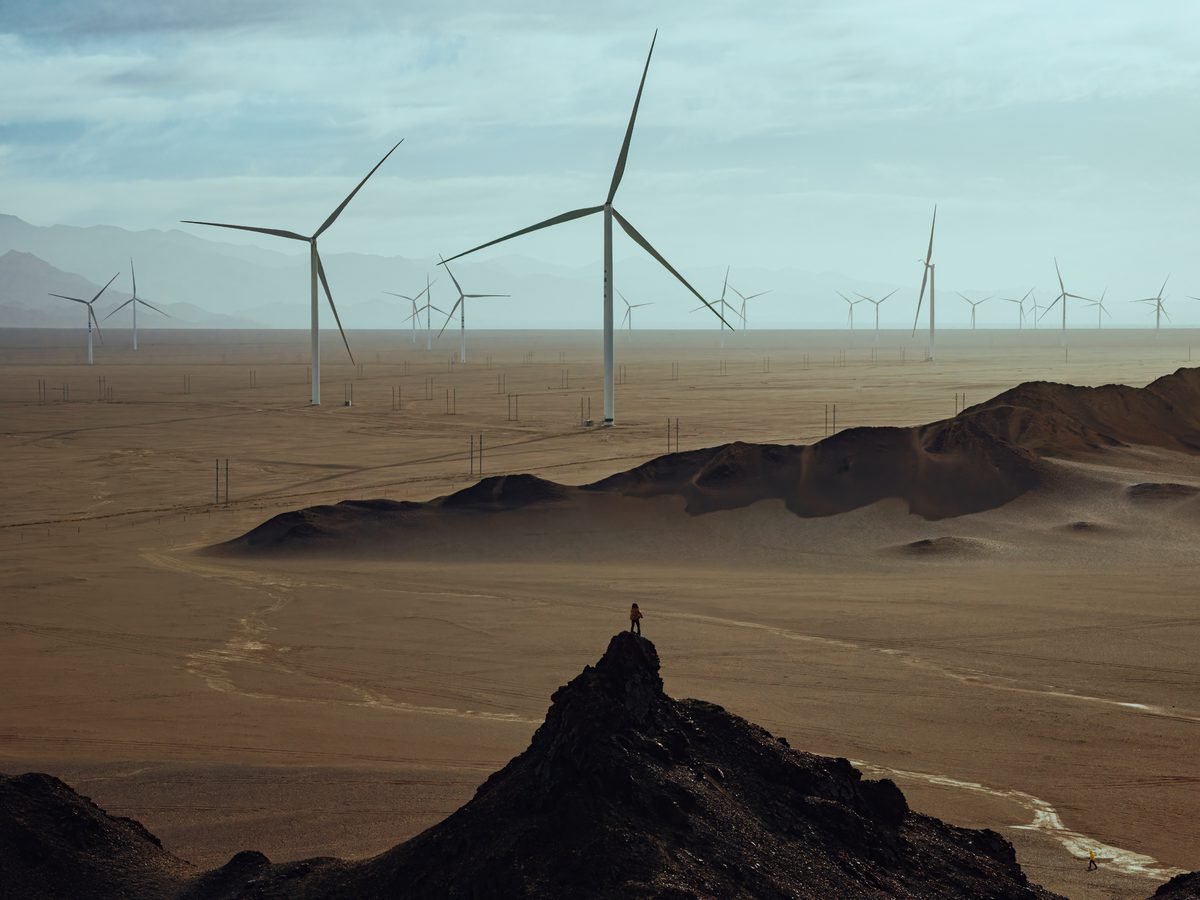
Chu's project began as landscape photography but evolved as he traveled through provinces like Guizhou, Yunnan, and Qinghai in 2022. "I kept seeing wind farms and solar power plants appear in my camera frame," he explained. "I realized this is the story of our time—and almost no one is documenting it in a systematic way." The resulting collection reveals patterns that are invisible from the ground: the precise geometric layouts of solar farms, the rhythmic spacing of wind turbines, and the unexpected ways these installations intersect with existing geography and human structures.
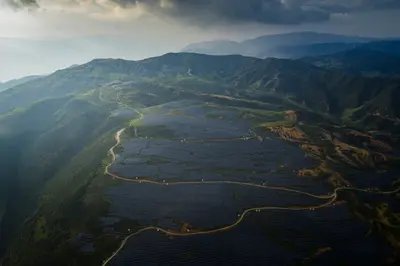
The photographs reveal several distinct integration patterns. In the Daliang Mountains of Sichuan Province, solar farms follow the contours of the terrain, creating a layered effect that echoes the region's terraced agriculture. Near the Gahai Wetland Reserve in Qinghai Province, wind turbines stand in careful relation to the protected ecosystem, their placement suggesting a negotiation between energy needs and environmental preservation. In Xiangshan County, Zhejiang Province, solar panels have been built directly onto tidal flats, creating a hybrid landscape where energy generation and coastal geography merge.
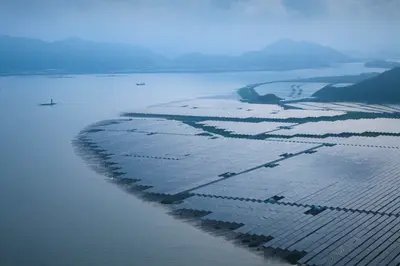
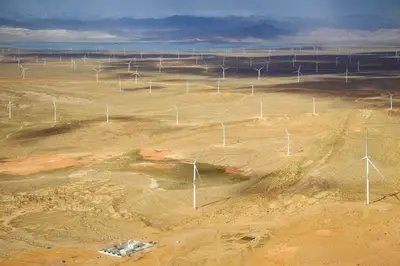
The visual language of these photographs raises questions about how we conceptualize renewable infrastructure. Traditional energy installations—coal plants, nuclear facilities, hydroelectric dams—have historically been treated as industrial sites, often hidden from view or separated from natural landscapes. China's renewable buildout presents a different model: infrastructure that is simultaneously industrial and environmental, visible and integrated.
This integration isn't always seamless. In the Tala Desert of Qinghai Province, sheep graze among solar panels in what appears to be a pragmatic coexistence. The arrangement suggests economic efficiency—land used for both agriculture and energy—but also raises questions about the long-term ecological impact of such dual-use systems. Similarly, in the karst mountains of Xingyi, Guizhou Province, a wind turbine stands against a dramatic geological backdrop, its industrial form contrasting with the ancient limestone formations.
The scale of China's renewable expansion creates visual patterns that are both impressive and unsettling. The geometric precision of solar farm layouts—rows of panels stretching to the horizon—evokes a sense of human control over vast landscapes. Yet these same installations are often placed in regions with limited water resources, raising questions about the environmental trade-offs of solar panel cleaning and maintenance in arid environments.
Wind farms present different visual and environmental challenges. The turbines near the Ming Dynasty Huguo Temple in Guizhou Province create a juxtaposition of ancient cultural heritage and modern technology. While this pairing suggests a harmonious integration of past and present, it also highlights how renewable infrastructure inevitably alters historical landscapes.
Urban integration follows different patterns. Rooftop solar arrays in Binzhou, Shandong Province, demonstrate how renewable energy can be woven into existing urban fabric without requiring new land. This approach addresses one of the most significant challenges of renewable expansion: land use competition. However, the visual uniformity of these rooftop installations raises questions about architectural diversity and the aesthetic integration of renewable technology into cityscapes.
The photographs also reveal what remains unchanged. A thermal power station in Dunhuang, Gansu Province, appears in Chu's collection, reminding viewers that China's energy transition is additive rather than replacement-based. The country continues to build new coal plants even as it leads the world in renewable installation—a pattern that complicates narratives of pure transition.
Chu's work suggests that renewable infrastructure is creating a new visual language for energy. The rhythmic patterns of wind turbines, the geometric precision of solar arrays, and the unexpected juxtapositions with natural and cultural landmarks form a distinct aesthetic. This visual transformation extends beyond China, offering a preview of how renewable energy might reshape landscapes globally as other countries accelerate their own transitions.
The project raises fundamental questions about the relationship between technology and landscape. Are these installations environmental restoration or industrial intrusion? Do they represent human mastery over nature or adaptation to its constraints? The photographs offer no definitive answers, instead presenting the complex reality of energy transition as it unfolds across one of the world's most rapidly changing landscapes.
As China continues to install renewable capacity at unprecedented rates, Chu's documentation provides a crucial visual record of this transformation. The images reveal both the breathtaking scale of the buildout and the subtle ways it is reshaping the relationship between human technology and the natural world. For observers outside China, these photographs offer a glimpse of what large-scale renewable transition actually looks like—not as abstract statistics or policy documents, but as a visible transformation of the landscape itself.
The project also highlights a gap in environmental documentation. While climate change and renewable energy are frequently discussed in terms of data and policy, the physical reality of these transformations often remains invisible. Chu's work suggests that understanding the full impact of energy transition requires looking at how installations interact with geography, ecology, and human settlement—not just at capacity numbers or carbon metrics.
Looking forward, the patterns visible in these photographs may become increasingly common worldwide. As other countries accelerate their renewable transitions, the visual language of wind farms, solar arrays, and hybrid installations will likely reshape landscapes across continents. Chu's project offers a framework for thinking about how to document and evaluate these changes—not just in terms of energy output, but in terms of how they alter our relationship with the places we inhabit.
The work ultimately presents renewable energy not as a simple solution to climate change, but as a complex transformation of landscape that requires careful consideration of visual, ecological, and cultural impacts. The photographs capture both the promise and the complexity of this transition, offering a visual vocabulary for discussing energy infrastructure that moves beyond simple metrics of capacity and cost.
Comments
Please log in or register to join the discussion