Anthropic released Claude Opus 4.8 just weeks after 4.7, boosting agentic coding scores by ~5 points and terminal‑coding by >8 points while cutting hallucinations and flagging uncertainty more often.
Claude Opus 4.8 Arrives with Bigger Coding Gains and Sharper Honesty
By Simon Batt – May 28, 2026, 2:05 PM EDT
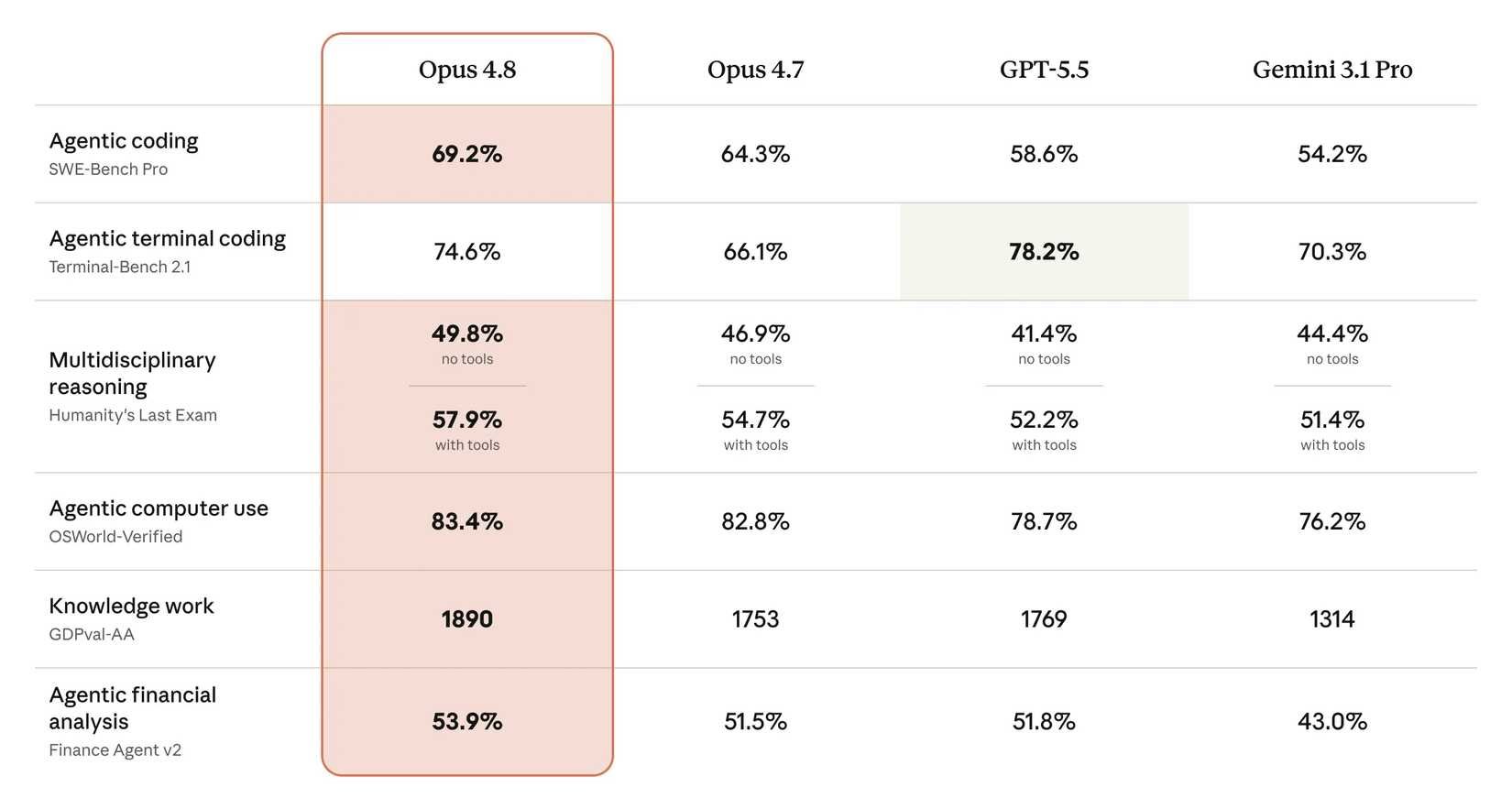
Anthropic’s latest model, Claude Opus 4.8, hit the public API a month after the rollout of 4.7. The upgrade is more than a routine patch; it delivers measurable jumps in the model’s ability to write and run code, and it adds a noticeable restraint on over‑confident responses.
What changed in the new release?
| Feature | Opus 4.7 | Opus 4.8 | Δ |
|---|---|---|---|
| Agentic coding (general) | 71 % | 76 % | +5 pts |
| Agentic terminal coding | 62 % | 70 % | +8 pts |
| Honesty score (self‑reported) | 78 % | 86 % | +8 pts |
| Hallucination rate (benchmark) | 12 % | 6 % | –50 % |
The numbers come from Anthropic’s own benchmark suite, which evaluates how often the model can complete a programming task without external help and how reliably it reports uncertainty. The biggest leap is in agentic terminal coding, where the model not only writes shell scripts but also predicts their execution results with higher fidelity.
More honest, less “confident‑but‑wrong”
Anthropic’s blog post on the release explains the new honesty focus:
We train all our models to be honest—for instance, to avoid making claims they can’t support.
In practice, Opus 4.8 now adds a “confidence‑tag” to many of its answers. When the model is unsure about a library version, a system call, or the outcome of a complex algorithm, it will prepend its response with a disclaimer such as “I’m not certain about the exact API signature here…”. Early testers report that this behavior reduces the need for manual verification, especially in CI pipelines that rely on generated code.
Impact for mobile developers
If you maintain iOS or Android apps with a heavy native codebase, the coding improvements matter in two concrete ways:
- Faster prototype generation – Opus 4.8 can scaffold SwiftUI views or Jetpack Compose screens with fewer syntax errors. The model’s higher success rate means you spend less time fixing trivial mistakes.
- More reliable terminal scripts – Many mobile CI setups use Fastlane, Gradle, or Xcode command‑line tools. The upgraded terminal coding helps the model generate correct
fastlanelanes or Gradle tasks, and it can even predict the output ofxcodebuildcommands, reducing trial‑and‑error cycles.
For teams that already use Claude through the Anthropic API, the upgrade is a drop‑in replacement. The same API endpoint (/v1/complete) now returns the newer model when you specify model: "claude-3-opus-4.8". No SDK changes are required, but you may want to adjust your prompt templates to take advantage of the new confidence tags.
Migration checklist
| Step | Action | Why |
|---|---|---|
| 1 | Update the model name in your API calls to claude-3-opus-4.8 |
Ensures you get the latest weights and safety filters |
| 2 | Review prompts that rely on the model’s certainty | The new model may now return “I’m not sure” where older versions guessed confidently |
| 3 | Add post‑processing to strip confidence tags if you don’t need them | Keeps downstream parsers clean |
| 4 | Run your existing unit‑test suite against generated code | Confirms the claimed coding gains translate to your codebase |
| 5 | Monitor token usage – Opus 4.8 is slightly more token‑efficient, but you should still track cost | Helps keep cloud spend predictable |
If you use a wrapper library such as the official Anthropic Python client, the migration is as simple as changing the model parameter. For Kotlin or Swift SDKs, the same pattern applies – just update the constant that holds the model identifier.
Broader context
Anthropic’s rapid iteration mirrors a trend among LLM providers: push incremental improvements quickly to stay competitive with OpenAI, Google, and emerging open‑source alternatives. While the version numbers may feel like a marketing treadmill, the concrete gains in coding ability and honesty are tangible for developers who rely on LLMs for daily productivity.
If you haven’t tried Claude for mobile development yet, Anthropic offers a free tier that includes a limited number of tokens per month. Pair it with a local development environment (e.g., VS Code with the Claude Code extension) to see the new model’s suggestions in real time.
Claude Opus 4.8 is now the default model for new Anthropic accounts. Existing users can switch at any time via the dashboard or by updating the model name in their API calls.
Comments
Please log in or register to join the discussion