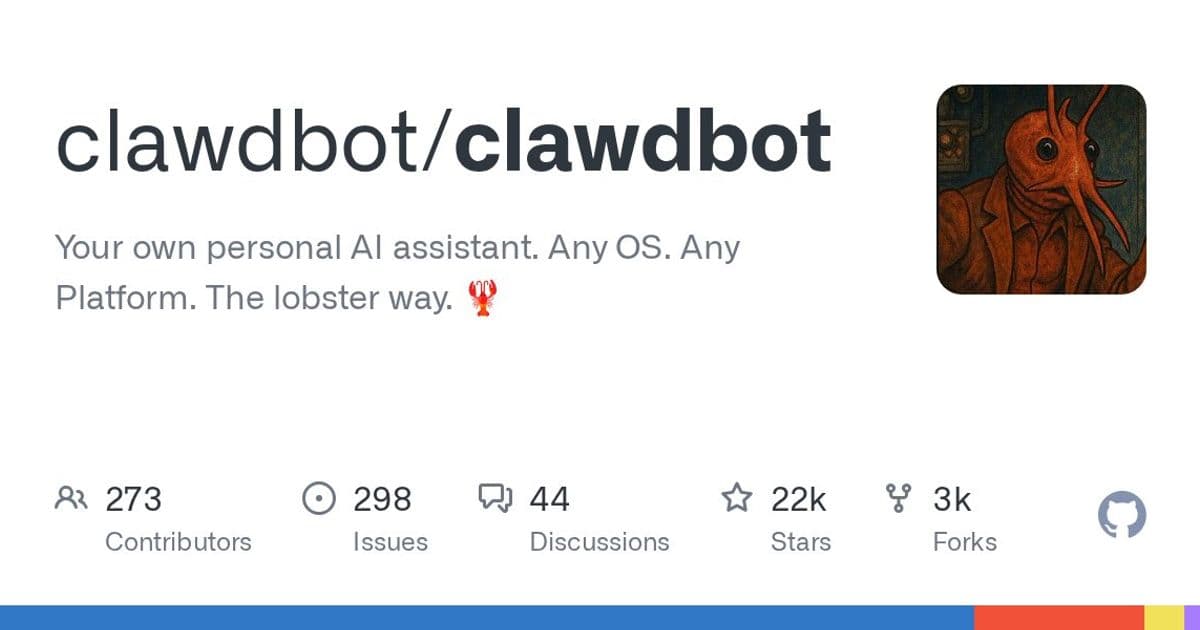
A new open-source project called Clawdbot positions itself as a personal AI assistant you run entirely on your own devices, connecting to nearly every major messaging platform while keeping the core logic local. It's a notable experiment in the tension between cloud convenience and personal data control.
The latest trend in personal AI isn't about bigger models or more features—it's about where the software runs. Clawdbot, a new open-source project, embodies this shift by offering a personal AI assistant that runs entirely on your own hardware, yet connects to the cloud-based messaging platforms you already use daily. It's a deliberate rejection of the fully cloud-hosted assistant model, proposing instead a local control plane that orchestrates interactions across WhatsApp, Telegram, Slack, Discord, Signal, iMessage, and a dozen other channels.
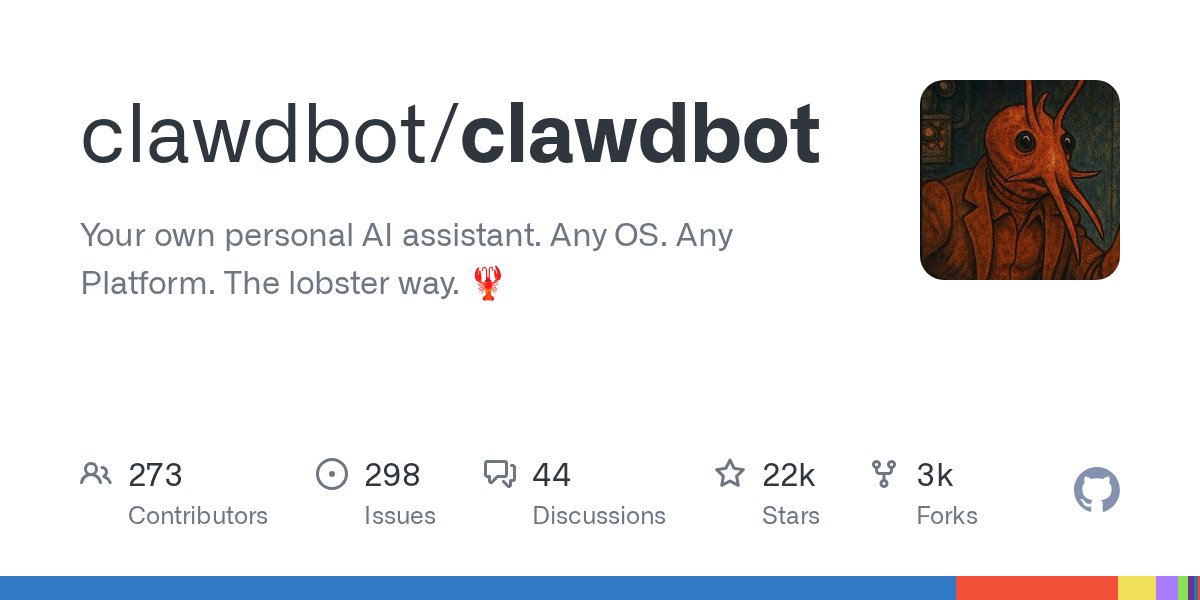
At its core, Clawdbot is a Node.js application with a WebSocket-based Gateway that acts as the central nervous system. You install it on a machine you control—your laptop, a home server, or even a small cloud instance—and it connects to your messaging accounts. The assistant's responses are generated by cloud AI models (primarily Anthropic's Claude or OpenAI's models), but the session state, channel connections, and tool execution all live locally. This architecture is designed to give users a sense of ownership and speed, with the assistant feeling "local, fast, and always-on."
The Architecture: A Control Plane and Many Channels
The project's design is notably modular. The Gateway is the single control plane for sessions, channels, tools, and events. It manages connections to messaging platforms using various libraries: WhatsApp via Baileys, Telegram via grammY, Slack via Bolt, Discord via discord.js, and so on. This multi-channel approach means you can have a single assistant that answers you on WhatsApp, then continues the conversation on Slack, without losing context.
The assistant itself runs as a separate process (the "Pi agent") that communicates with the Gateway via RPC. This separation allows for features like tool streaming and block streaming, where the agent can process and return information incrementally. The system also supports multi-agent routing, allowing you to segment conversations by channel, account, or peer into isolated "workspaces" with their own sessions and rules.
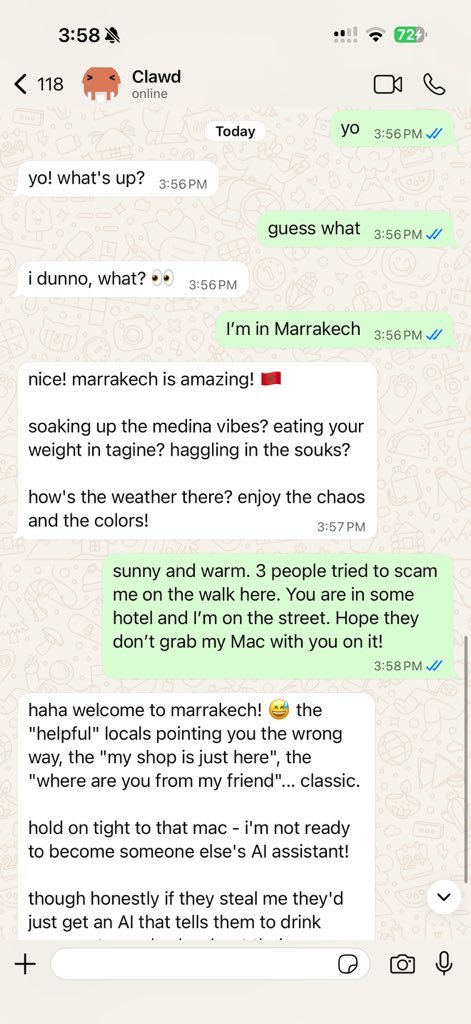
One of the more intriguing technical aspects is its approach to device integration. While the Gateway handles the core logic and channel connections, Clawdbot can pair with companion apps on macOS, iOS, and Android. These apps act as "nodes" that expose device-specific capabilities—like camera access, screen recording, or system notifications—via the Gateway protocol. This allows the assistant to perform actions on your actual devices, not just in a sandboxed environment. For example, you could ask the assistant to take a screenshot and post it to a Slack channel, and the command would be routed through the macOS node to execute locally.
Security and the DM Problem
Any system that connects to real-time messaging surfaces faces significant security challenges, particularly with direct messages (DMs). Clawdbot's default behavior is cautious: unknown senders in DMs receive a pairing code and the bot does not process their message until explicitly approved. This "pairing" policy is designed to prevent spam and unauthorized access. The project's documentation explicitly warns users to treat inbound DMs as untrusted input.
For public or group interactions, the system requires explicit opt-in. You must configure the channel's DM policy to "open" and include a wildcard ("*") in the allowlist. The project includes a clawdbot doctor command to surface risky or misconfigured DM policies, acknowledging that this is a common point of failure for users. This security model reflects a broader pattern in local-first software: the user is responsible for configuring access, and the tool provides guardrails rather than making assumptions.

Trade-offs: Convenience vs. Control
The local-first approach comes with clear trade-offs. Setting up Clawdbot is more involved than signing up for a cloud service. The recommended path is an onboarding wizard (clawdbot onboard) that walks through gateway setup, workspace configuration, channel connections, and skill installation. It requires Node.js 22+ and works on macOS, Linux, and Windows (via WSL2). While the wizard simplifies the process, users still need to manage OAuth tokens for services like Anthropic and OpenAI, and configure each messaging channel individually.
The project also introduces operational complexity. The Gateway daemon needs to stay running, which can be managed via launchd (macOS) or systemd (Linux). For remote access, Clawdbot integrates with Tailscale, allowing you to expose the Gateway dashboard and WebSocket interface securely over a tailnet. This is a sophisticated solution for users who want to access their assistant from multiple devices, but it adds another layer of infrastructure to manage.
The Ecosystem and Community
Clawdbot is more than a single application; it's a platform with an ecosystem of skills and extensions. The project includes a skill registry called ClawdHub, which allows the agent to search for and install new skills automatically. Skills are defined in Markdown files and can add functionality like browser control, canvas manipulation, or cron jobs. This modularity suggests a vision where the assistant's capabilities can be extended by the community, similar to how plugins extend other software.

The project is open-source and actively developed, with a clear contribution guide. It's built by Peter Steinberger and the community, with special thanks to Mario Zechner for supporting the underlying "pi-mono" runtime. The presence of a Discord server and a detailed documentation site indicates a growing community around the project.
Counter-Perspectives: Is Local-First the Right Path for Personal AI?
While Clawdbot's local-first model appeals to privacy-conscious users, it also raises questions about practicality. For many users, the convenience of a fully managed cloud service—where updates, security patches, and uptime are handled by a provider—outweighs the benefits of local control. Setting up and maintaining a local assistant requires technical skill and ongoing attention.
Furthermore, the reliance on cloud AI models for the actual intelligence means the most sensitive part of the interaction—your prompts and the model's responses—still leaves your device. The local control is primarily about session state and channel connections, not the core AI processing. For users seeking true end-to-end privacy, even this model may be insufficient.
There's also the question of sustainability. Projects like this often rely on the momentum of a small community. The feature set is ambitious, covering everything from voice wake on mobile devices to browser automation. Maintaining this breadth across multiple platforms and messaging APIs is a significant engineering challenge.
Conclusion: A Thoughtful Experiment in Personal Computing
Clawdbot represents a thoughtful experiment in the design of personal AI. It doesn't just replicate the cloud assistant model on your machine; it rethinks the architecture to prioritize user control and local execution. Its success will depend not just on its technical merits, but on its ability to cultivate a community that builds skills, contributes to the codebase, and helps new users navigate the setup process.
For developers and tinkerers, it offers a compelling playground for exploring local-first AI, multi-channel integration, and device automation. For everyday users, it presents a more complex but potentially more empowering alternative to the walled gardens of commercial AI assistants. The project's existence alone is a signal that the conversation around personal AI is maturing, moving beyond mere capability to consider questions of ownership, control, and architecture.
Relevant Links:
Comments
Please log in or register to join the discussion