ClawRun offers a simplified approach to deploying and managing AI agents by abstracting away the infrastructure complexities, allowing developers to get their AI agents running in seconds rather than days.
ClawRun has emerged as a promising new tool in the AI development space, addressing a critical pain point for developers: the complexity of deploying and maintaining AI agents. The open-source project provides a hosting and lifecycle management layer that simplifies the entire process, from initial deployment to ongoing maintenance.
The core problem ClawRun solves is the significant overhead involved in getting AI agents operational. Traditionally, developers need to configure servers, manage dependencies, handle scaling, implement monitoring, and ensure security - a process that can take days or even weeks. ClawRun abstracts away these complexities, allowing developers to focus on their AI models and user interactions rather than infrastructure concerns.
At its core, ClawRun deploys AI agents into secure sandboxes, with Vercel Sandbox being the current provider. The platform manages the full lifecycle of these agents, including startup processes, heartbeat keep-alive mechanisms, snapshot and resume functionality, and wake-on-message capabilities. This approach ensures that AI resources aren't wasted on idle instances while maintaining responsiveness when needed.

The platform's architecture is designed with flexibility in mind. Its pluggable system supports various AI agents, cloud providers, and messaging channels, making it adaptable to different use cases and technical requirements. This modularity positions ClawRun as a potential backbone for the growing ecosystem of AI applications that need reliable, scalable hosting.
Key features that set ClawRun apart include:
- Single-command deployment of supported AI agents
- Persistent sandboxes that intelligently sleep when idle and wake when messages arrive
- Integration with popular messaging platforms like Telegram, Discord, Slack, and WhatsApp
- Both web dashboard and CLI interfaces for real-time interaction and management
- Cost tracking and budget enforcement across all deployed instances
- Extensible architecture for custom integrations
The deployment process is straightforward, as demonstrated by the single command npx clawrun deploy. This initiates a wizard that guides users through selecting an LLM provider and model, configuring messaging channels, setting cost limits, and defining network policies before deploying to the chosen provider. Once deployed, interaction can happen through either the CLI with clawrun agent my-instance or the web dashboard using clawrun web my-instance.
For developers looking to implement ClawRun, the project provides comprehensive documentation covering setup guides, framework examples, and configuration references. The open-source nature of the project, licensed under Apache-2.0, encourages community contributions and transparency.
The potential market impact of ClawRun lies in its ability to democratize AI agent deployment. By removing infrastructure barriers, it enables smaller teams and individual developers to deploy sophisticated AI applications that were previously only accessible to well-resourced organizations. This could accelerate innovation in the AI space by lowering the entry barrier for new applications.
As the AI landscape continues to evolve, tools like ClawRun that abstract away operational complexities will become increasingly valuable. The project's focus on cost efficiency through intelligent resource management also addresses a significant concern in AI development: the high computational costs associated with running large language models and other AI systems.
The GitHub repository for ClawRun shows active development and community engagement, with issues and discussions open for contributions. This suggests a growing ecosystem around the project, which could lead to expanded capabilities and integrations in the future.
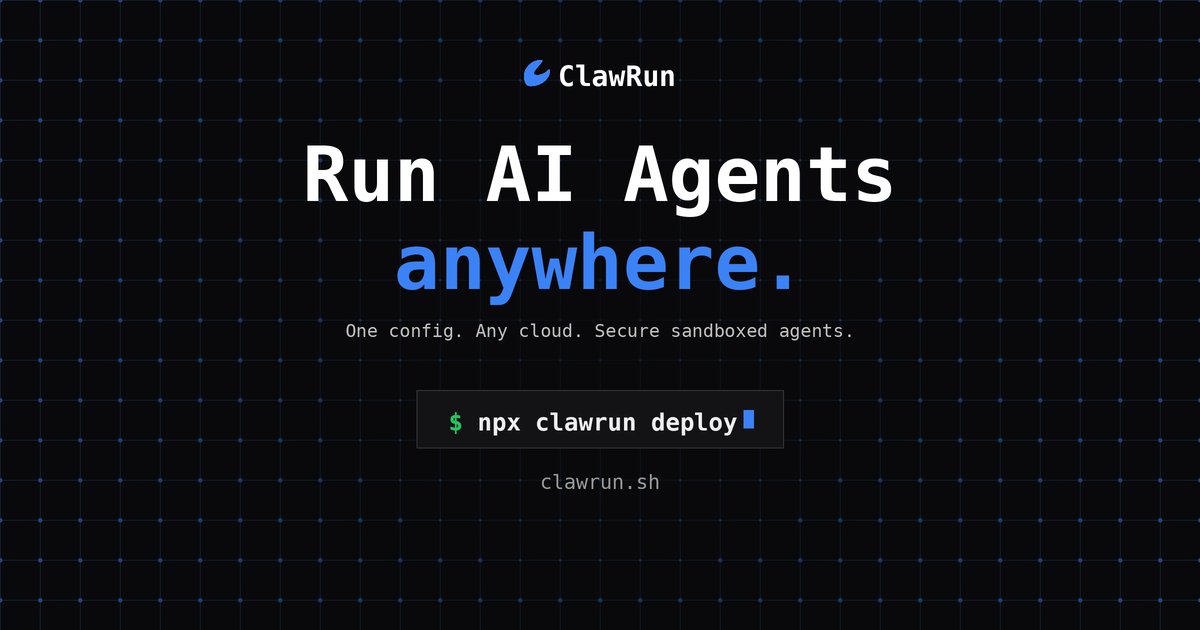
For developers interested in exploring ClawRun, the project's GitHub repository provides the source code, while the official website offers additional information and documentation. As the platform continues to evolve and add support for additional cloud providers and AI frameworks, it may become an essential tool in the AI development toolkit.
Comments
Please log in or register to join the discussion