Cloudflare now hosts Anthropic’s Claude Managed Agents, letting enterprises run the agent’s execution layer on Cloudflare’s edge while keeping orchestration on Claude. The article compares this offering with competing providers, outlines pricing and migration steps, and evaluates the business impact for regulated organizations.
Cloudflare Extends Claude Managed Agents: What It Means for Multi‑Cloud Strategies
What changed
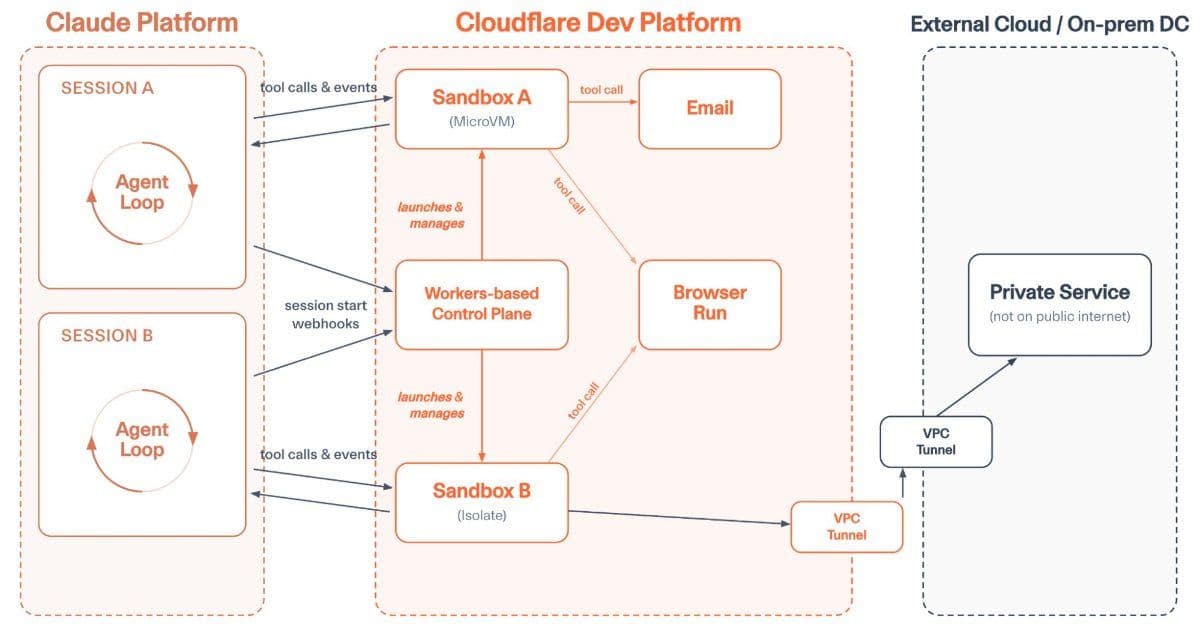
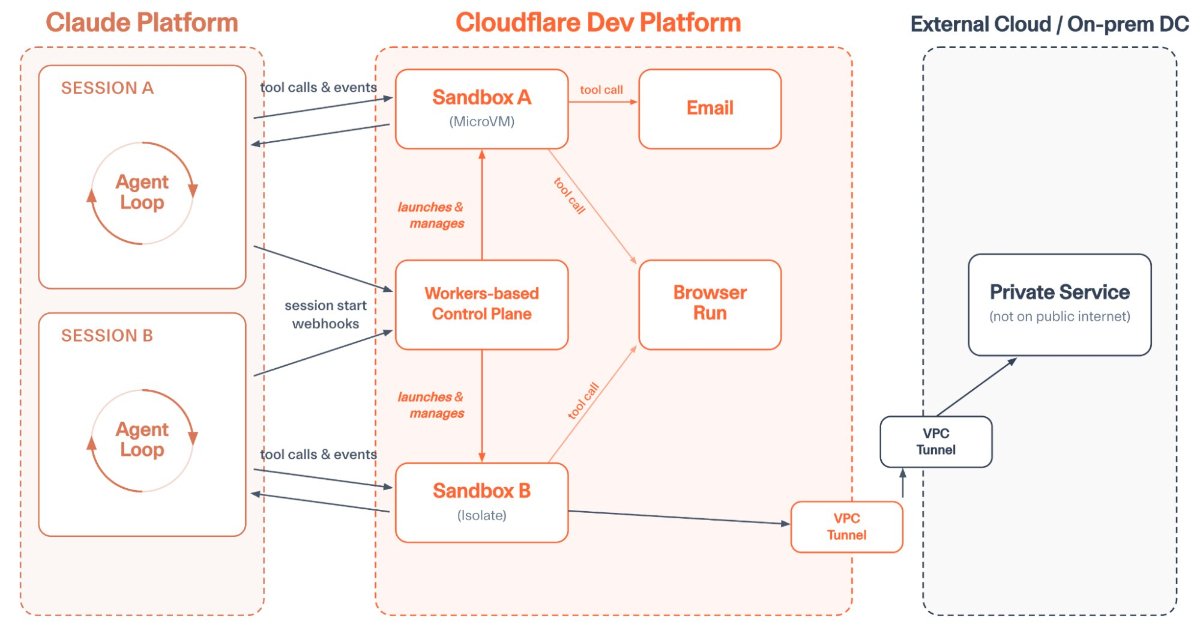
Cloudflare announced native support for Claude Managed Agents. The integration lets developers keep the “brain” – Claude’s orchestration and large‑language‑model inference – on Anthropic’s platform, but run the “hands” – sandboxed code, browsing, tool execution – on Cloudflare’s edge network. The default deployment includes:
- Sandboxed Workers‑compatible runtimes (lightweight or VM‑based)
- Private Service Access via Workers VPC and Cloudflare Mesh
- Built‑in logging, audit trails, and email capabilities
- Browser‑Run automation and quick‑start templates
- Git‑backed artifact repositories for versioned agent code
Anthropic describes the model as decoupling the brain from the hands: the LLM stays on Anthropic, while the execution environment can be placed on any cloud that supports the required runtime. Cloudflare’s entry gives enterprises a path to run agents inside their own security perimeter without abandoning Claude’s advanced tool use.
Provider comparison
| Feature | Cloudflare + Claude | Vercel + Claude | Modal + Claude | AWS Bedrock Agents |
|---|---|---|---|---|
| Execution location | Edge Workers (global PoPs) or dedicated VM sandbox | Edge Functions (global) | Managed containers (US‑central) | Lambda/EC2 (regional) |
| Private connectivity | Workers VPC, Cloudflare Mesh, Zero‑Trust tunnels | Vercel Edge Network (public only) | Modal Private‑Link (VPC‑peered) | PrivateLink, Transit Gateway |
| Logging & audit | Built‑in Workers Logs, Cloudflare Logs, configurable retention | Vercel Analytics (limited) | Modal Observability (custom) | CloudWatch Logs, CloudTrail |
| Tooling integration | Artifacts (Git‑like), Workers AI, Dynamic Workers | Vercel Integrations (limited) | Modal SDK, custom Docker images | Bedrock Toolkits, SageMaker |
| Pricing model | Pay‑as‑you‑go for Workers (requests + CPU‑ms) + Claude API usage | Pay‑as‑you‑go for Functions + Claude API | Hourly container cost + Claude API | Request‑based Bedrock pricing + Lambda compute |
| Compliance focus | SOC 2, ISO 27001, PCI‑DSS via private VPCs | No dedicated compliance zone | GDPR‑ready private VPCs | FedRAMP, HIPAA, ISO‑27001 |
Key takeaways
- Latency: Cloudflare’s edge locations (over 300 PoPs) can reduce round‑trip time for agents that need to fetch data from geographically dispersed services. Vercel’s edge is comparable, but Modal’s containers are region‑bound, potentially adding latency for global workloads.
- Network control: Only Cloudflare and Modal provide true private‑link style connectivity that never traverses the public internet. This matters for banks, healthcare, or any regulated domain.
- Observability: Cloudflare bundles request logs, audit trails, and optional log‑push to external SIEMs. Competing stacks often require a separate observability layer.
- Cost predictability: Workers pricing is granular (0.5 µUSD per request + CPU‑ms), which can be easier to forecast than Vercel’s tiered function pricing. Modal’s container billing can spike with long‑running agents.
Migration considerations
1. Assess the execution footprint
- Identify agent workloads that rely on heavy CPU or GPU. Cloudflare Workers AI currently supports inference on CPUs; for GPU‑intensive tasks you may need to fall back to a VM sandbox or hybrid model.
- Map private endpoints (databases, legacy APIs). Use Cloudflare Mesh to create a secure tunnel to on‑prem resources; verify that required ports are allowed.
2. Refactor code for the Workers runtime
- Convert any Node.js or Python scripts to the Workers runtime API (Web Standard APIs, fetch, KV). For VM‑based sandboxes, package the code as a Docker image and push to Cloudflare Container Registry.
- Replace environment‑variable secrets with Workers Secrets or Zero‑Trust token injection, ensuring the agent never stores credentials at rest.
3. Set up version control with Artifacts
- Initialize an Artifacts repository (
cf workers init --artifact) and push the agent code. This provides Git‑like history, roll‑backs, and CI/CD hooks. - Connect the repo to a CI pipeline (GitHub Actions, GitLab CI) that runs tests against a local Workers dev environment before promotion.
4. Configure observability and compliance hooks
- Enable Cloudflare Logs and route them to a SIEM (Splunk, Elastic, or Azure Sentinel) via Logpush.
- Define audit policies that require every agent action to be logged with request ID, user context, and outcome.
- For regulated sectors, request a SOC 2 attestation for the specific Workers VPC configuration.
5. Cost modeling
| Cost component | Cloudflare estimate (per M requests) | Claude API (per M tokens) |
|---|---|---|
| Workers request | $0.50 | – |
| Workers CPU‑ms (average 10 ms) | $0.07 | – |
| Claude Managed Agent orchestration | – | $2.00 (prompt) + $0.15 (completion) |
| Data egress (edge → private) | $0.02/GB | – |
A typical agent that processes 10 M requests per month, consumes 2 B tokens, and transfers 50 GB of data would cost roughly $5,500 on Cloudflare plus $300 for Claude usage, before any discounts. Compare this with a Vercel‑only deployment where function pricing can reach $0.80 per M requests and no built‑in private connectivity, potentially adding $1,200 in VPN costs.
Business impact
Security and compliance
Enterprises gain full control over the execution environment. By keeping the agent’s hands inside a private VPC, banks can enforce zero‑trust policies, inject short‑lived credentials, and retain immutable logs for auditors. The separation also simplifies data residency: sensitive payloads never leave the corporate network, while Claude still processes the LLM prompts in Anthropic’s compliant data centers.
Operational agility
Developers can spin up a new agent in minutes using Cloudflare’s quick‑start templates, then push updates through the Artifacts CI pipeline. Because the runtime is serverless, scaling is automatic – spikes in request volume are handled by the edge network without provisioning additional VMs.
Cost efficiency
Pay‑as‑you‑go pricing aligns with the intermittent nature of many AI‑driven workflows (e.g., on‑demand document summarization). Organizations can avoid over‑provisioning compute and only pay for Claude token usage, which remains the dominant cost factor.
Vendor lock‑in mitigation
The “brain‑hands” split means a future migration away from Claude only requires updating the orchestration endpoint, while the Cloudflare execution layer can remain unchanged. Conversely, if a company prefers a different edge provider, the same Workers‑compatible code can be redeployed to Fastly Compute@Edge or AWS Lambda@Edge with minimal changes.
Bottom line
Cloudflare’s support for Claude Managed Agents gives regulated enterprises a pragmatic path to adopt AI agents without surrendering control of their infrastructure. The offering stands out for its edge‑wide latency advantage, built‑in private networking, and granular audit capabilities. When planning a migration, focus on refactoring to the Workers runtime, establishing secure private links, and modeling the combined Cloudflare‑Claude cost structure. Companies that prioritize compliance and observability will find the Cloudflare‑Claude combo a compelling alternative to the more public‑internet‑centric solutions from Vercel or Modal.
Renato Losio is a principal cloud architect based in Berlin, an AWS Data Hero, and a regular contributor to InfoQ.

Comments
Please log in or register to join the discussion