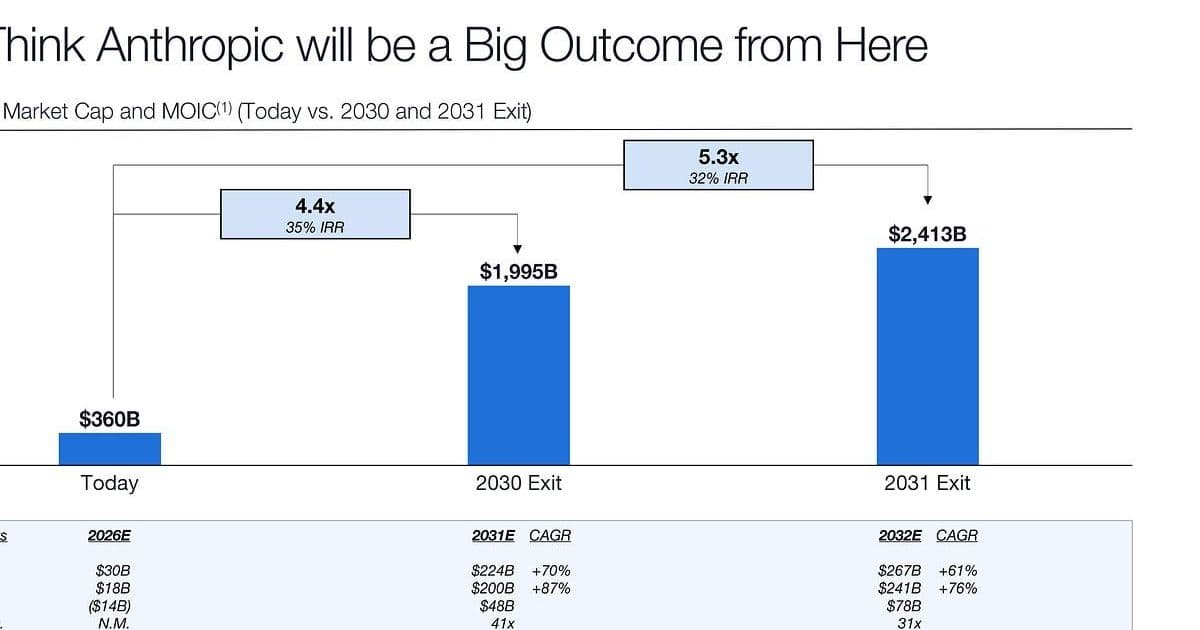
Leaked Coatue presentation estimates Anthropic will lose $14B in 2026 on $18B revenue while targeting $1.995T valuation by 2030, raising questions about AI startup economics and market sustainability.
Coatue Management's leaked January 2026 presentation has sent shockwaves through the AI investment community, projecting that Anthropic will lose $14 billion in EBITDA on $18 billion in revenue by 2026 while targeting a staggering $1.995 trillion valuation by 2030. The confidential document, obtained by Newcomer, offers a rare glimpse into the financial projections and valuation expectations driving the current AI investment frenzy.
The presentation's central thesis appears to be that Anthropic's losses are justified by its potential to capture a massive share of the AI market, with the firm estimating that the company could generate $100 billion in revenue by 2028 and achieve a $1.995 trillion valuation within four years. This would represent a compound annual growth rate of over 100% from 2026 to 2030, a trajectory that even the most optimistic tech investors would consider aggressive.
What makes these projections particularly noteworthy is that they come from Coatue, a major investor in both Anthropic and other AI companies. The firm's willingness to model such substantial losses suggests a belief that the AI market will be so large that even companies burning billions of dollars annually will be able to achieve profitable scale. However, the presentation also acknowledges the significant risks involved, including intense competition from OpenAI, Google, and other well-funded competitors.
Industry analysts are divided on whether these projections represent realistic growth expectations or signs of an AI valuation bubble. Some point to the rapid adoption of AI tools and the massive enterprise demand for AI capabilities as justification for aggressive growth projections. Others argue that the projected losses are unsustainable and that the AI market may not be large enough to support multiple companies burning billions of dollars annually.
The timing of this leak is particularly interesting given recent developments in the AI industry. Microsoft's rollout of Copilot Cowork, Mistral's $830 million debt financing for European data centers, and the continued fundraising by AI chip startups like Rebellions all suggest that capital continues to flow into the AI sector despite questions about profitability. The presentation's release may influence how investors evaluate other AI companies and their path to profitability.
One key question raised by the Coatue presentation is whether the AI industry is following a similar trajectory to previous technology booms, where companies prioritized growth over profitability before eventually achieving scale. The comparison to the dot-com era is inevitable, though proponents argue that AI's potential to transform virtually every industry makes it fundamentally different from previous technology waves.
For Anthropic specifically, the projections highlight the massive capital requirements of competing in the AI race. Building and training large language models requires enormous computing resources, and the company's losses reflect the current reality that AI development is still a capital-intensive endeavor with uncertain paths to profitability. The presentation suggests that Anthropic believes it can achieve profitability through scale, but the timeline and feasibility remain uncertain.
The leaked document also provides insight into how major investors are thinking about AI valuations. The $1.995 trillion target represents a belief that AI companies could eventually be worth as much as the largest tech companies today, despite generating far less revenue. This valuation framework assumes that AI will become as fundamental to the economy as search, social media, or e-commerce have become, creating opportunities for massive market capitalization even with current loss structures.
As the AI industry continues to evolve, the tension between growth and profitability will likely remain a central theme. The Coatue presentation offers a window into how one major investor is navigating this challenge, but whether Anthropic and other AI companies can achieve the projected growth while managing their substantial losses remains one of the most important questions facing the technology industry today.
The broader implications extend beyond Anthropic to the entire AI ecosystem. If these projections prove accurate, they could justify continued massive investment in AI infrastructure, model development, and applications. If they prove overly optimistic, they could trigger a reassessment of AI company valuations and potentially slow the current pace of investment in the sector.
Comments
Please log in or register to join the discussion