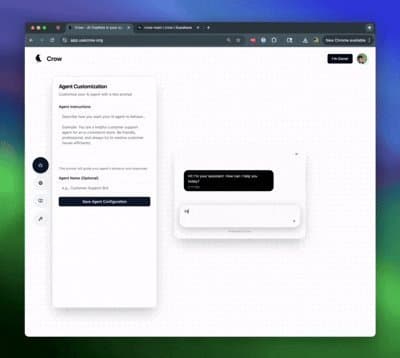
Crow introduces a novel AI copilot that understands application architecture to execute complex user workflows through natural language commands, promising zero-backend-rewrite integration and context-aware task completion.
Crow AI Copilot: Bridging the Gap Between User Intent and Application Execution
In the rapidly evolving landscape of AI-driven interfaces, the concept of "copilots" has expanded beyond code assistance to fundamentally reshape how users interact with applications. Crow, a new entrant in this space, positions itself as a transformative solution by enabling AI agents that understand an application's inner workings and take meaningful actions within it. By addressing critical technical challenges around context management, tool reliability, and integration complexity, Crow aims to deliver on the long-promised vision of truly intelligent in-app automation.
The technical hurdles of building such systems are substantial. Traditional approaches to application automation often require extensive API redesigns, complex state management scaffolding, and brittle context-handling mechanisms. These challenges have historically limited AI-driven workflows to niche use cases or required prohibitive engineering investments. Crow tackles these head-on with a three-pillar architecture focused on session continuity, reliable tool execution, and seamless backward compatibility.
At the core of Crow's offering is its sophisticated context management system. Unlike conventional implementations that rely on brittle context hacks or custom scaffolding, Crow's agent maintains full session state across requests. It remembers previous actions, tracks workflow progress, and preserves relevant data throughout user interactions. This eliminates the common frustration of AI assistants losing track of complex multi-step tasks, enabling coherent execution of intricate workflows that span multiple application screens.
Equally critical is Crow's approach to tool calling. The platform handles the intricate routing of requests to appropriate backend services, manages retries during failures, and validates inputs—all without requiring developer intervention. This "no babysitting" philosophy represents a significant advancement over earlier AI systems that left engineers constantly patching around execution errors. By abstracting these complexities, Crow enables developers to expose existing application capabilities to the AI agent without modifying core infrastructure.
The integration process exemplifies Crow's pragmatic approach. Rather than requiring backend rewrites or API restructuring, the platform connects to existing systems through a remarkably lightweight implementation:
<!-- Add Crow to your app -->
<script
  src="https://api.usecrow.org/static/crow-widget.js"
  data-product-id="user_123456789"
></script>
This simplicity belies the underlying sophistication. The script tag initializes an agent that wraps the application's backend, understanding its actions, constraints, and data models. The platform automatically maps natural language requests to appropriate backend functions, creating a conversational interface that executes real workflows.
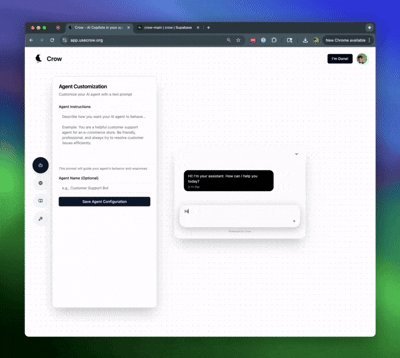
The user experience implications are profound. Where traditional interfaces force users through complex menu hierarchies and multi-screen workflows, Crow enables direct command execution. Users can simply state their goal in natural language—"Create a project with these parameters and invite these team members"—and watch as the copilot handles the entire process end-to-end. This shift from "hunt-and-click" to "tell-and-achieve" dramatically reduces cognitive load and accelerates task completion.
For development teams, Crow offers a compelling value proposition. By offloading the complexities of AI agent development to a specialized platform, engineers can focus on core product functionality rather than building and maintaining custom AI infrastructure. The platform's enterprise-grade reliability and scalability—from startup to enterprise—further simplify adoption, while granular control mechanisms ensure the copilot operates within defined boundaries.
As AI continues to permeate software development, solutions like Crow represent a maturation of the copilot concept—from assisting with code to assisting with application usage. The ability to deploy sophisticated in-app automation in minutes, without backend changes, could accelerate the democratization of AI-driven interfaces across industries. However, the ultimate test will lie in production performance and the platform's ability to generalize across diverse application domains.
Crow's emergence signals a pivotal moment in AI application integration, where the promise of conversational interfaces finally meets the practical realities of production systems. By solving the technical challenges that have historically hindered in-app AI agents, this platform may well be the catalyst that transforms how we design and interact with software in the years to come.
Source: Crow
Comments
Please log in or register to join the discussion