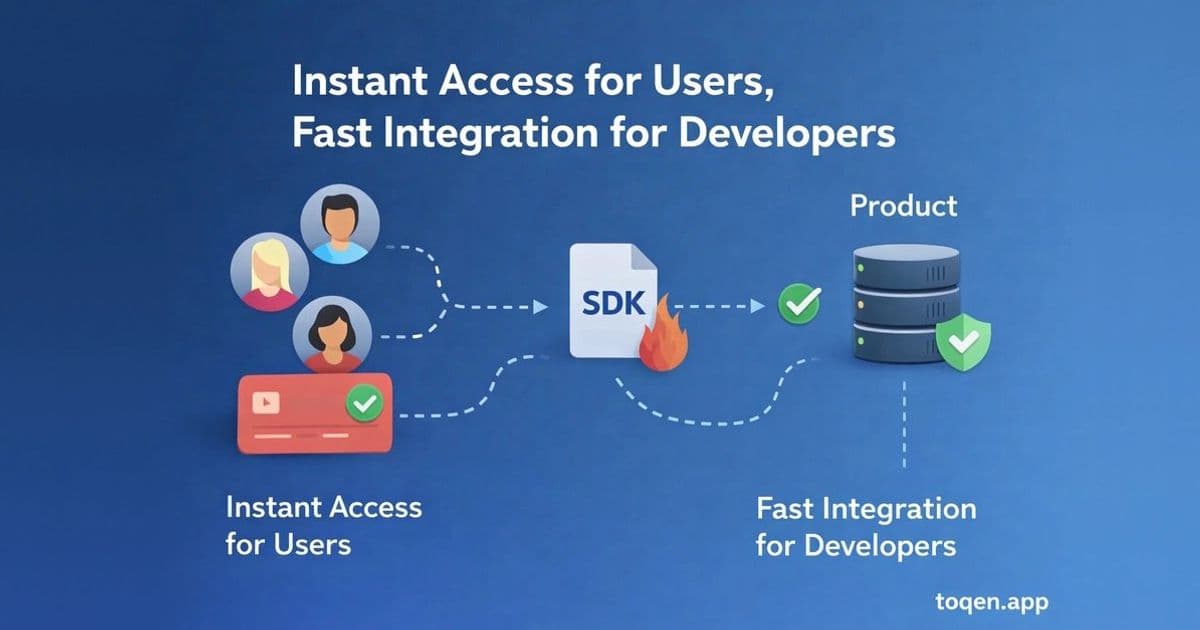
Toqen.app offers a new approach to authentication that eliminates the need for complex login systems within products, enabling developers to integrate secure access in minutes rather than months.
Authentication infrastructure has become one of the most complex subsystems in modern software products. What starts as a simple login form quickly evolves into a sprawling network of security checks, session management, recovery flows, and abuse prevention mechanisms. This complexity creates a fundamental tension: every new product needs reliable access control, but implementing it requires significant engineering effort that diverts resources from core product features.
The Authentication Paradox
The traditional approach to authentication forces product teams into a difficult choice. They can either build a custom authentication system that requires ongoing maintenance, security updates, and compliance work, or they can use existing solutions that often come with their own integration complexities and architectural constraints.
This creates what might be called the authentication paradox: the more sophisticated and secure your product needs to be, the more complex and resource-intensive your authentication infrastructure becomes. A simple e-commerce site might start with basic email/password authentication, but quickly needs to add multi-factor authentication, session management, password recovery, rate limiting, and various compliance features.
A Different Approach to Access
Toqen.app was designed around a simple but powerful idea: what if products didn't need to implement authentication infrastructure at all? Instead of building login systems inside products, Toqen.app proposes connecting products to an external access layer through a lightweight SDK.
The core insight is that authentication infrastructure has become a commodity concern that can be standardized and outsourced, much like how cloud services have replaced the need for companies to run their own data centers.
The Integration Experience
From a developer's perspective, the Toqen.app approach is intentionally minimal. The basic integration requires only two things: installing the SDK and storing a minimal user record. Everything else—login flows, session infrastructure, cryptographic verification, abuse prevention—is handled by the access layer.
This minimalism is by design. The SDK includes a development mode that runs with a built-in in-memory store, allowing developers to start building product features immediately without configuring any database. This means the access flow works out of the box, enabling extremely fast local setup.
From Development to Production
When moving to production, products store their user data in their own databases while maintaining minimal user records. The typical approach involves keeping an internal user identifier, product-specific data, and optional profile information. The SDK documentation provides clear step-by-step guides for connecting existing databases without requiring architectural redesign.
This separation of concerns is crucial: Toqen.app handles access infrastructure, sessions, security mechanisms, and abuse prevention, while products handle their own business logic and functionality. Security updates and improvements to the access infrastructure are maintained by the Toqen.app platform, allowing product teams to avoid maintaining complex authentication systems in their codebase.
Technical Architecture
The SDK provides middleware that checks access cookies, validates signatures, decodes claims, and adds access context to request objects. Authorization functions check for valid access and return appropriate error codes when access is not present.
This architecture creates clear boundaries between responsibilities. The product team focuses on building features and business logic, while the access layer handles the complex, security-sensitive aspects of authentication. This separation also means fewer infrastructure components to maintain and less security-sensitive code inside the product.
Why This Matters for Engineering Teams
For engineering teams, this approach offers several compelling advantages:
- Extremely fast initial integration: Basic setup typically takes around 10 minutes
- Predictable architecture: Clear separation between access infrastructure and product logic
- Reduced security burden: Less security-sensitive code inside the product
- Fewer maintenance responsibilities: No need to maintain authentication infrastructure
- Focus on core functionality: Teams can concentrate on building product features rather than authentication systems
This matters particularly for startups and small teams who need to move quickly but can't afford to build and maintain sophisticated authentication systems. It also benefits larger organizations that want to standardize authentication across multiple products without duplicating effort.
The Broader Context
Toqen.app's approach fits into a broader trend of specialized infrastructure services that handle commodity concerns so product teams can focus on differentiation. Just as companies use Stripe for payments or AWS for hosting, Toqen.app proposes using a specialized service for authentication infrastructure.
The pilot integrations currently being offered represent an opportunity to test this approach in real-world scenarios. The goal is to demonstrate how access infrastructure can remain lightweight while still providing secure and reliable access.
Looking Forward
As products continue to evolve and security requirements become more stringent, the complexity of authentication infrastructure will likely continue to grow. Approaches like Toqen.app's offer a potential solution by externalizing this complexity while maintaining the flexibility and control that product teams need.
For engineering teams struggling with authentication complexity, this represents an interesting alternative worth exploring. The question isn't whether authentication infrastructure is necessary—it clearly is—but rather who should be responsible for building and maintaining it.
The answer, according to Toqen.app, might be: not you.
Comments
Please log in or register to join the discussion