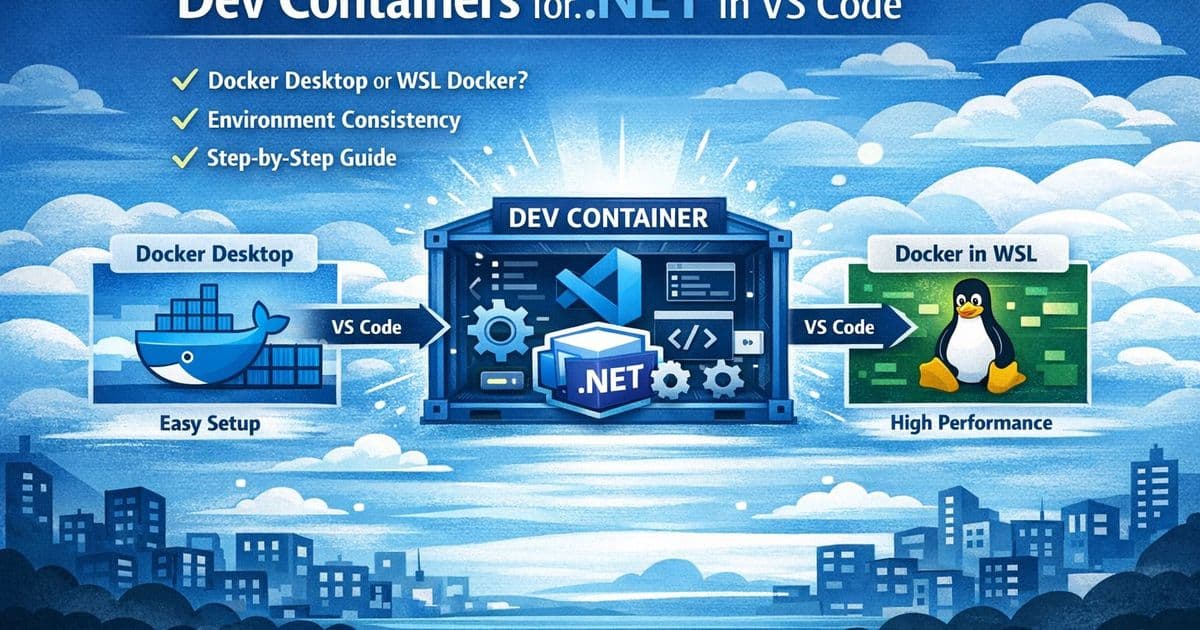
A comprehensive analysis of Dev Containers for .NET development, examining provider options, implementation strategies, and business impact in multi-cloud contexts.
The development environment landscape has evolved significantly with the rise of containerization technologies. For .NET development teams, Dev Containers represent a fundamental shift in how we approach local development environments, moving away from machine-specific setups toward version-controlled, reproducible configurations. This transition carries strategic implications for organizations operating across multiple cloud providers and implementing cloud-native architectures.
The Strategic Shift to Containerized Development
Traditional development workflows often result in environment inconsistencies that manifest as the familiar "it works on my machine" problem. .NET development presents unique challenges with SDK version conflicts, OS-specific dependencies, and database configuration variations across developer machines. Dev Containers address these issues by encapsulating the entire development environment within a container, providing consistency across all developer workstations regardless of host operating system.
The strategic value extends beyond consistency. By treating development environments as code, organizations can:
- Accelerate onboarding processes through standardized environments
- Eliminate environment drift between development and production
- Enable seamless transitions between projects with different technology stacks
- Facilitate remote work and distributed team collaboration
Provider Comparison: Container Runtime Options
When implementing Dev Containers for .NET, organizations must select an appropriate container runtime provider. The choice impacts performance, resource utilization, and integration with existing cloud infrastructure.
Docker Desktop
Docker Desktop remains the most widely adopted solution for containerized development on Windows and macOS. For .NET developers, it offers:
- Integrated graphical interface for container management
- Seamless integration with Visual Studio Code and the Dev Containers extension
- Pre-configured images optimized for .NET development
- Automatic handling of container networking and volume mounting
However, Docker Desktop consumes significant system resources and may face licensing restrictions in enterprise environments. Organizations with strict security policies may also require alternative solutions.
Docker Engine in WSL
For organizations seeking a more lightweight or Linux-native approach, Docker Engine running within Windows Subsystem for Linux (WSL) provides:
- Reduced resource consumption compared to Docker Desktop
- Linux-native container behavior, closer to production environments
- Better performance for Linux-based .NET containers
- Integration with existing WSL workflows
This approach requires additional configuration and Linux knowledge but offers superior performance for teams already utilizing WSL for development workflows.
Alternative Container Runtimes
While Docker dominates the container ecosystem, organizations evaluating multi-cloud strategies should consider alternative runtimes:
- Podman: Offers daemonless architecture, enhanced security, and better Kubernetes compatibility
- containerd: Provides a lightweight, production-focused runtime with strong ecosystem support
- Singularity: Designed for high-performance computing environments with specific security requirements
For .NET development, these alternatives may offer advantages in specific contexts, particularly when container workloads need to span public clouds, private data centers, and edge environments.
Multi-Cloud Implementation Strategies
Organizations implementing Dev Containers across multiple cloud platforms must consider several strategic factors:
Cloud Provider Integration
Each major cloud provider offers container services that integrate with Dev Containers:
- AWS: Amazon ECS, EKS, and AWS Fargate provide managed container services
- Azure: Azure Container Instances and AKS offer native container orchestration
- Google Cloud: GKE and Cloud Run provide Kubernetes-based solutions
The choice of cloud provider impacts:
- Networking configuration for container communication
- Storage options for persistent data
- Security model integration
- Cost optimization strategies
Cross-Cloud Container Images
For .NET applications running across multiple clouds, container image portability becomes critical. Organizations should:
- Use multi-stage builds to optimize image size across platforms
- Leverage .NET's cross-platform capabilities effectively
- Implement cloud-agnostic configuration management
- Consider container registries accessible from all target environments
Network and Storage Considerations
Dev Containers in multi-cloud environments require careful network and storage configuration:
- Implement consistent DNS resolution across cloud providers
- Configure appropriate port mappings for containerized services
- Select storage solutions that work across different cloud platforms
- Ensure data persistence strategies meet requirements in each environment
Business Impact Analysis
Implementing Dev Containers for .NET development carries significant business implications:
Productivity Improvements
Organizations report substantial productivity gains through:
- Reduced time spent on environment setup and debugging
- Faster onboarding of new developers (typically 40-60% reduction)
- Decreased context switching between projects
- Improved developer satisfaction and retention
Risk Reduction
Dev Containers mitigate several development risks:
- Eliminate environment-specific bugs through consistent configurations
- Reduce security vulnerabilities through isolated development environments
- Simplify compliance requirements through standardized tooling
- Decrease knowledge silos through documented, reproducible environments
Cost Optimization
While containerization introduces some overhead, the long-term cost benefits include:
- Reduced infrastructure requirements through efficient resource utilization
- Lowered cloud costs through standardized, optimized container images
- Decreased maintenance overhead for development environments
- Optimized CI/CD pipeline performance through containerized workflows
Migration Considerations
Teams transitioning to Dev Containers should consider:
- Incremental adoption strategies for existing projects
- Training requirements for development teams
- Integration with existing CI/CD pipelines
- Documentation and knowledge management practices
Strategic Implementation Framework
For organizations planning Dev Container adoption, a structured approach ensures successful implementation:
Assessment Phase
Evaluate current development workflows, identify pain points, and establish clear success metrics. Consider:
- Current environment consistency challenges
- Existing container knowledge within the team
- Integration requirements with cloud infrastructure
- Security and compliance requirements
Planning Phase
Develop a comprehensive implementation plan including:
- Container runtime provider selection based on organizational requirements
- .NET SDK and dependency management strategy
- Integration with existing development tools and workflows
- Monitoring and observability requirements
Implementation Phase
Execute the implementation with careful attention to:
- Container image optimization for .NET applications
- Network and storage configuration for multi-cloud compatibility
- Security hardening of containerized environments
- Documentation and knowledge transfer processes
Optimization Phase
Continuously improve the Dev Container implementation based on:
- Performance metrics and developer feedback
- Evolving cloud provider offerings
- New .NET container best practices
- Changing organizational requirements
Future Outlook
The Dev Container ecosystem continues to evolve with several trends shaping the future:
Enhanced Cloud Integration
Cloud providers are increasingly offering native Dev Container support, with deeper integration between local development environments and cloud services. This trend will further simplify multi-cloud development workflows.
AI-Assisted Development
AI-powered tools are beginning to integrate with Dev Containers, offering intelligent code completion, automated testing, and optimized container configuration suggestions tailored to .NET development patterns.
Edge Computing Considerations
As organizations expand into edge computing environments, Dev Containers will need to address unique constraints around resource availability, network connectivity, and offline capabilities.
Conclusion
Dev Containers represent a strategic evolution in .NET development, offering significant business benefits through environment consistency, improved productivity, and reduced risk. For organizations operating across multiple cloud platforms, Dev Containers provide a consistent development experience that bridges the gap between local development and cloud deployment.
The strategic implementation of Dev Containers requires careful consideration of container runtime providers, multi-cloud integration strategies, and organizational requirements. When implemented effectively, Dev Containers transform development from a source of friction into a strategic advantage, enabling teams to focus on innovation rather than environment configuration.
Organizations that embrace Dev Containers as part of their cloud-native strategy position themselves for greater agility, reduced operational overhead, and accelerated development cycles in an increasingly complex multi-cloud landscape.
Comments
Please log in or register to join the discussion