Testing demonstrates significant performance gains in classic PhysX-enabled games when using a secondary GPU dedicated to physics calculations, with up to 76% average FPS improvement in Batman: Arkham Asylum at 4K resolution.
In the ever-evolving landscape of PC gaming hardware, enthusiasts continue to explore innovative ways to maximize performance, even with older titles that leverage legacy technologies. Our recent investigation into dual GPU configurations for PhysX acceleration reveals compelling performance gains in classic Batman Arkham titles when pairing an RTX 5090 with a secondary RTX 5060 dedicated solely to physics calculations.
The Evolution of PhysX Technology
PhysX represents a fascinating chapter in GPU acceleration history. Originally developed by Swiss company NovodeX AG in 2001, the physics simulation engine was acquired by Ageia in 2004. Ageia pioneered hardware-accelerated physics technology through specialized Physics Processing Units (PPUs), but the technology gained mainstream traction only after Nvidia's 2008 acquisition of Ageia. Following this acquisition, Nvidia discontinued standalone PPUs and integrated PhysX acceleration directly into its GPU architecture via CUDA.
The Batman Arkham series stands as one of the most prominent implementations of PhysX technology, utilizing the API for numerous effects including dynamic fog, cloth simulation, destructible environments, and particle effects. Other notable titles featuring PhysX include Mafia II, Mirror's Edge, and the Metro series.
Why GPUs Excel at Physics Calculations
The fundamental advantage of GPUs for physics processing lies in their architecture. Unlike CPUs with limited cores designed for sequential processing, modern GPUs feature thousands of parallel cores optimized for simultaneous mathematical and logical calculations. This parallel processing capability makes them exceptionally well-suited for the complex physics calculations required in games.
During the peak period of PhysX integration (2005-2015), CPUs struggled significantly with these calculations, leading to substantial performance degradation when hardware acceleration wasn't available. While modern CPUs have improved, the PhysX implementation in these legacy games remains specifically optimized for GPU acceleration, leaving even contemporary processors at a disadvantage.
The RTX 50-Series and 32-bit PhysX Challenge
The launch of the GeForce RTX 50-series in early 2025 introduced an unexpected challenge for PhysX enthusiasts. With this generation, Nvidia deprecated support for 32-bit CUDA, which initially rendered hardware acceleration for PhysX incompatibility with 32-bit games that support it. This created a significant performance regression for users with these new GPUs when enabling PhysX effects in classic titles.
However, Nvidia addressed this limitation in December 2025 through a driver update that restored 32-bit PhysX support for the RTX 50-series in select games. Our testing builds upon this restored functionality to explore the potential of dual GPU configurations.
Single GPU vs. Dual GPU Performance Trade-offs
Even with hardware acceleration, enabling PhysX on a single GPU configuration imposes a substantial performance penalty. In the Batman Arkham games, the performance decrease when enabling GPU-accelerated PhysX compared to disabling it entirely ranges from 40-70%, depending on the specific title and scene complexity. This performance hit occurs because the primary GPU must simultaneously render the game world while processing physics calculations.
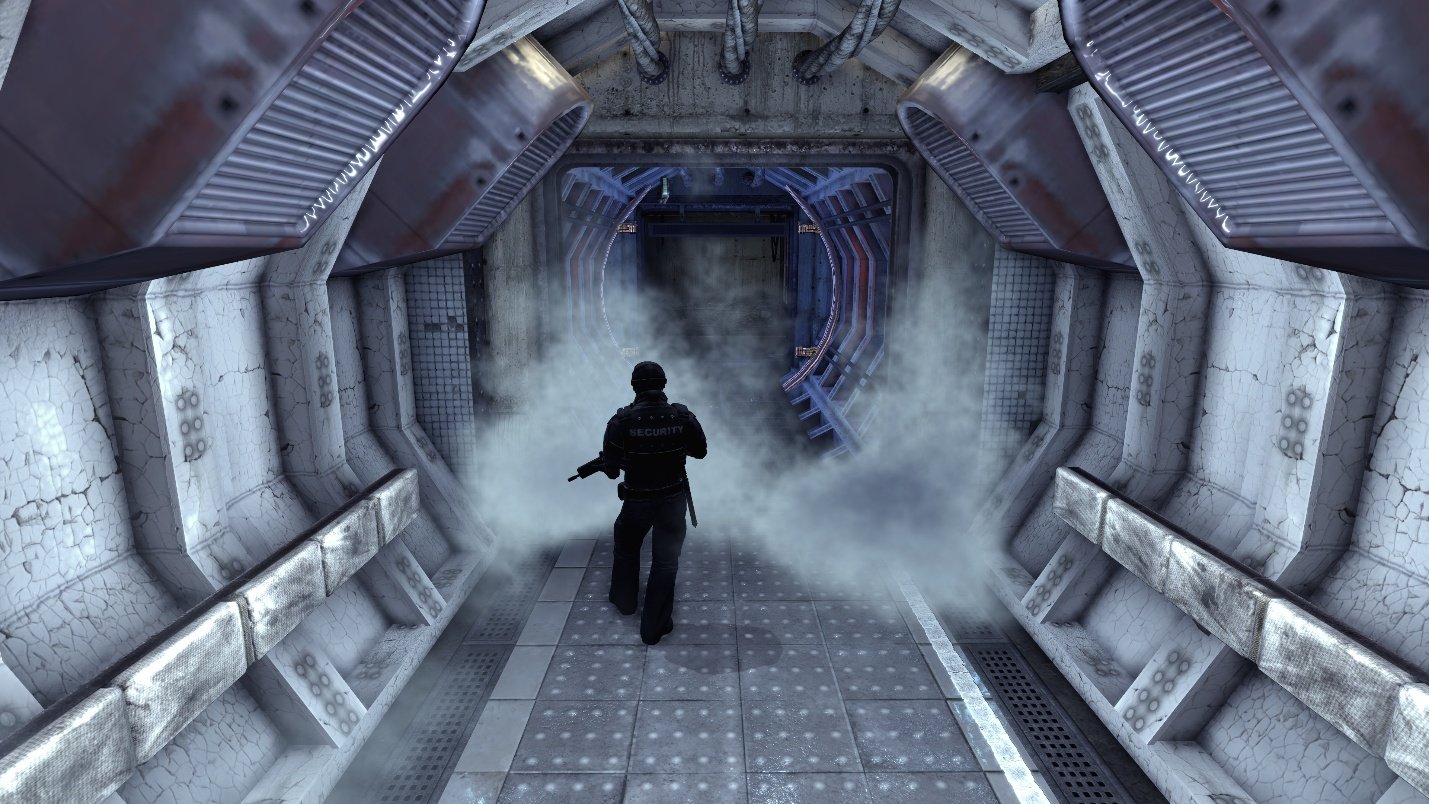
A dual-GPU setup offers a compelling solution to this bottleneck. By designating a secondary GPU as the dedicated PhysX processor through the NVIDIA control panel, all physics calculations are offloaded to the second card, allowing the primary GPU to focus exclusively on rendering. This approach, while not as widely discussed as the now-defunct SLI technology, remains viable for enthusiasts seeking maximum performance in PhysX-enabled titles.
Test Methodology and System Configuration
Our test system featured:
- Primary GPU: MSI GeForce RTX 5090 Vanguard SOC
- Secondary GPU (PhysX): Asus Dual GeForce RTX 5060 OC
- CPU: Ryzen 7 9800X3D
- Memory: 64GB (2x32GB) G.SKILL Flare X5 DDR5 @6200 MHz CL30
- Storage: Crucial T700 Gen5 SSD
- Motherboard: Asus ROG STRIX B850-F Gaming WiFi
- Cooling: Corsair Nautilus 360 RS AIO Cooler
- Operating System: Windows 11 25H2 (Build 26200.7922) with HAGS enabled
- Graphics Driver: Nvidia Driver 595.76
We tested each game using its built-in benchmark to ensure consistent measurement of performance across all PhysX effects. All tests were conducted at 4K resolution with all settings maximized, including PhysX effects.
Batman: Arkham Asylum Results
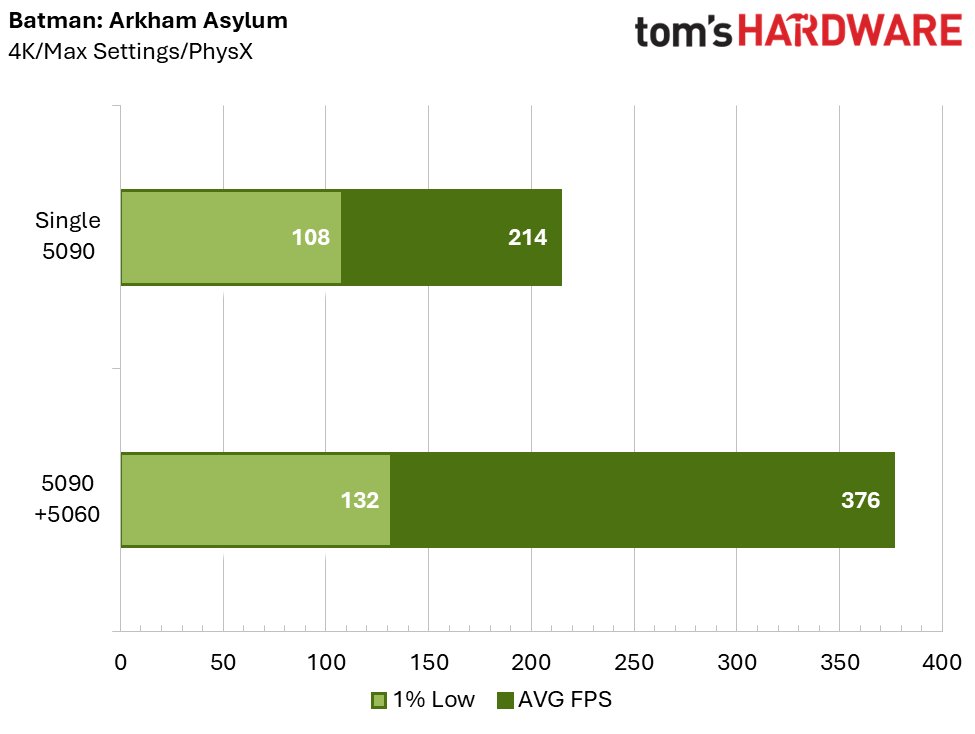
The first title in our testing suite delivered the most dramatic results. Batman: Arkham Asylum showed a massive 76% increase in average framerate when using the RTX 5060 as a dedicated PhysX processor compared to the RTX 5090 handling both rendering and physics calculations. The 1% lows also improved by 22%, demonstrating that the dual GPU configuration provided not just higher average performance but also more consistent frame times.
With this setup, we achieved an average framerate of nearly 400 frames per second at 4K with all PhysX effects enabled—a remarkable achievement for a 15-year-old game. Interestingly, the RTX 5060, responsible solely for PhysX calculations, showed modest utilization averaging just 19% throughout the benchmark, with peaks reaching only 27%. This indicates that even a modest GPU can handle PhysX processing efficiently when unburdened by rendering duties.
Batman: Arkham City Results
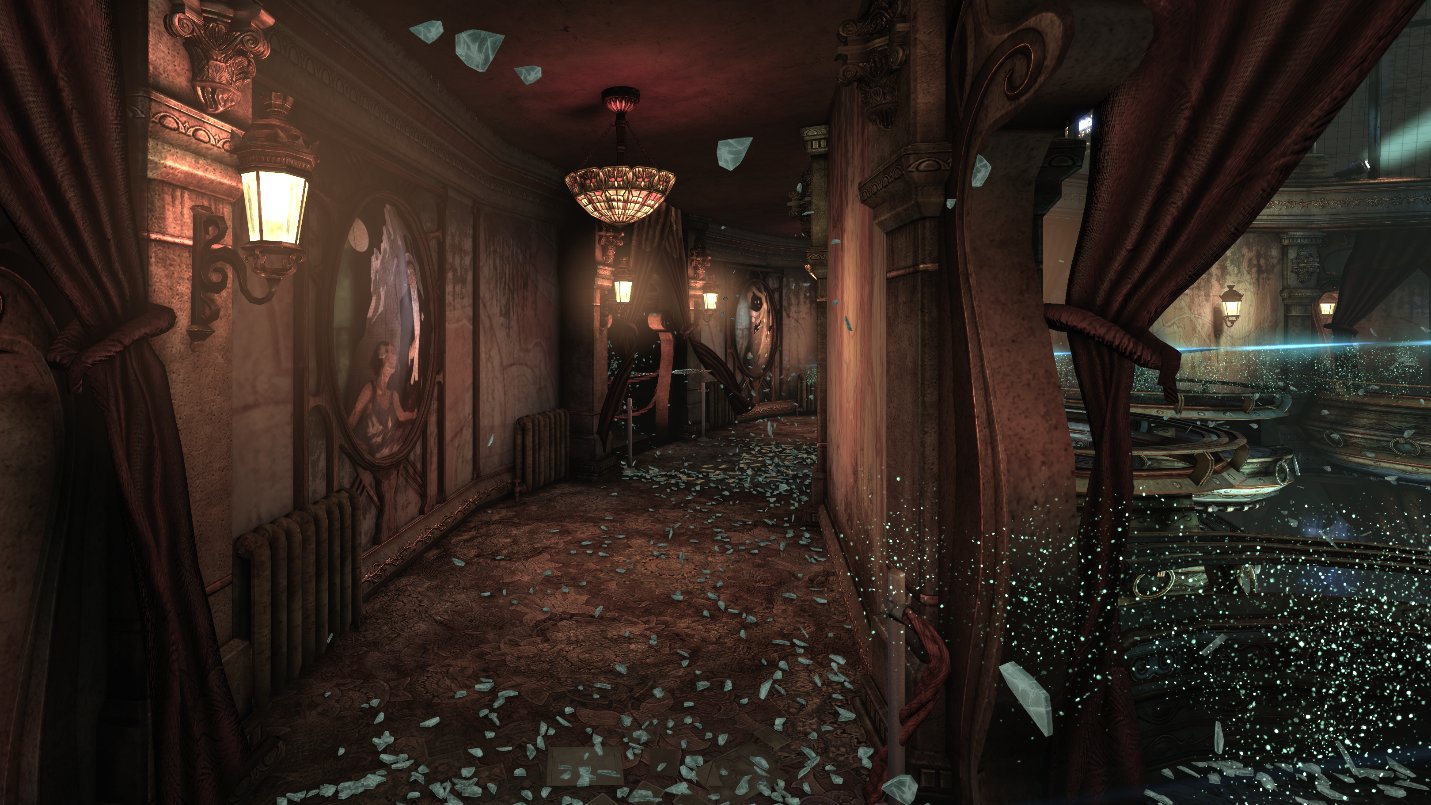
Batman: Arkham City, which implements more advanced PhysX effects including dynamic fog and steam, dynamic bank notes, additional rigid bodies, destructible environments, cloth simulation, and debris effects, still delivered impressive performance gains. We observed a 66% increase in average framerate with the dual GPU configuration, resulting in an average of 244 frames per second at 4K with all effects enabled.
The RTX 5060's utilization in this title was even lower than in Arkham Asylum, averaging just 14% with peaks at 26%. This suggests that the PhysX calculations in Arkham City, while visually impressive, may be less computationally intensive than those in the original game.
Batman: Arkham Origins Results
Batman: Arkham Origins presented a different performance profile. While we still observed a 25% boost to average framerate, the improvement was less dramatic than in the previous titles. Notably, the 1% lows took a slight hit in this configuration, indicating potential frame time inconsistencies despite the higher average performance.
The RTX 5060 showed significantly higher utilization in this title, averaging 37% with peaks reaching 49%. This substantial increase in utilization compared to the previous games sheds light on how demanding PhysX processing can be in certain titles and why enabling it on a single GPU setup can cause such dramatic performance degradation.
Batman: Arkham Knight Results
As the most technologically advanced title in our test suite, Batman: Arkham Knight uses PhysX for interactive smoke and fog, and interactive paper debris. Unlike the previous titles, this is a 64-bit PhysX game for which the RTX 50-series has native support, making it significantly more demanding than the 32-bit titles.
In this case, we observed a 19% increase in average framerate, the lowest improvement of all tested games. However, unlike Batman: Arkham Origins, we saw a notable 13% improvement in 1% lows, indicating more consistent frame times. The RTX 5060's utilization was the highest of all tested games, averaging 42% with peaks reaching 61%, reflecting the increased computational demands of Arkham Knight's PhysX implementation.
Practical Implications and Feasibility
While the performance improvements demonstrated in our testing are substantial, it's important to acknowledge the practical limitations of this approach. A dual-GPU setup requires:
- Sufficient case space to accommodate both graphics cards
- A power supply capable of handling the combined power draw
- A motherboard with multiple PCIe slots
- An additional GPU, even if it's an older or lower-end model
For many users, these requirements may make this configuration impractical. However, for enthusiasts with existing hardware and the desire to maximize performance in classic PhysX titles, this approach offers a compelling solution to the performance challenges inherent in these games.
The variable performance gains across different titles also highlight the importance of game-specific optimization. The extent to which PhysX effects impact performance depends on how extensively and efficiently each game implements these effects, leading to the inconsistent results we observed across the Batman Arkham series.
Conclusion
While SLI technology may be largely a relic of the past, the concept of using a secondary GPU dedicated to PhysX calculations remains a viable strategy for enthusiasts seeking maximum performance in legacy titles that leverage this technology. Our testing demonstrates that even a modest RTX 5060 can provide substantial performance benefits when paired with a high-end primary GPU like the RTX 5090 in PhysX-enabled games.
For those with existing hardware and the desire to revisit classic titles like the Batman Arkham series, this dual-GPU approach offers a way to experience these games with maximum visual fidelity and performance. As the PC gaming landscape continues to evolve, such innovative use of legacy hardware represents one of the many ways enthusiasts continue to push the boundaries of what's possible with their systems.
Comments
Please log in or register to join the discussion