Claude’s new dynamic workflows promise to turn multi‑day engineering projects into single‑session AI orchestrations. Early adopters report impressive speedups, yet higher token costs and operational complexity raise questions about broader adoption.
Dynamic Workflows in Claude Code: Hype, Reality, and the Road Ahead
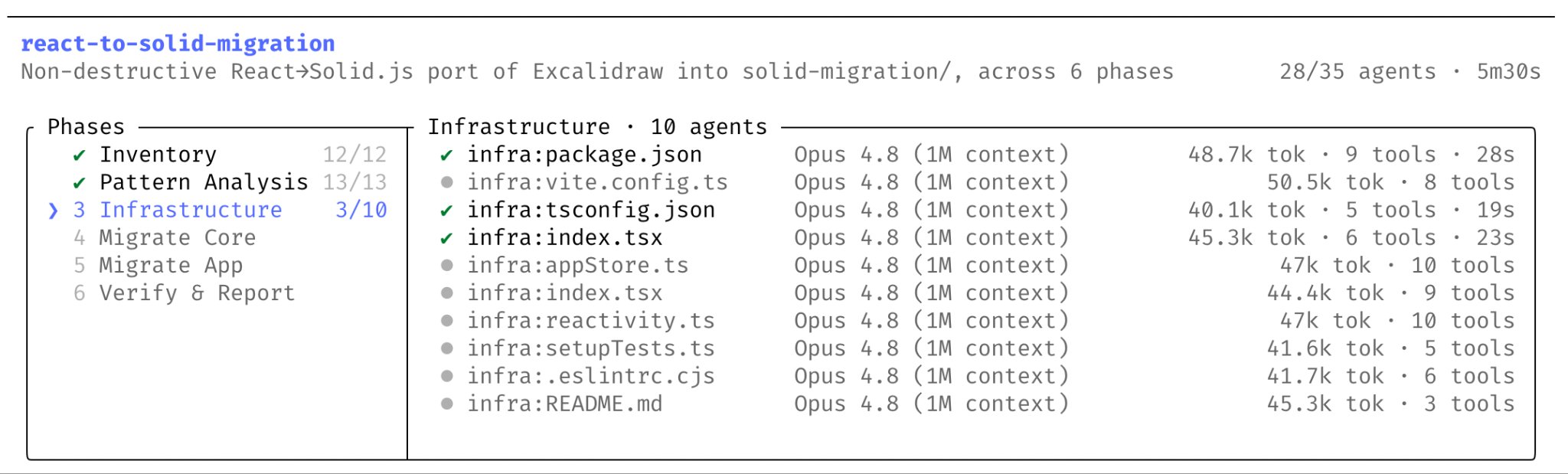
Claude’s latest product announcement touts dynamic workflows – a feature that lets the model spin up dozens to hundreds of parallel sub‑agents, each tackling a slice of a large code‑base or migration task. In theory, a job that once required weeks of manual effort can now be completed in days, or even hours, with Claude handling orchestration, verification, and iterative refinement automatically.
Why the community is buzzing
- Speed claims backed by a concrete case – Jarred Sumner’s port of the Bun runtime from Zig to Rust reportedly finished 750 k lines of code in eleven days, with a 99.8 % test‑suite pass rate. The write‑up (see the original blog post) details a workflow that mapped lifetimes, generated Rust files, and ran a continuous fix‑loop – all driven by Claude’s parallel agents. The numbers are eye‑catching and have already been cited in several internal tech‑radar decks.
- Broad availability – The feature ships in a research preview across the Claude Code CLI, desktop client, VS Code extension, and major cloud marketplaces (Amazon Bedrock, Vertex AI, Microsoft Foundry). This multi‑channel rollout lowers the friction for teams that already embed Claude in their CI pipelines.
- Built‑in safety nets – By design, each sub‑agent’s output is cross‑checked by adversarial agents before the final answer reaches the user. For high‑stakes changes – security audits, migration scripts, or large‑scale refactors – this double‑checking is a compelling safety net.
Evidence from early adopters
- Codebase‑wide bug hunts – Teams at Anthropic have run parallel scans over services with millions of lines, then automatically verified each finding. The resulting reports reportedly contain far fewer false positives than traditional static‑analysis tools.
- Framework migrations – A fintech startup used dynamic workflows to replace a legacy authentication library across 3 k files. The migration completed in under a week, with the workflow automatically opening PRs for each changed file and running the full test suite after each batch.
- Security hardening – A security consultancy ran a “stress‑test” workflow that generated adversarial inputs against their own code, surfacing edge‑case validation bugs that manual review missed.
These anecdotes suggest that, when the problem fits a parallelizable pattern, Claude can indeed compress the timeline dramatically.
Counter‑perspectives and practical concerns
Token consumption and cost
Dynamic workflows consume significantly more tokens than a standard Claude Code session. The announcement warns users to start with scoped tasks to gauge usage. For large enterprises, the cost model could become a barrier, especially when workflows run for hours or days and generate hundreds of thousands of tokens per run.
Complexity of orchestration
While Claude abstracts the orchestration, developers still need to define clear prompts and understand the ultracode setting. Mis‑specifying the task can lead to runaway sub‑agent creation, exhausting quotas or producing noisy output. Some engineers have reported needing multiple iterations to get the workflow to converge on a useful answer.
Debugging and observability
When a workflow fails midway, the state is saved, but extracting a human‑readable trace of what each sub‑agent did can be non‑trivial. Teams accustomed to step‑through debugging may find the black‑box nature of parallel agents unsettling, especially in regulated industries where audit trails are mandatory.
Vendor lock‑in and portability
Dynamic workflows are currently tied to Claude’s ecosystem (CLI, desktop, VS Code, and the listed cloud providers). Migrating to another LLM platform would require re‑implementing the orchestration logic, potentially erasing the productivity gains.
Balancing the promise with the pitfalls
The core idea – letting an LLM break a monolithic task into many smaller, verifiable pieces – aligns with a broader trend toward AI‑augmented developer tooling. Projects like GitHub Copilot’s “Chat” mode and Meta’s “Code Llama” with tool‑use extensions are moving in a similar direction, but Claude’s explicit parallelism is a step further.
For teams that:
- have large, legacy codebases;
- need high‑confidence transformations (e.g., security patches);
- already spend heavily on Claude tokens;
Dynamic workflows could be a net win, provided they allocate budget for the extra token usage and invest in prompt‑engineering expertise.
Conversely, for smaller startups or open‑source projects where budget constraints dominate and tasks are often single‑pass refactors, the added complexity may outweigh the speed benefits. In those cases, a more traditional, human‑in‑the‑loop approach with Copilot or LLM‑driven code suggestions might remain preferable.
Getting started (quick checklist)
- Enable the feature – Max/Team plans have it on by default; Enterprise admins must toggle it in the Claude Code settings.
- Choose a launch mode – Either ask Claude directly (e.g., “Create a dynamic workflow to migrate this repo to TypeScript”) or turn on the ultracode toggle in the effort menu.
- Scope the first run – Start with a modest subset of files to gauge token consumption and runtime.
- Monitor usage – The CLI prints an estimated token count before execution; keep an eye on the dashboard for cost alerts.
- Review generated PRs – Even with automated verification, a final human review is recommended for critical changes.
Looking ahead
If the early adopters’ results hold up at scale, dynamic workflows could become a standard component of AI‑first development pipelines. However, the community will likely demand:
- Transparent cost models (e.g., per‑sub‑agent token pricing);
- Better observability tools (visual DAGs of sub‑agent execution);
- Cross‑provider compatibility (exportable workflow definitions).
Until those gaps are addressed, the feature sits at an exciting yet tentative crossroads: a powerful proof‑of‑concept that may reshape how we think about large‑scale code engineering, but one that still requires careful budgeting and operational discipline.
For the full technical reference, see the official Claude Code dynamic workflow documentation.
Comments
Please log in or register to join the discussion