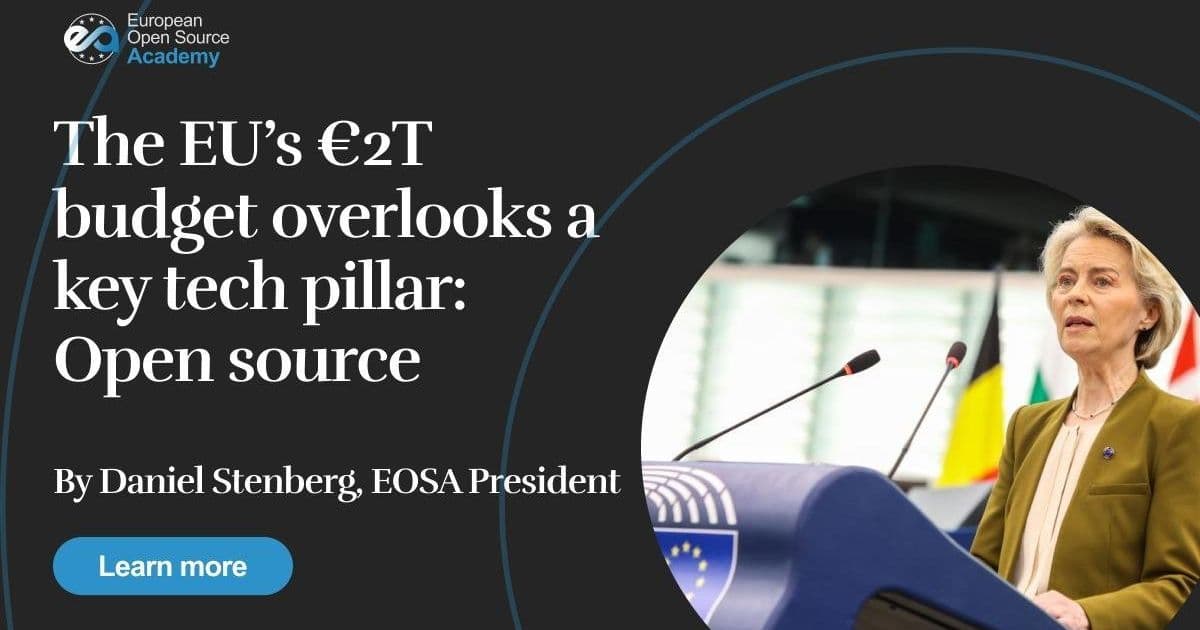
The European Commission's landmark €2tn budget proposal prioritizes digital resilience but omits dedicated funding for open source software—the invisible backbone of modern infrastructure. This oversight jeopardizes Europe's cybersecurity, innovation capacity, and autonomy from U.S. and Chinese tech dominance. Experts warn the exclusion undermines recent legislation and could cripple the bloc's digital ambitions.
The Open Source Blind Spot in Europe's Trillion-Euro Tech Future
When the European Commission unveiled its historic €2tn seven-year budget on July 16—the largest in EU history—it promised to boost digital autonomy, cybersecurity, and competitiveness. Yet buried beneath ambitious allocations for innovation and resilience lay a critical omission: zero dedicated funding for open source software, the foundational layer powering Europe's digital ecosystem.
The Invisible Infrastructure Crisis
Open source isn't just developer tools—it's the oxygen of modern technology. From government systems and banking infrastructure to AI research and IoT devices, collaborative software built by global communities underpins 90% of enterprise IT. Daniel Stenberg, president of the European Open Source Academy and creator of the ubiquitous cURL tool, notes its irreplaceable value:
"Open source offers transparency, security, and flexibility that proprietary software cannot match. It's what allows European SMEs and public institutions to compete without being locked into Big Tech ecosystems."
The oversight is especially jarring given open source's explicit recognition in landmark EU policies:
- Cyber Resilience Act: Mandates security standards for software foundations
- AI Act: Relies on open frameworks for ethical AI development
- Cloud and AI Development Act: Assumes accessible building blocks
Sovereignty Through Collaboration, Not Isolation
Advocates propose an EU Sovereign Tech Fund—modeled after Germany's successful program—to systematically support critical open source maintenance. Unlike innovation grants chasing "shiny new projects," this would address the unglamorous but vital work of:
- Security hardening for widely used libraries
- Long-term maintenance of foundational tools
- Documentation and accessibility improvements
"This isn't about European isolationism," explains Stenberg. "It's about investing in global public infrastructure that enables our digital autonomy while offering a third way between U.S. platform monopolies and China's state-controlled models."
The Competitiveness Fund Paradox
Most alarming is the absence of open source in the European Competitiveness Fund—the budget's primary vehicle for digital transformation. The fund targets "innovation and digitalisation" yet ignores the very tools enabling those goals. Consequences of this gap include:
| Risk | Impact |
|---|---|
| Security Vulnerabilities | Underfunded projects → More Log4j-style crises |
| Vendor Lock-in | Forced reliance on non-EU cloud/AI platforms |
| Innovation Drain | Talent exodus to better-funded ecosystems |
A Fixable Future
The budget remains in negotiation until 2025—leaving a window to rectify what experts call a strategic miscalculation. Embedding open source explicitly in the Competitiveness Fund's digital pillar would:
- Strengthen cyber resilience at the dependency level
- Empower public institutions with customizable tools
- Create EU-led alternatives to proprietary cloud/AI stacks
As Stenberg warns: "Without this investment, Europe's €2tn bid for sovereignty may crumble on unstable digital foundations."
Authored by Daniel Stenberg, co-founder of cURL and president of the European Open Source Academy. Source: TheNextWeb
Comments
Please log in or register to join the discussion