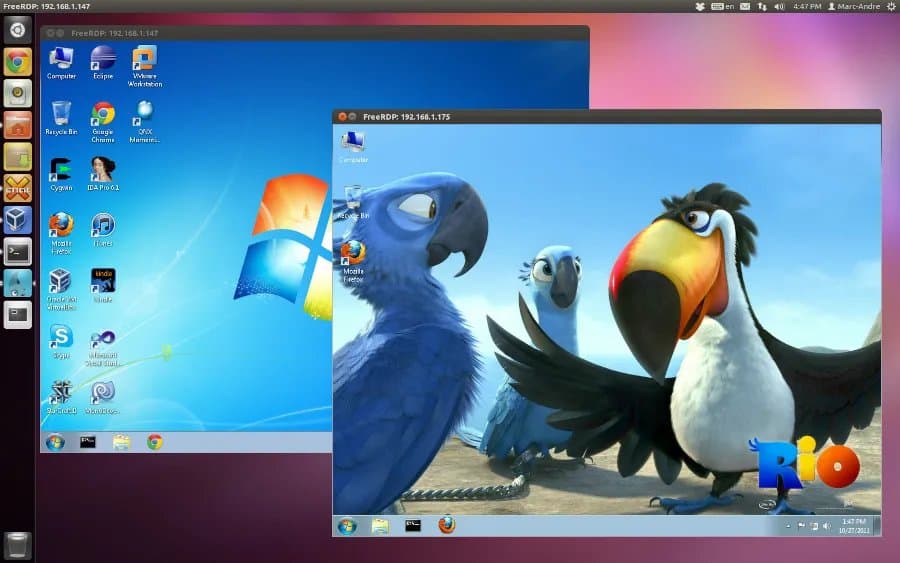
FreeRDP 3.23 delivers crucial security fixes for 11 CVEs while adding multi-monitor and HiDPI support to its SDL client.
The open-source FreeRDP project has released version 3.23, addressing 11 critical security vulnerabilities while simultaneously improving the user experience with enhanced SDL client capabilities. This update represents a significant milestone for organizations and individuals relying on FreeRDP for Remote Desktop Protocol connectivity.
Critical Security Fixes Address Multiple Attack Vectors
The FreeRDP 3.23 release tackles 11 CVEs discovered through comprehensive code analysis, including:
- CVE-2026-26965 through CVE-2026-26955: Multiple out-of-bounds write vulnerabilities
- CVE-2026-26271: Client denial of service possibilities
- CVE-2026-25997 through CVE-2026-25941: Heap-use-after-free bugs, global buffer overflow, and additional integer overflow issues
These vulnerabilities span various attack vectors, from memory corruption to potential remote code execution scenarios. The developers' thorough analysis has resulted in a substantially more secure client implementation.
Enhanced SDL Client Experience
Beyond the security improvements, FreeRDP 3.23 introduces significant enhancements to its SDL client:
Multi-Monitor Support
The SDL client now properly handles multiple monitor configurations, allowing users to extend their remote desktop across several displays. This feature is particularly valuable for power users and professionals who require expanded screen real estate for their remote work environments.
HiDPI Improvements
HiDPI display support has been substantially improved, providing crisper text rendering and better scaling on high-resolution monitors. This enhancement addresses long-standing usability issues for users on modern displays with pixel densities exceeding 200 PPI.
Configuration Isolation
A new configuration isolation feature has been introduced, allowing for more secure and compartmentalized settings management. This helps prevent configuration conflicts and enhances overall system stability.
Technical Implementation Details
The security fixes involved comprehensive memory management improvements, including:
- Enhanced bounds checking throughout the codebase
- Improved memory allocation and deallocation routines
- Additional validation for incoming RDP packets
- Strengthened error handling to prevent information disclosure
For the SDL client improvements, the development team implemented:
- Extended X11 and Wayland backend support for multi-monitor setups
- DPI-aware scaling algorithms for consistent display across different resolutions
- Enhanced OpenGL acceleration for better performance on HiDPI displays
Availability and Migration
FreeRDP 3.23 is available immediately through standard package managers and direct downloads from the GitHub repository. Organizations should prioritize updating their FreeRDP installations, particularly those exposed to external networks or handling sensitive remote desktop sessions.
The update process is straightforward for most distributions, with packages available for Debian, Ubuntu, Fedora, and other major Linux distributions. Windows and macOS users can also access the updated binaries through their respective package managers.
Impact on Enterprise Deployments
For enterprise environments, this release provides critical security hardening that should be incorporated into regular patch management cycles. The enhanced SDL client features also improve the end-user experience, potentially reducing support tickets related to display configuration issues.
Organizations using FreeRDP in production environments should conduct thorough testing of the multi-monitor and HiDPI features, as these represent significant changes to the display handling subsystem.
Community Response
The FreeRDP development community has been praised for their rapid response to the discovered vulnerabilities and their commitment to maintaining a secure, feature-rich RDP client. The balance between security fixes and user experience improvements demonstrates the project's maturity and responsiveness to user needs.
Comments
Please log in or register to join the discussion