Google has expanded its Gmail end-to-end encryption (E2EE) feature to mobile devices, allowing enterprise users to send and receive encrypted emails directly within the Gmail app on Android and iOS without additional tools.
Google has taken a significant step in enhancing email privacy by rolling out end-to-end encryption (E2EE) for Gmail on mobile devices. The feature, which was previously available only on the web version, is now accessible to all Android and iOS users with the appropriate enterprise licenses, marking a major milestone in secure business communications.
Native E2EE Experience on Mobile
Starting this week, enterprise users can compose and read end-to-end encrypted messages directly within the Gmail app on both Android and iOS platforms. This eliminates the need for third-party applications or mail portals that were previously required to handle encrypted communications.
"For the first time, users can compose and read these E2EE messages natively within the Gmail app on Android and iOS. No need to download extra apps or use mail portals," Google announced on Thursday. "Users with a Gmail E2EE license can send an encrypted message to any recipient, regardless of what email address the recipient has."
How It Works
The end-to-end encryption feature is powered by Google's client-side encryption (CSE) technical control. When a user enables the "Additional encryption" option by clicking the lock icon while composing a message, the email and its attachments are encrypted on the client device before being sent to Google's servers.
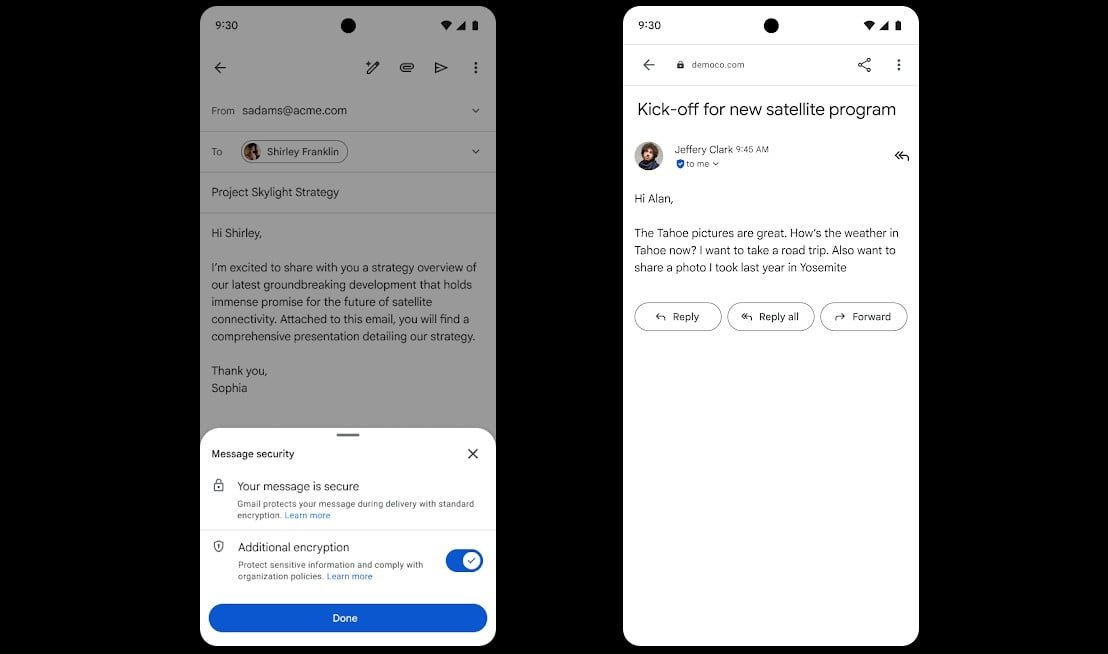
This approach ensures that even Google cannot read the contents of the encrypted messages, providing an additional layer of privacy and security. The encrypted messages are delivered as regular emails to recipients' inboxes if they use the Gmail app. For recipients using other email services, the messages can be read in a web browser, regardless of their device or service provider.
Availability and Licensing
The mobile E2EE feature is now available for all client-side encryption users with Enterprise Plus licenses and the Assured Controls or Assured Controls Plus add-on. However, administrators must first enable the Android and iOS clients in the CSE admin interface via the Admin Console before users can access the feature.
Compliance and Security Benefits
Google emphasizes that this feature combines the highest level of privacy and data encryption with a user-friendly experience. It enables simple encrypted email for customers ranging from small businesses to large enterprises and public sector organizations.
The client-side encryption approach helps organizations meet various regulatory requirements, including:
- Data sovereignty requirements
- HIPAA compliance for healthcare organizations
- Export control regulations
- Industry-specific data protection standards
By ensuring that Google and third parties cannot read the encrypted data, organizations can maintain greater control over their sensitive information while still leveraging Google's email infrastructure.
Evolution of Gmail's E2EE
Gmail's end-to-end encryption journey has been progressive. The CSE feature was initially introduced in Gmail on the web in December 2022 as a beta test, following an initial rollout to other Google Workspace applications including Google Drive, Docs, Sheets, Slides, Google Meet, and Calendar.
The feature reached general availability for Google Workspace Enterprise Plus, Education Plus, and Education Standard customers in February 2023. Google began rolling out its new end-to-end encryption model in beta for Gmail enterprise users in April 2025, and now the feature has expanded to mobile devices.
Enterprise Security Landscape
This move by Google comes amid growing concerns about email security and privacy. Recent security incidents, including the confirmed hack of FBI Director Patel's personal email inbox, have highlighted the importance of robust encryption for sensitive communications.
The expansion of E2EE to mobile devices addresses a critical need in today's business environment, where professionals increasingly rely on mobile devices for work communications. By providing native support for encrypted emails on smartphones and tablets, Google is making it easier for organizations to maintain security standards without compromising convenience.
What This Means for Users
For enterprise users, the rollout of mobile E2EE means:
- Enhanced privacy for sensitive business communications
- Simplified workflow without switching between apps
- Consistent security experience across desktop and mobile
- Better compliance with industry regulations
- Reduced risk of data breaches or unauthorized access
As businesses continue to navigate an increasingly complex security landscape, features like mobile end-to-end encryption represent important tools in protecting sensitive information while maintaining productivity and user experience.
Comments
Please log in or register to join the discussion