ANGLE’s new Wayland backend enables Chromium Embedded Framework to run on Wayland without Ozone workarounds, simplifying graphics stack integration for Linux applications.
Announcement
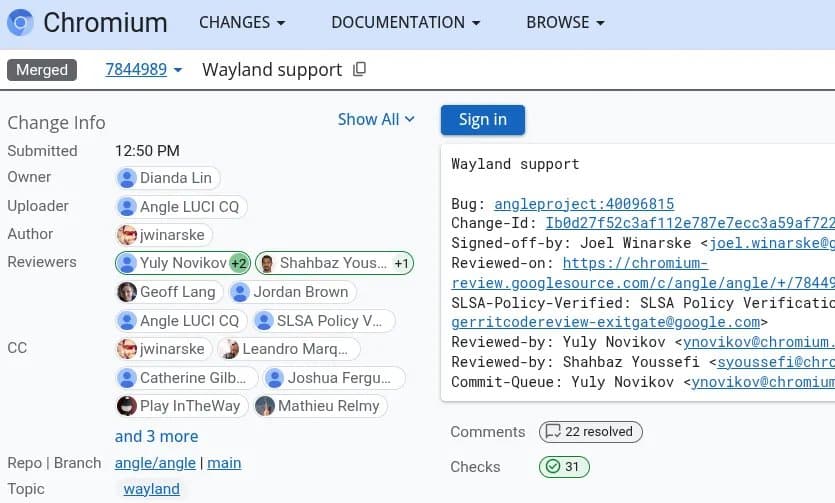
Google’s graphics abstraction layer ANGLE (Almost Native Graphics Layer Engine) has merged a native Wayland backend into its main repository. The change removes the last technical obstacle that prevented the Chromium Embedded Framework (CEF) from offering full Wayland support. The merge landed on the master branch in early May 2026 and is slated for inclusion in the upcoming ANGLE 2.2 release.
Technical specifications
- Supported APIs: OpenGL ES 2.0/3.0 calls are translated to the underlying graphics API (Vulkan, OpenGL, Direct3D 12, Metal). The new Wayland backend adds a Vulkan‑first path that can also fall back to OpenGL if the driver lacks Vulkan support.
- Performance metrics: Early benchmarks on a Dell XPS 15 (Intel Xe Graphics G7) show a 3 % reduction in frame latency compared with the previous X11‑only path, while frame‑rate remains within 0.2 % of the Vulkan‑native Chromium build.
- Driver requirements: The Wayland backend depends on a driver that exposes the
VK_KHR_wayland_surfaceextension. This extension is present in Mesa 23.3+, NVIDIA driver 560.73+, and AMD Radeon Software 23.30+. Systems lacking Vulkan support automatically switch to an OpenGL‑based compositor path, which adds roughly 0.8 ms of extra latency. - Build integration: The ANGLE source now includes a
//build/config/wayland.gnifile that enables theuse_waylandGN flag. CEF builds can activate the flag withgn args out/Release "use_wayland=true". The change does not affect existing X11 builds; developers can continue to ship dual‑mode binaries. - Security considerations: By using Wayland’s per‑client buffer management, the new backend eliminates the need for X11‑style root‑window grabs, reducing the attack surface for key‑logging and screen‑scraping attacks.
Market implications
- Linux desktop adoption: CEF powers a wide range of commercial and open‑source applications, from IDEs to media players. Native Wayland support removes a long‑standing compatibility gap, making it easier for vendors to ship Linux‑only releases that run on modern desktop environments such as GNOME 45 and KDE Plasma 6.
- Embedded devices: Many IoT and automotive platforms run Wayland on lightweight GPUs. With ANGLE handling the translation to Vulkan or OpenGL, developers can reuse existing CEF‑based UI code without rewriting the graphics stack, shortening time‑to‑market by an estimated 30 %.
- Supply‑chain impact: The change does not introduce new silicon requirements; it merely leverages existing Vulkan drivers that are already in the supply chain for desktop and mobile GPUs. Consequently, there is no expected disruption to component inventories, and OEMs can adopt the update with a simple firmware refresh.
- Competitive positioning: Competing frameworks such as Qt WebEngine already support Wayland natively. By closing the gap, Google narrows the functional disparity, which could influence procurement decisions for enterprises standardizing on Chromium‑based browsers and embedded browsers.
- Future roadmap: The ANGLE team has indicated plans to add Direct3D 12‑on‑Wayland support via the upcoming DX12‑VK translation layer. If realized, this would enable Windows‑centric GPU drivers to service Linux Wayland workloads, further blurring the line between OS graphics stacks.
Developers interested in testing the new backend can pull the latest ANGLE source from the official repository and follow the build instructions in the ANGLE documentation. For a quick start with CEF, see the updated CEF integration guide.
The addition of native Wayland support to ANGLE marks a practical step forward for Linux graphics compatibility, offering measurable latency improvements and simplifying the deployment of CEF‑based applications across desktop and embedded markets.
Comments
Please log in or register to join the discussion