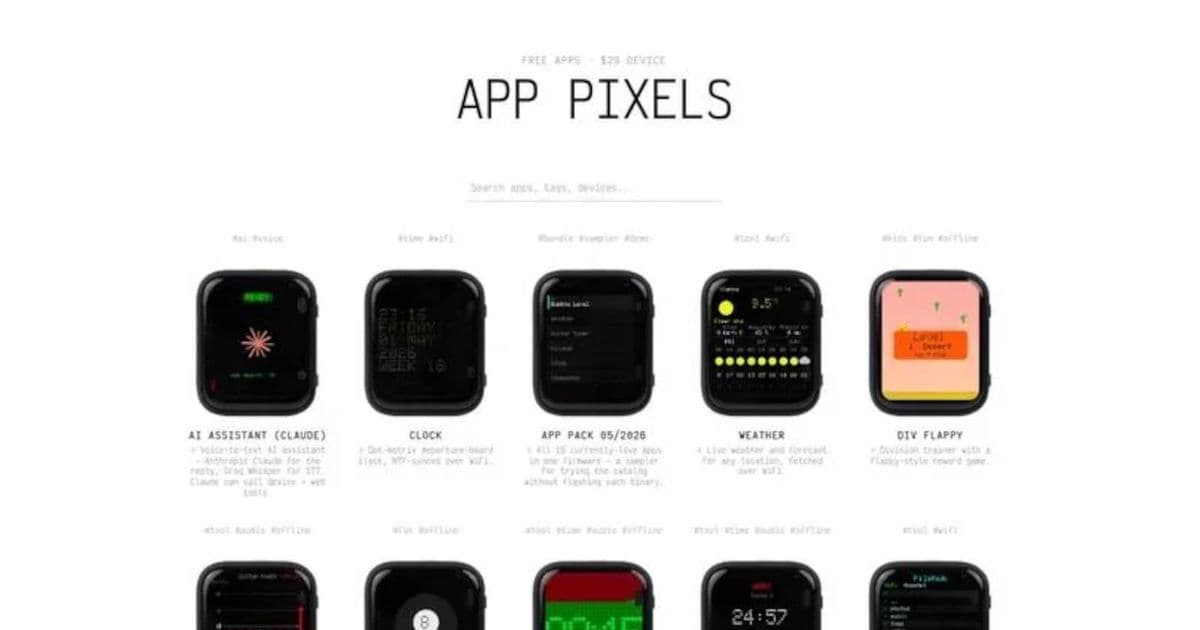
App Pixels introduces a revolutionary browser-based app store for ESP32 devices, enabling users to flash applications directly through the Web Serial API without complex setup requirements.
The world of microcontrollers and IoT devices just became more accessible with the launch of App Pixels, a browser-based application store specifically designed for the Waveshare ESP32-S3 1.8 AMOLED development board. This innovative platform leverages the Web Serial API to allow users to flash applications directly from their web browser, eliminating the traditional barriers of driver installation, toolchain configuration, and terminal commands that have typically limited microcontroller development to more technical users.
Understanding the ESP32-S3 Platform
The Waveshare ESP32-S3 1.8 AMOLED represents an interesting entry point into the ESP32 ecosystem. Priced at approximately $30, this compact device features a 1.8-inch AMOLED display and is built around the ESP32-S3 microcontroller, which offers dual-core processing, Wi-Fi and Bluetooth capabilities, and ample flash memory for applications. The device resembles a smartwatch without straps, making it particularly suitable for wearable projects or standalone display applications.
For developers working with ESP32 devices, the traditional workflow involves setting up the Arduino IDE or ESP-IDF framework, installing appropriate drivers, configuring the toolchain, and using command-line tools to flash firmware. This process, while well-documented, presents a significant learning curve for hobbyists and non-technical users who might be interested in experimenting with microcontrollers but lack programming experience.
App Pixels: Democratizing ESP32 Development
The creator of App Pixels identified this accessibility gap and developed a solution that transforms the ESP32-S3 from a development board requiring technical expertise into a user-friendly device comparable to consumer electronics. The platform currently offers 20 curated applications, each designed to showcase different capabilities of the hardware:
- Claude: A voice recording application that demonstrates the audio processing capabilities of the ESP32-S3
- Pomodoro Timer: A productivity app that takes advantage of the AMOLED display's crisp visuals
- Flappy Bird Math Game: An educational twist on the classic game, combining entertainment with learning
- Dice Roller: A simple utility that demonstrates random number generation and display output
- And several other tools ranging from utilities to entertainment applications
The core innovation of App Pixels lies in its use of the Web Serial API, a web standard that allows web applications to communicate with serial devices connected to a user's computer. This eliminates the need for platform-specific drivers or complex installation processes, making the flashing experience as simple as visiting a website and clicking a button.
Technical Implementation and Cross-Platform Considerations
From a technical standpoint, App Pixels represents an interesting convergence of web technologies and embedded systems development. The Web Serial API, supported by modern browsers including Chrome, Edge, and Opera, provides a standardized way for web applications to access serial ports without requiring browser extensions or native applications.
For users, the experience is remarkably straightforward:
- Connect the Waveshare ESP32-S3 to your computer via USB
- Navigate to the App Pixels website in a compatible browser
- Select the desired application from the curated list
- Click the flash button and confirm the device selection
- Wait for the application to be installed
This simplicity masks the underlying technical complexity, including the handling of device enumeration, firmware transfer protocols, and error handling that would typically require significant development effort.
For developers interested in contributing to the App Pixels ecosystem, the platform offers an interesting model for application distribution. Applications are compiled to run on the ESP32-S3 hardware and packaged in a way that can be transferred through the Web Serial API. This requires understanding the ESP32 toolchain, the specific capabilities of the Waveshare board, and the constraints of microcontroller development.
Impact on the Developer Community
The introduction of App Pixels has several implications for the ESP32 development community:
Lowering the barrier to entry: By eliminating the need for complex setup, the platform makes microcontroller development accessible to a broader audience, including educators, artists, and hobbyists without programming backgrounds.
Simplified distribution: Developers can share their applications through a centralized platform without worrying about distribution mechanisms or user setup requirements.
Standardized user experience: The consistent flashing process across all applications reduces user friction and improves the overall experience.
Educational potential: The platform could serve as an excellent introduction to microcontroller concepts for students and beginners, with immediate visual feedback through the AMOLED display.
However, there are limitations to consider. The current implementation is specific to the Waveshare ESP32-S3 1.8 AMOLED board, which means users with different ESP32 variants would need alternative solutions. Additionally, the Web Serial API requires a physical connection to the device, limiting remote application installation scenarios.
Migration and Future Development
For existing ESP32 developers, App Pixels presents both opportunities and considerations. The platform offers a new distribution channel for applications targeting the Waveshare ESP32-S3, potentially expanding the reach of their work beyond traditional maker communities.
Developers looking to migrate their existing applications to the App Pixels ecosystem would need to:
- Ensure their application is compatible with the Waveshare ESP32-S3 1.8 AMOLED hardware
- Package the application in a format compatible with the Web Serial API transfer mechanism
- Adhere to any guidelines or requirements established by the App Pixels platform
The future development of App Pixels could potentially expand to support additional ESP32 variants, introduce more sophisticated application management features, or integrate with other web technologies to enhance the user experience.
Conclusion
App Pixels represents an interesting evolution in microcontroller development, bridging the gap between traditional embedded systems programming and accessible, user-friendly application distribution. By leveraging the Web Serial API and focusing on a specific hardware platform, the creator has developed a solution that makes ESP32 development more approachable without sacrificing the power and flexibility that makes these devices so appealing to developers.
For users of the Waveshare ESP32-S3 1.8 AMOLED, the platform offers a simple way to explore different applications and use cases for their device. For developers, it provides a new avenue for sharing their work with a broader audience. As web technologies continue to evolve and hardware becomes more capable, platforms like App Pixels may play an increasingly important role in the future of embedded development.
The App Pixels website can be found at app-pixels.com, where users can explore the available applications and experience the browser-based flashing process firsthand. For those interested in the technical implementation or contributing to the project, the creator has shared details on the ESP32 subreddit, providing additional context and opportunities for community engagement.
Comments
Please log in or register to join the discussion