An exploration of using Rust as a high-level language by focusing on type-first domain modeling, functionalish logic, and domain-driven design to achieve most of Rust's benefits while minimizing its steep learning curve.
The Pursuit of Programming Perfection: A High-Level Rust Approach
The author's journey through programming languages reflects a universal quest for the ideal development experience—a language that balances expressiveness, performance, ecosystem strength, and developer experience without compromise. This exploration centers on Rust, traditionally viewed as a systems programming language, and proposes a methodology to harness its strengths while mitigating its notorious learning curve.
The Language Dilemma
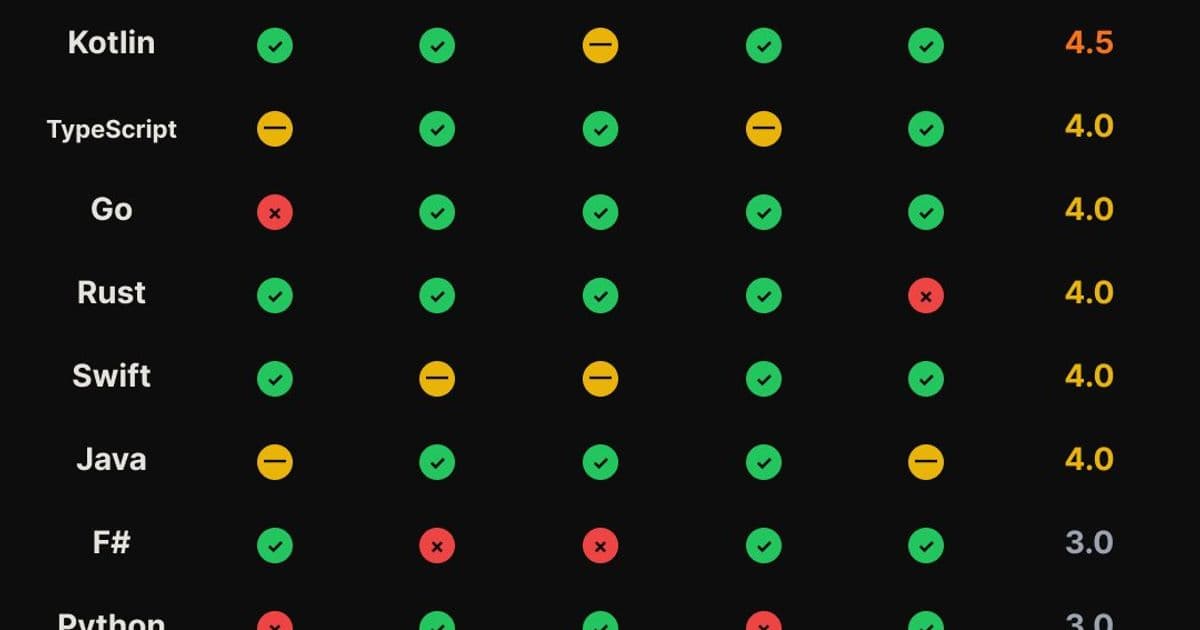
The author's experience with F#, TypeScript, and C# represents the common compromise developers make when selecting tools for production work. Each language presents significant advantages yet lacks certain critical features that would make it truly exceptional. F# offers powerful type systems but suffers from limited ecosystem support and syntax minimalism that can impede readability. TypeScript provides unparalleled ecosystem ubiquity yet struggles with type system inconsistencies and constant evolution. C# presents a solid object-oriented foundation but requires extensive boilerplate and lacks modern features like native union types and exhaustive pattern matching.
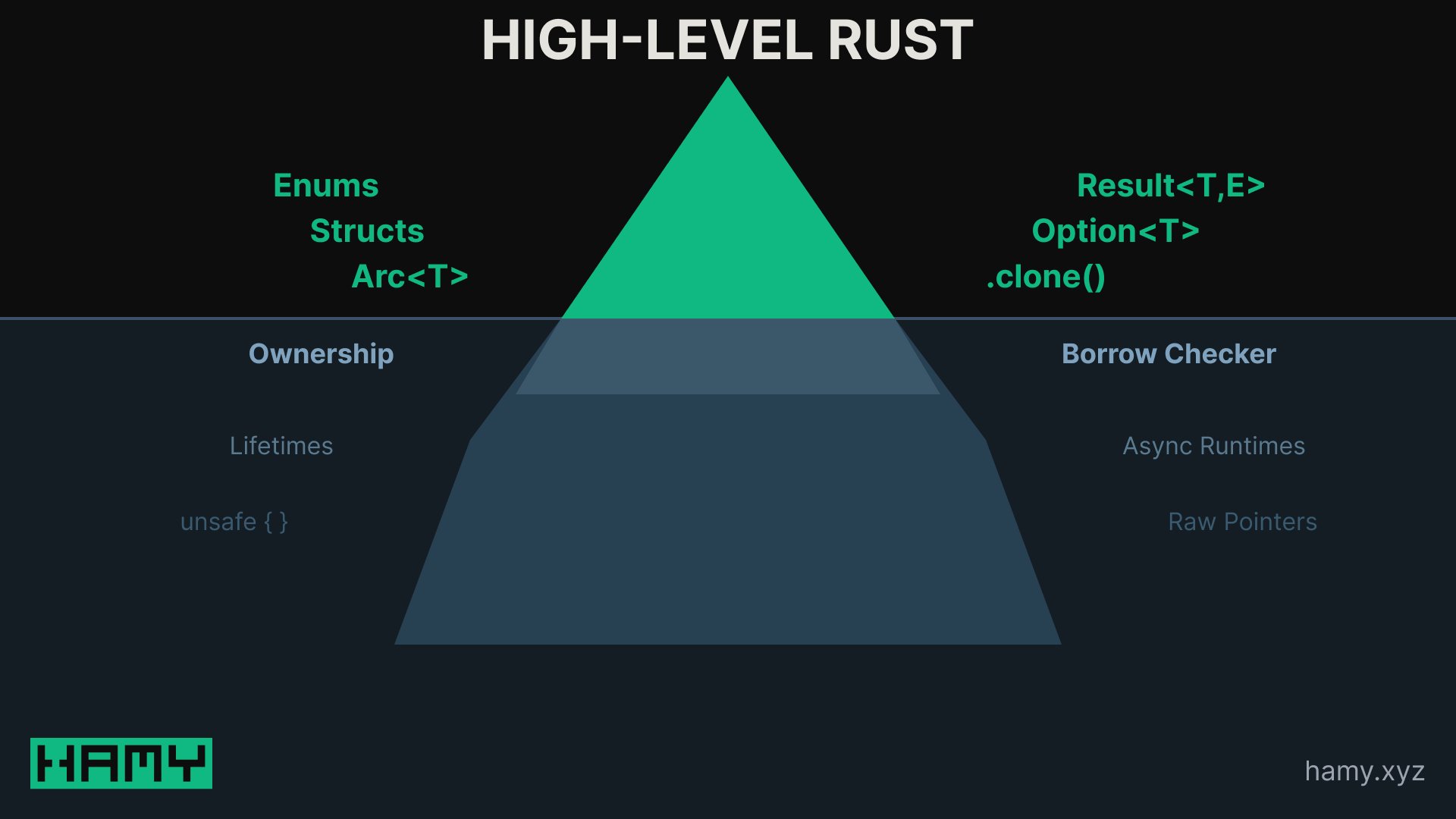
This language selection dilemma becomes particularly relevant when considering Rust, which the author identifies as "perfect, except for the productivity." The traditional barriers to entry—ownership, borrowing, lifetimes, and async runtime complexities—have historically deterred developers who don't work at the systems level from adopting Rust despite its compelling type system and performance characteristics.
The High-Level Rust Manifesto
The central thesis proposes a paradigm shift in Rust usage: treating it not as a systems language requiring meticulous memory management, but as a high-level language that happens to offer exceptional performance when needed. This approach strategically embraces certain limitations to achieve a more favorable developer experience while retaining most of Rust's core benefits.
The methodology consists of three pillars:
Type-first domain modeling: Leveraging Rust's enum and struct capabilities to create domain models where invalid states become unrepresentable. This approach aligns with the principle that "what cannot be represented cannot occur," leading to more robust applications through compile-time guarantees.
Functionalish logic: Emphasizing immutability by default, pure functions, and strategic cloning rather than mutation. This approach works with Rust's type system rather than against it, accepting performance trade-offs for developer experience gains.
Domain-driven design: Encapsulating business logic within services exposed through trait interfaces, utilizing
Arc<dyn TRAIT>for shared references. This pattern facilitates dependency injection, testability, and code organization while maintaining type safety.
Performance Trade-offs and Practical Considerations
The approach explicitly accepts a 10-30% performance penalty in exchange for improved developer velocity, which represents a calculated trade-off for most applications. This performance differential becomes particularly significant when compared to Rust's baseline performance, which already exceeds most other high-level languages.
However, the author astutely identifies a critical caveat: cloning in Rust differs fundamentally from garbage-collected languages. The absence of automatic memory management means that careless cloning can lead to substantial performance degradation, potentially making Rust applications slower than those written in languages with more sophisticated memory management. This realization has motivated the development of LightClone, a proposed package to enforce "cheap clones" and prevent performance pitfalls.
Applicability and Limitations
The high-level Rust approach demonstrates particular value in specific contexts:
- Web APIs and CRUD services where correctness outweighs raw performance
- Business logic-heavy applications with complex domain requirements
- Projects where type safety provides significant value
- Teams transitioning from functional programming paradigms
Conversely, this approach proves less suitable for:
- Performance-critical hot paths where every nanosecond matters
- Game engines requiring maximum throughput
- Complex concurrent systems with shared mutable state
- Situations where the full power of Rust's ownership system could provide critical safety guarantees
Broader Implications for Language Evolution
This exploration reflects a significant trend in programming language adoption: the increasing importance of developer experience and type safety alongside traditional performance metrics. As AI-assisted coding tools become more sophisticated, the cognitive load associated with complex type systems and memory management decreases, making languages like Rust more accessible.
The proposal also highlights an interesting philosophical question about language design: should languages be used strictly as intended, or can we adapt our approaches to leverage specific aspects of a language while mitigating its complexities? The high-level Rust approach suggests that pragmatic adaptation may yield better outcomes than strict adherence to language orthodoxy.
Counter-Perspectives and Community Reaction
Experienced Rust developers might view this approach as unnecessarily restrictive, failing to leverage Rust's most powerful features. The ownership system, borrowing checker, and explicit memory management represent not merely obstacles but fundamental design choices that enable Rust's unique safety guarantees. By avoiding these elements, developers might miss opportunities to build truly high-performance, reliable systems.
Furthermore, the functional programming emphasis with its reliance on cloning contradicts Rust's core philosophy of zero-cost abstractions. The language was designed to provide high-level expressiveness without performance penalties, and this approach reintroduces precisely those penalties it seeks to avoid in other languages.
Future Directions and Open Questions
The author's journey with high-level Rust remains in its early stages, with active exploration through various projects including web services, games, and CLI applications. Several questions remain open:
- How can the type system be extended to distinguish between cheap and expensive clones?
- What patterns emerge when applying this approach to larger, more complex codebases?
- How does this methodology compare to similar approaches in other languages?
- Can tooling be developed to automatically identify and optimize performance-critical sections that would benefit from mutation rather than cloning?
The development of LightClone represents an important step toward addressing some of these challenges, potentially creating a middle ground between functional purity and practical performance considerations.
Conclusion: A Pragmatic Path Forward
The high-level Rust approach offers a compelling compromise for developers seeking the benefits of Rust's type system and performance without committing to its full complexity. By strategically embracing certain limitations and accepting measured performance trade-offs, this methodology makes Rust accessible to a broader range of developers and application domains.
As programming continues to evolve, we may see more such pragmatic approaches that leverage specific language strengths while mitigating their complexities. The perfect programming language may remain elusive, but methodologies like high-level Rust demonstrate that we can often get closer to our ideal development experience through thoughtful adaptation rather than strict adherence to language orthodoxy.
For those interested in exploring this approach further, the author's work on LightClone and related projects provides concrete starting points. The GitHub repository for LightClone promises compile-time safety for cheap clones, potentially addressing one of the most significant performance concerns in functional-style Rust code.
Ultimately, the high-level Rust approach represents not merely a programming technique but a philosophy—one that prioritizes practical outcomes over theoretical purity while still respecting the fundamental strengths that make Rust such an compelling language in the first place.
Comments
Please log in or register to join the discussion