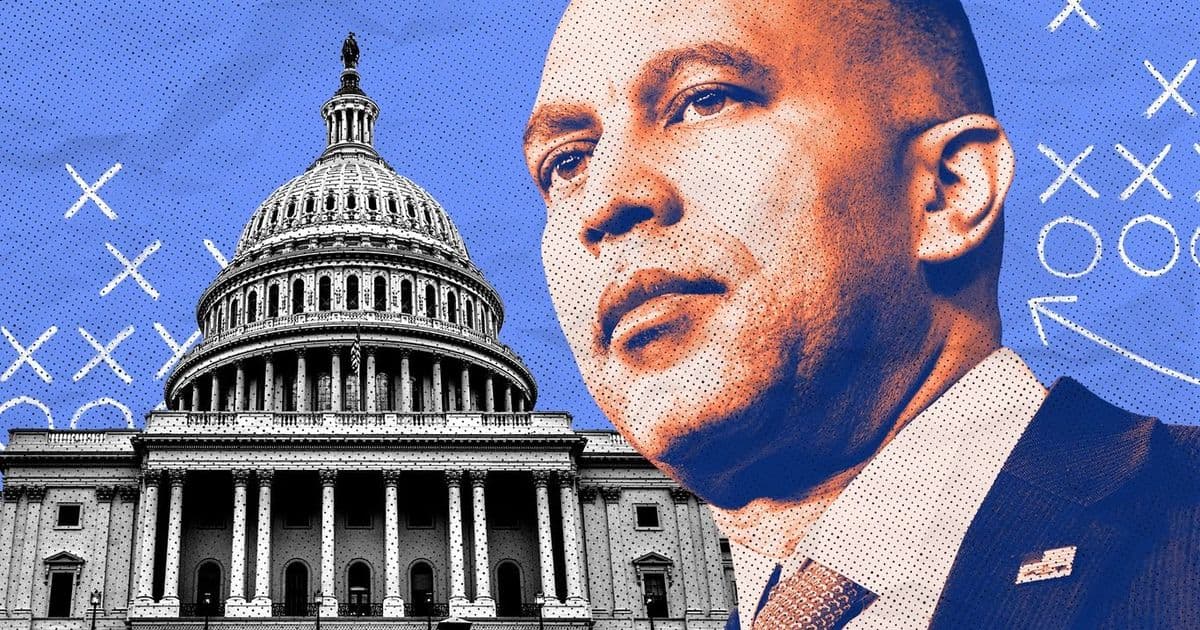
House Minority Leader Hakeem Jeffries has come out against a bipartisan funding bill that would provide resources for the Department of Homeland Security (DHS) and Immigration and Customs Enforcement (ICE), setting up a potential clash with Republican leadership and complicating the path to a government funding deal.
House Minority Leader Hakeem Jeffries has publicly opposed a bipartisan funding bill that would provide resources for the Department of Homeland Security (DHS) and Immigration and Customs Enforcement (ICE). The move, confirmed in a statement released Thursday, signals a significant hurdle in the ongoing negotiations to avoid a government shutdown and underscores the deep divisions within Congress over immigration policy and border security spending.
The bill in question is part of a larger package of appropriations measures needed to fund federal agencies through the remainder of the fiscal year. The DHS and ICE portions of the legislation have been a point of contention for months, with Republicans pushing for increased funding for border enforcement and Democrats seeking more resources for asylum processing and humanitarian aid. Jeffries' opposition, as the top Democrat in the House, indicates that the Democratic caucus is unlikely to support the bill in its current form, which could force Republican leaders to either make concessions or risk a shutdown by failing to secure enough votes.
The funding bill for DHS and ICE is particularly contentious because it directly addresses the ongoing crisis at the U.S.-Mexico border. Republicans have argued that the current levels of funding are insufficient to manage the influx of migrants, citing the need for more border patrol agents, detention facilities, and technology for surveillance. Democrats, including Jeffries, have countered that the bill's provisions would lead to a more militarized and punitive approach to immigration enforcement, potentially exacerbating humanitarian concerns and failing to address the root causes of migration. Jeffries' statement emphasized that the bill "fails to provide the necessary resources for humane and orderly immigration processing" and instead "prioritizes enforcement over solutions."
The implications of this opposition are multifaceted. First, it complicates the legislative calendar. Congress is operating under a series of continuing resolutions (CRs) that extend funding at current levels, but these are temporary fixes. A long-term appropriations package is needed to provide stability for federal agencies. With Jeffries' opposition, the path to passing the DHS and ICE funding bill becomes narrower, potentially requiring further negotiations or a separate vote on the components. This could delay the overall funding process and increase the risk of a shutdown if deadlines are missed.
Second, the standoff highlights the broader political dynamics ahead of the 2024 election. Immigration remains a top issue for voters, and both parties are positioning themselves to appeal to their bases. For Republicans, supporting increased funding for DHS and ICE is a way to demonstrate a tough stance on border security. For Democrats, opposing such funding allows them to align with progressive groups and voters who are concerned about immigration enforcement practices. Jeffries' move may be aimed at rallying Democratic support and signaling that the party will not compromise on what it views as core principles.
Third, the debate over DHS and ICE funding touches on larger questions about federal spending priorities. The Department of Homeland Security oversees a wide range of functions, including cybersecurity, disaster response, and aviation security. ICE, a component of DHS, is primarily responsible for immigration enforcement. Critics of the current bill argue that it overemphasizes enforcement at the expense of other critical DHS missions, such as cybersecurity threats or disaster preparedness. Proponents, however, maintain that border security is a fundamental responsibility of the federal government and that adequate funding is essential for national security.
In practical terms, the bill's passage would have direct effects on operations at the border and within immigration agencies. Additional funding could lead to an increase in the number of border patrol agents, the expansion of detention facilities, and the deployment of new surveillance technologies. Conversely, if the bill is blocked or significantly altered, it could result in resource constraints that affect how DHS and ICE manage their daily operations. For example, without increased funding, agencies might struggle to process asylum claims efficiently, leading to longer wait times and more individuals in limbo.
The opposition from Jeffries also raises questions about the future of bipartisan cooperation on immigration. In recent years, bipartisan efforts to reform immigration laws have repeatedly failed, and the current funding debate is another example of the partisan divide. If Democrats and Republicans cannot find common ground on funding for DHS and ICE, it may signal that broader immigration reforms are even more unlikely in the near term. This could have long-term consequences for the stability of the immigration system and the treatment of migrants.
As the situation develops, all eyes will be on the House and Senate leadership to see how they navigate this impasse. Will Republicans attempt to pass the bill with only Republican votes, risking a veto or a shutdown? Or will they seek to modify the bill to gain Democratic support? The answers to these questions will shape not only the immediate funding outcome but also the political landscape for the remainder of the year. For now, Jeffries' opposition stands as a clear statement of Democratic priorities and a challenge to the current legislative approach.
Comments
Please log in or register to join the discussion