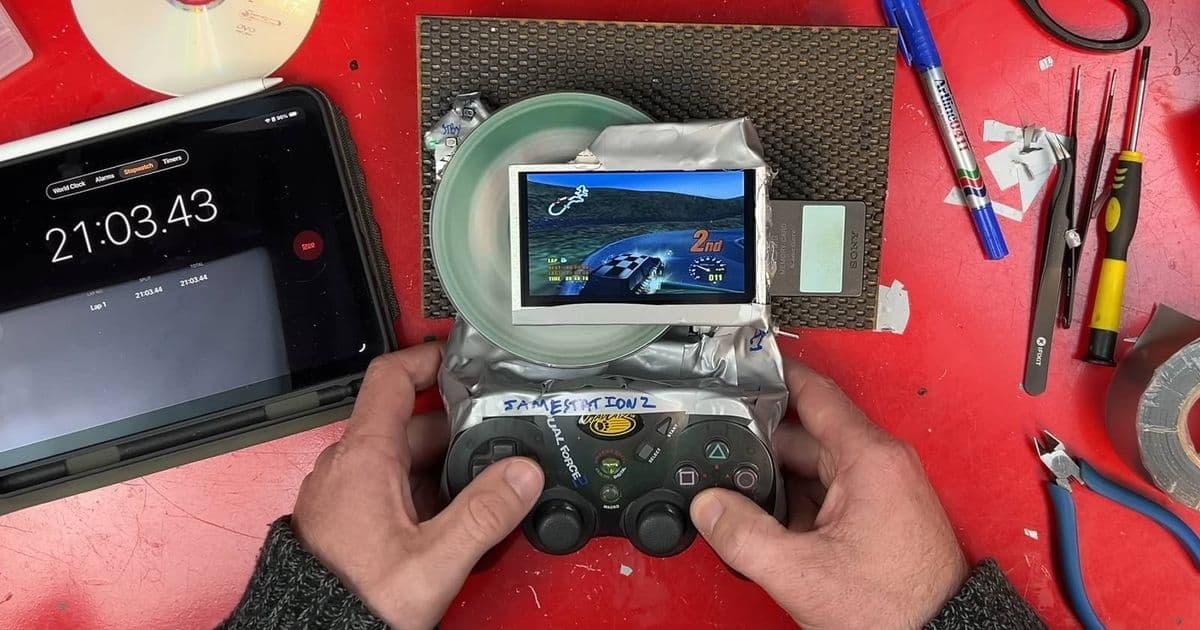
Modder James Channel has turned a PlayStation 2 Slim into a duct‑taped handheld, complete with a MadCatz controller, LCD screen and an exposed, spinning optical disc that looks like a tiny buzz‑saw. Powered by a 10,000 mAh battery, the contraption can run for about five hours—outlasting the Steam Deck and the upcoming Switch 2—while still managing to read discs thanks to custom EEPROM tweaks and cloned Sony calibration tools.
A DIY handheld that looks like it belongs in a sci‑fi workshop
Video‑game modder James Channel has taken the PlayStation 2 Slim’s motherboard, slapped a MadCatz controller onto it, added a small LCD panel and, for the love of all things retro, left the optical disc drive exposed. The result is the JameStation 2, a handheld that spins its disc like a miniature buzz‑saw while you game.
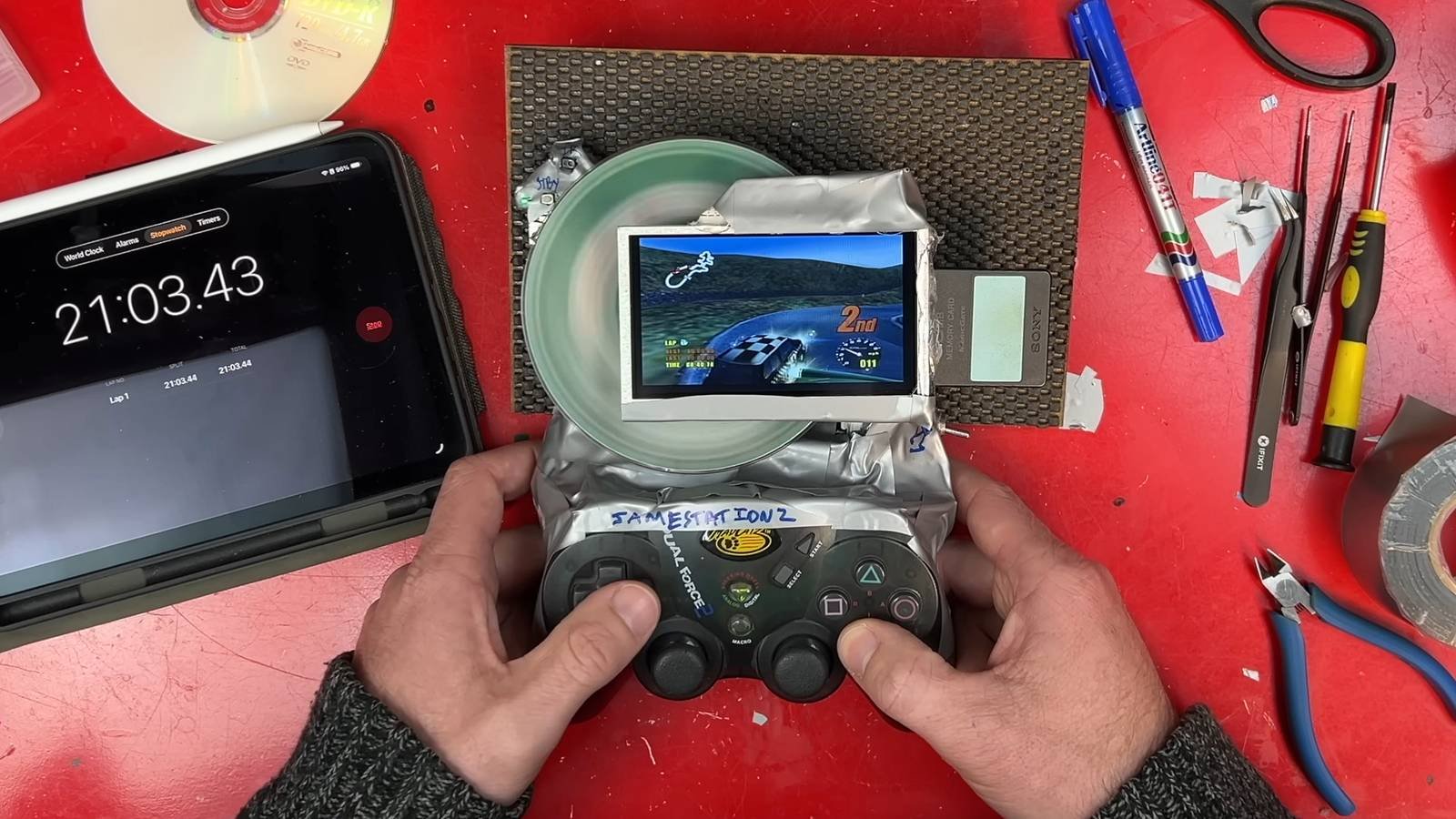
The entire assembly is held together with what appears to be a full roll of duct‑tape, even covering the display. While the tape isn’t a great heat‑sink, Channel reports that the device’s passive cooling is “not that bad,” though it does get warm during extended play sessions.
How it actually works
Core hardware
- Motherboard – The stock PS2 Slim board, which already contains the Emotion Engine CPU, Graphics Synthesizer and the original DVD‑ROM controller.
- Disc drive – Instead of being hidden behind a plastic shell, the drive’s spindle motor is left uncovered. It spins at the same 2,400 RPM as the original console, which is fast enough to read discs but slow enough that the exposed platter isn’t a safety hazard.
- Controller – A MadCatz GamePad (model not specified) is wired directly to the console’s controller ports, giving the handheld a familiar button layout.
- Display – A 5‑inch LCD panel, sourced from a generic Android tablet, is mounted on the front and connected to the PS2’s video output via a custom HDMI‑to‑component adapter.
- Power – A 10,000 mAh lithium‑ion power bank supplies 5 V to the console through a step‑down regulator, delivering roughly five hours of gameplay on a full charge.
Software tricks
The PS2’s optical drive relies on calibration data stored in an EEPROM. Channel used a cloned Sony calibration tool to rewrite the EEPROM, allowing the drive to operate without the original console’s firmware constraints. This tweak is essential because the handheld’s power supply and timing differ from a standard PS2 Slim.
Battery life that surprises
At first glance, a handheld built from a 2004 console and a roll of tape wouldn’t seem like a battery‑saving machine. Yet the JameStation 2’s 10,000 mAh pack provides about five hours of continuous play. For comparison:
- Steam Deck – roughly 2.5‑3 hours on a 40 Wh battery.
- Nintendo Switch 2 (rumored specs) – around 3‑4 hours on a 46 Wh pack.
The longer runtime comes from the PS2’s relatively low power draw (≈25 W) and the fact that the device runs games directly from disc without the overhead of an operating system or emulation layer.
Ecosystem lock‑in and practical considerations
While the JameStation 2 is a fascinating proof‑of‑concept, it highlights the challenges of repurposing legacy hardware:
- Software compatibility – The handheld can only run games that the original PS2 Slim supports. No homebrew, no modern patches, and no ability to run games from a micro‑SD card without additional hardware.
- Portability trade‑offs – The exposed disc drive adds bulk and a potential point of failure. The duct‑tape construction, while visually striking, is not suited for daily transport.
- Thermal management – Passive cooling works for short sessions, but extended play can push the internal temperature above safe limits, risking component degradation.
- Ecosystem lock‑in – Because the device relies on Sony’s proprietary disc format and calibration data, it cannot be easily adapted to other consoles or emulation platforms without significant engineering effort.
For enthusiasts who love the tactile feel of a physical disc and want a nostalgic handheld experience, the JameStation 2 delivers a unique, if somewhat impractical, slice of retro gaming.
Why it matters for the modding community
The project shows that hardware hacking still has room for creativity beyond software emulation. By exposing the disc drive, Channel turned a functional component into a visual centerpiece, reminding us that the physicality of older consoles can be as compelling as the games they run.
Moreover, the successful EEPROM rewrite demonstrates that even closed‑source calibration data can be reverse‑engineered with the right tools, opening doors for future mods that require low‑level hardware tweaks.
Final thoughts
The JameStation 2 isn’t a product you’d buy off a shelf, but it’s a compelling showcase of what can be achieved with a bit of soldering, a roll of duct‑tape, and a willingness to experiment. It may not replace the Steam Deck or Switch 2 for everyday portable gaming, but it offers a conversation‑starter for anyone who loves the quirks of retro hardware.
If you’re curious to see the build in action, check out James Channel’s full walkthrough video on his YouTube channel.
Comments
Please log in or register to join the discussion