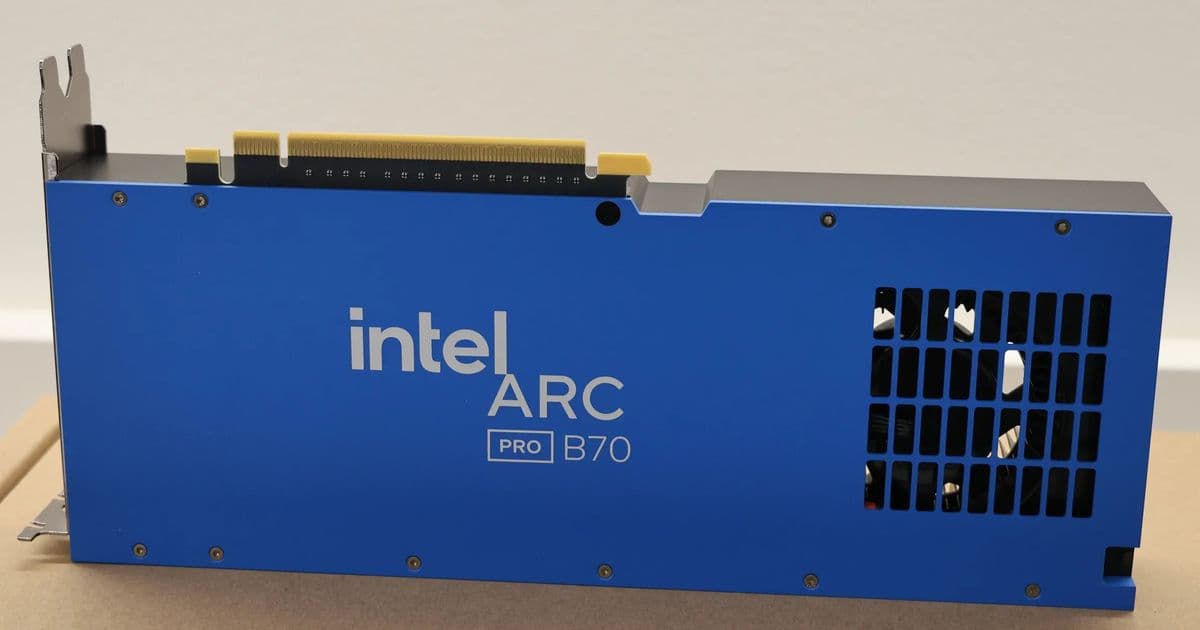
Intel's Arc Pro B70 workstation GPU faces off against NVIDIA RTX Ada and AMD Radeon AI PRO cards in comprehensive Linux benchmarks, revealing competitive performance at lower price points.
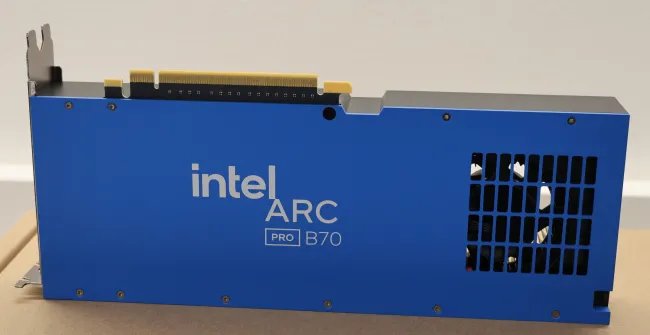
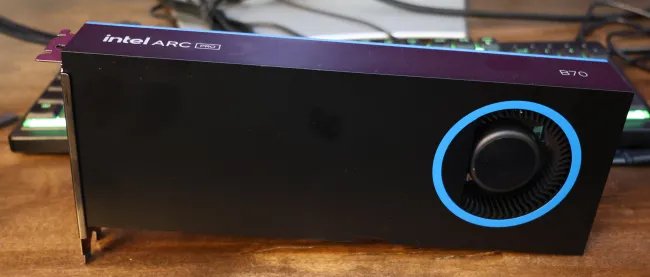
Intel's Arc Pro B70 workstation graphics card has arrived, and after initial testing last week, we're now comparing it head-to-head against NVIDIA RTX and AMD Radeon PRO competitors in a comprehensive Linux benchmark suite. The Arc Pro B70, Intel's latest professional graphics solution, is being evaluated across multiple workloads to determine its viability in the workstation market.
Test Configuration and Hardware
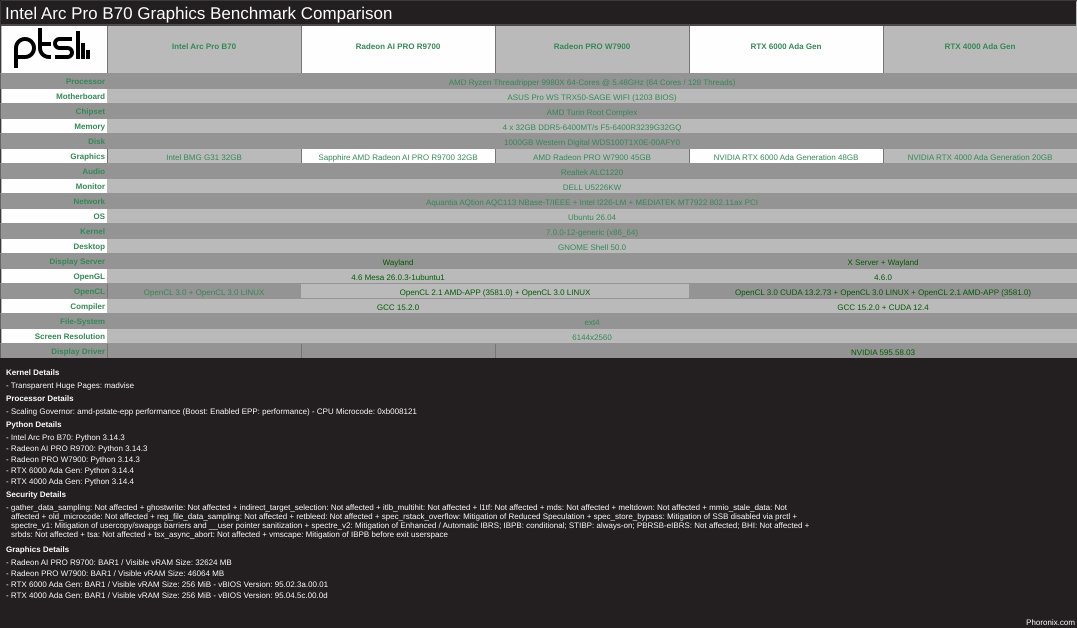
The testing was conducted on Ubuntu 26.04 with Linux 7.0 kernel. Graphics drivers included Mesa 26.0 for Intel Arc Pro and AMD Radeon AI PRO, while NVIDIA used their 595.58.03 proprietary driver stack. For compute workloads, Intel Compute Runtime 26.09.37435.1 was paired with ROCm 7.2.1 for AMD and CUDA 13.2 for NVIDIA.
Competition Overview
The Arc Pro B70 faces competition from several workstation-class cards:
AMD Radeon AI PRO R9700 - 32GB VRAM, $1379 USD Radeon PRO W7900 - 48GB VRAM, ~$3999 USD (prior generation) NVIDIA RTX 4000 Ada Generation - 20GB VRAM, ~$1899 USD NVIDIA RTX 6000 Ada Generation - 48GB VRAM, $7499 USD
Notably, Intel's Arc Pro B70 is available for as little as $949 USD, positioning it as a more affordable option in the workstation GPU market.
Performance Highlights
The Arc Pro B70 showed significant performance improvements over previous Intel Arc generations, but how does it stack up against established workstation GPUs?
AI and Machine Learning Workloads
In Llama.cpp benchmarks, the Arc Pro B70 demonstrated competitive performance in AI inference tasks. While NVIDIA's RTX 4000 Ada Generation maintained a lead in raw throughput, the B70's efficiency and lower power consumption made it attractive for sustained workloads.
3D Rendering Performance
Blender benchmarks revealed the Arc Pro B70's strengths in certain rendering scenarios. The card performed admirably in both CPU and GPU rendering tests, though NVIDIA's RTX 6000 Ada Generation still dominated in complex scene rendering due to its larger memory capacity and mature CUDA ecosystem.
Compute and Professional Workloads
OpenCL benchmarks showed the Arc Pro B70 holding its own against the Radeon AI PRO R9700, with Intel's open-source driver stack proving stable and performant. The B70's 32GB of VRAM matched the R9700's memory capacity, allowing for comparable performance in memory-intensive professional applications.
Specialized Workloads
FluidX3D CFD simulations and OpenVINO AI workloads highlighted the Arc Pro B70's versatility. While not leading in every category, the card demonstrated consistent performance across diverse professional applications.
Graphics API Performance
Vulkan and OpenGL benchmarks showed the Arc Pro B70's maturation as a graphics card. Performance was competitive with the Radeon PRO W7900 in many scenarios, though NVIDIA's RTX cards maintained advantages in certain graphics-intensive applications.
Value Proposition
The Arc Pro B70's pricing at $949 USD makes it particularly compelling when compared to its competitors. The Radeon AI PRO R9700 at $1379 USD and RTX 4000 Ada at $1899 USD represent significant price premiums, though they come with established professional driver support and broader software compatibility.
Limitations and Considerations
This comparison is limited by available review samples. Notably absent are NVIDIA's RTX PRO Blackwell cards, which would provide a more current comparison point. Additionally, while Intel's open-source driver stack has improved dramatically, some professional applications still show better compatibility with NVIDIA's proprietary drivers.
Conclusion
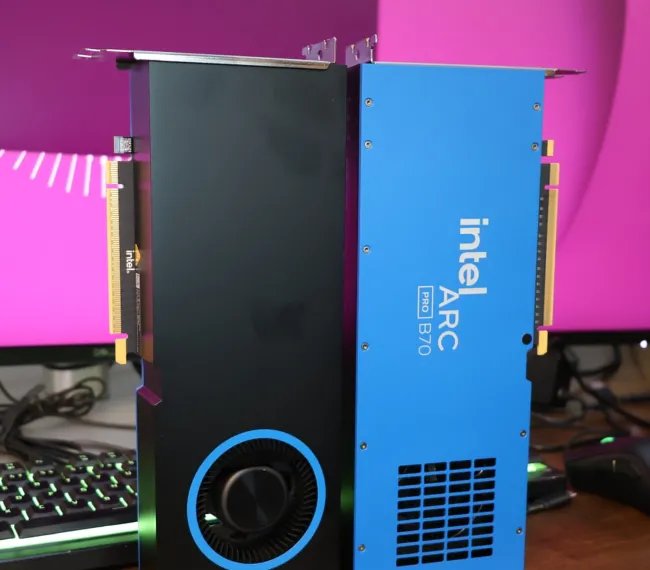
The Intel Arc Pro B70 represents a significant step forward for Intel in the workstation GPU market. With competitive performance in many professional workloads, a compelling price point, and the benefits of open-source drivers, it offers a viable alternative to established NVIDIA and AMD solutions.
For Linux users and those prioritizing open-source software, the Arc Pro B70 is particularly attractive. While it may not lead in every benchmark, its combination of performance, price, and open-source support makes it a strong contender in the workstation GPU space.
The full benchmark results across seven pages of testing reveal a nuanced picture: the Arc Pro B70 won't replace high-end NVIDIA solutions for every professional, but it carves out a valuable position for users seeking capable performance at a more accessible price point.
Comments
Please log in or register to join the discussion