Intel is winding down BigDL, which matters less as a single repository shutdown and more as another data point in Intel’s shrinking open-source AI stack for CPUs, Arc GPUs, Xeon boxes, and lab-scale LLM rigs.
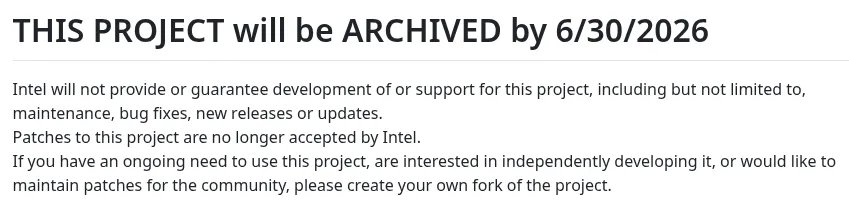
Intel is preparing to end development of BigDL, its open-source AI and data analytics framework that tried to make Intel hardware useful from a Core Ultra laptop up through Xeon, Arc, Flex, Max, Spark clusters, and secured SGX or TDX environments. According to the Phoronix report, the repository was briefly marked as archived, then updated to indicate that archival is scheduled for June 30, 2026.
That date matters. If you have BigDL in a reproducible lab build, CI image, Spark pipeline, or LLM test harness, the clock is not theoretical. After June 30, the code may remain visible, but the practical maintenance model changes from vendor-supported open source to frozen dependency archaeology.
{{IMAGE:2}}
Product: What BigDL Was Supposed To Be
BigDL was never just one narrow inference library. The official BigDL documentation describes a stack with several pieces:
| BigDL component | Main job | Hardware angle |
|---|---|---|
| LLM, later moved toward IPEX-LLM | Local LLM inference and tuning | Intel CPU, Intel GPU, Intel NPU paths |
| Orca | Distributed TensorFlow and PyTorch pipelines | Spark, Ray, Kubernetes, YARN |
| Nano | Framework acceleration for TensorFlow and PyTorch | CPU and GPU optimization paths |
| DLlib | Deep learning on Spark-style APIs | Cluster workloads |
| Chronos | Time-series AutoML | Scaled analytics workloads |
| Friesian | Recommendation systems | Data-heavy serving and training |
| PPML | Privacy-preserving big data and AI | Intel SGX and TDX |
That breadth was both useful and expensive. BigDL sat at the awkward intersection of Python packaging, JVM/Spark infrastructure, Intel runtime stacks, PyTorch, TensorFlow, OpenVINO, quantization, and XPU support. In a homelab, that means one dependency can touch your base OS, kernel driver, Python version, GPU runtime, Java stack, and container image all at once.
The shutdown is surprising because BigDL’s LLM branch was aimed at exactly the kind of hardware story Intel still needs: local inference across CPUs, integrated GPUs, Arc cards, and data-center accelerators. The BigDL docs say bigdl-llm moved to IPEX-LLM, but IPEX-LLM itself had already become a separate project and, per the Phoronix report, was archived earlier in 2026. That leaves Intel users with a messy decision tree: keep old BigDL or IPEX-LLM environments frozen, move to lower-level Intel extension stacks, or abandon Intel-specific LLM acceleration paths for broader tools like llama.cpp, Ollama, vLLM, PyTorch, or OpenVINO.
Performance Data: Why This Project Had Users
BigDL existed because raw framework support was often not enough to get good Intel hardware utilization. Anyone who has watched a Xeon server pull 180 W while Python feeds one sad CPU thread knows the pain. The value proposition was automation: take a familiar model or data pipeline, then apply Intel-tuned execution, quantization, distributed scheduling, or hardware security pieces without rewriting the whole stack.
Project-published numbers show why that was attractive.
| Source area | Reference result | What it means in practice |
|---|---|---|
| BigDL 2.0 paper | Up to 9.6x speedup in reported experiments | BigDL’s best case was not small cleanup. It could change whether a workload fit in a lab maintenance window. |
| BigDL Nano example in docs | ResNet18-style inference example drops from 45.145 ms original to 5.846 ms with OpenVINO INT8 | That is a 7.72x latency reduction in the shown example, with an accuracy trade-off from 0.975 to 0.962. |
| BigDL Nano BF16/JIT example | 45.145 ms original to 9.782 ms JIT BF16 channels-last | Roughly 4.62x faster in the docs example, while keeping the displayed metric at 0.975. |
| BigDL-LLM docs | Self-speculative decoding described as about 30 percent faster for FP16 or BF16 latency on Intel GPU or CPU | Useful for interactive inference where token latency matters more than maximum batch throughput. |
| BigDL-LLM docs | INT2 path claimed large models such as Mixtral-8x7B could fit on 16 GB Intel GPU memory | Memory footprint, not raw TOPS, is often the first blocker on Arc-class cards. |
For a benchmark-obsessed builder, the Nano latency table is the kind of data that matters because it exposes the real trade: performance is not free. INT8 was the fastest entry in the example, but it also showed lower metric value. BF16 and JIT paths were slower than the INT8 OpenVINO path, but they preserved the displayed metric. That is exactly how hardware tuning usually lands in the real rack: there is no single “fast” switch, there is a matrix of latency, accuracy, power, compatibility, and operational pain.
A simple efficiency view makes the impact clearer:
| Optimization path from docs example | Latency | Relative speed vs original | Accuracy or metric shown |
|---|---|---|---|
| Original | 45.145 ms | 1.00x | 0.975 |
| BF16 | 27.549 ms | 1.64x | 0.975 |
| JIT FP32 channels-last | 19.247 ms | 2.35x | 0.975 assumed |
| JIT BF16 channels-last | 9.782 ms | 4.62x | 0.975 |
| OpenVINO INT8 | 5.846 ms | 7.72x | 0.962 |
| ONNX Runtime INT8 qlinear | 7.123 ms | 6.34x | 0.981 |
That table is also a reminder that vendor stacks are not just about peak benchmark screenshots. They bundle a bunch of annoying work: graph conversion, memory layout, quantization format selection, CPU vector paths, GPU runtime selection, and sometimes model-specific fixes. Losing maintenance means those pieces stop tracking upstream PyTorch, TensorFlow, Spark, Python, driver, and OS changes.
Power Consumption: The Hidden Cost Of Frozen AI Software
BigDL going EOL does not directly change your wall power tomorrow. Your Arc A770, Core Ultra laptop, or Xeon workstation will draw the same watts under the same binary. The power risk is indirect, but very real.
AI efficiency is usually measured as tokens per second per watt, images per joule, or jobs completed per kilowatt-hour. If an old framework pins you to an old runtime, you may miss newer kernels, lower-overhead schedulers, better batching, improved quantization, and driver fixes. That can turn into higher idle time, lower accelerator occupancy, and more CPU babysitting.
For homelab accounting, I would split the power impact into three buckets:
| Risk bucket | What changes after EOL | How to measure it |
|---|---|---|
| Idle and service overhead | Old services, Python workers, Spark jobs, or containers may stay resident even when the useful workload is done | Measure idle watts at the wall before and after removing BigDL services |
| Accelerator utilization | Frozen kernels may underuse Arc, Flex, Max, or iGPU resources compared with newer runtimes | Compare GPU busy percent, VRAM use, tokens per second, and package power |
| Job completion energy | A slower but compatible path may burn more total watt-hours than a faster replacement | Log wall watts and total runtime for the same prompt set or inference batch |
For Linux boxes, I would log wall power with a smart PDU or plug meter, then correlate with intel_gpu_top, powertop, RAPL counters, and application throughput. On Windows Arc rigs, use Intel’s tooling plus wall measurements, because software-reported package power rarely tells the whole story. If the replacement path is OpenVINO or llama.cpp, run the same quantized model, same context length, same prompt batch, and same driver version. Otherwise the numbers are noise with a spreadsheet skin.
Compatibility: The Real Breakage Zone
The biggest practical issue is not that BigDL disappears. The issue is that BigDL sat between fast-moving projects. Python, PyTorch, TensorFlow, Spark, Java, CUDA-adjacent assumptions in ML packages, Intel GPU drivers, oneAPI pieces, and Linux distributions all move. A project can be perfectly usable on the day it is archived and still become painful six months later.
The compatibility pressure points are predictable:
| Layer | Likely problem | Builder response |
|---|---|---|
| Python | Old wheels may not support newer Python releases | Freeze Python 3.10 or 3.11 environments where BigDL already works |
| PyTorch and TensorFlow | API and binary ABI drift | Pin framework versions and export working containers |
| Intel GPU stack | Driver and runtime updates may break old assumptions | Keep a known-good driver image or document rollback steps |
| Spark and Java | Cluster jobs are sensitive to version skew | Save full Spark, Scala, Java, and BigDL version tuples |
| Security | Archived code may stop receiving fixes | Avoid exposing BigDL services directly to untrusted networks |
| LLM tooling | IPEX-LLM and BigDL-LLM paths may lag current models | Prefer active backends for new deployments |
This is especially relevant for PPML users. BigDL’s privacy-preserving path referenced SGX and TDX, which are not casual weekend features. They involve firmware, BIOS toggles, kernel support, attestation flows, and threat models. If that stack is in production, BigDL EOL is a migration planning event, not a “check later” bookmark.
Build Recommendations: What I Would Do In The Lab
For existing BigDL users, the first rule is to snapshot working systems before the archive date. That means container images, wheel caches, conda environment exports, Dockerfiles, benchmark scripts, model hashes, driver versions, and BIOS settings. Treat it like preserving a known-good firmware image before flashing a server board.
| Current BigDL use | Recommendation | Replacement candidates |
|---|---|---|
| LLM inference on Intel GPU | Do not start new work on BigDL-LLM | llama.cpp, Ollama, OpenVINO, active PyTorch XPU paths |
| Spark-based deep learning | Freeze current jobs, then test migration separately | Native Spark ML, Ray, PyTorch distributed, vendor-neutral pipelines |
| TensorFlow or PyTorch acceleration | Re-benchmark without BigDL Nano | OpenVINO, ONNX Runtime, Intel Extension for PyTorch where maintained |
| SGX or TDX big-data workflows | Start a formal risk review | Intel TDX and SGX docs, cloud confidential computing stacks, maintained security frameworks |
| Recommendation or time-series pipelines | Separate model logic from BigDL wrappers | Standard PyTorch, TensorFlow, scikit-learn, Spark, Ray, domain-specific libraries |
For new builds, I would avoid adding BigDL unless you are reproducing an existing result. The archive date makes it a poor foundation for fresh infrastructure. A homelab can tolerate weirdness, but it should not voluntarily add a dead dependency to the core image unless the benchmark win is huge and documented.
My migration checklist would look like this:
| Step | Pass condition |
|---|---|
| Export the current environment | pip freeze, conda export, Docker image digest, driver versions, kernel version, firmware notes |
| Re-run baseline benchmarks | Same model, same batch size, same context, same dataset, same power meter |
| Test one replacement at a time | No mixed upgrades while comparing performance |
| Track watts and latency together | Tokens per second alone is not enough |
| Validate accuracy | Quantized paths need perplexity, task score, or application-specific checks |
| Keep rollback media | A working old image beats a half-remembered install guide |
For LLM work on Intel Arc or Core Ultra systems, the practical replacement path depends on what you measure. If your priority is local chat and model variety, llama.cpp or Ollama will usually be easier to keep current. If your priority is Intel-tuned deployment and model conversion, OpenVINO deserves a serious test. If you need PyTorch-native experimentation, watch Intel’s active PyTorch XPU support and avoid building around archived glue code.
For server builders, the main question is whether BigDL was doing something you actually needed or whether it was just present in an old image. If it was only installed because a tutorial said so, remove it and benchmark the simpler stack. If it was delivering a measured 2x, 4x, or 7x improvement, preserve the working setup first, then plan a measured migration.
Bottom Line
BigDL’s end is not just another GitHub repository going quiet. It removes a high-level Intel AI path that connected laptops, Arc GPUs, Xeon servers, Spark clusters, quantization, and confidential computing under one project name. The code may remain useful for existing builds, but after June 30, 2026, the maintenance burden shifts to users.
For anyone running Intel hardware in a lab or small server room, the right response is measurement, not panic. Snapshot the working stack, record latency and wall power, then test replacements against the same workload. If BigDL was only a convenience layer, move on. If it was carrying your performance numbers, preserve it like any other critical but aging dependency and start benchmarking the exit path now.
Comments
Please log in or register to join the discussion