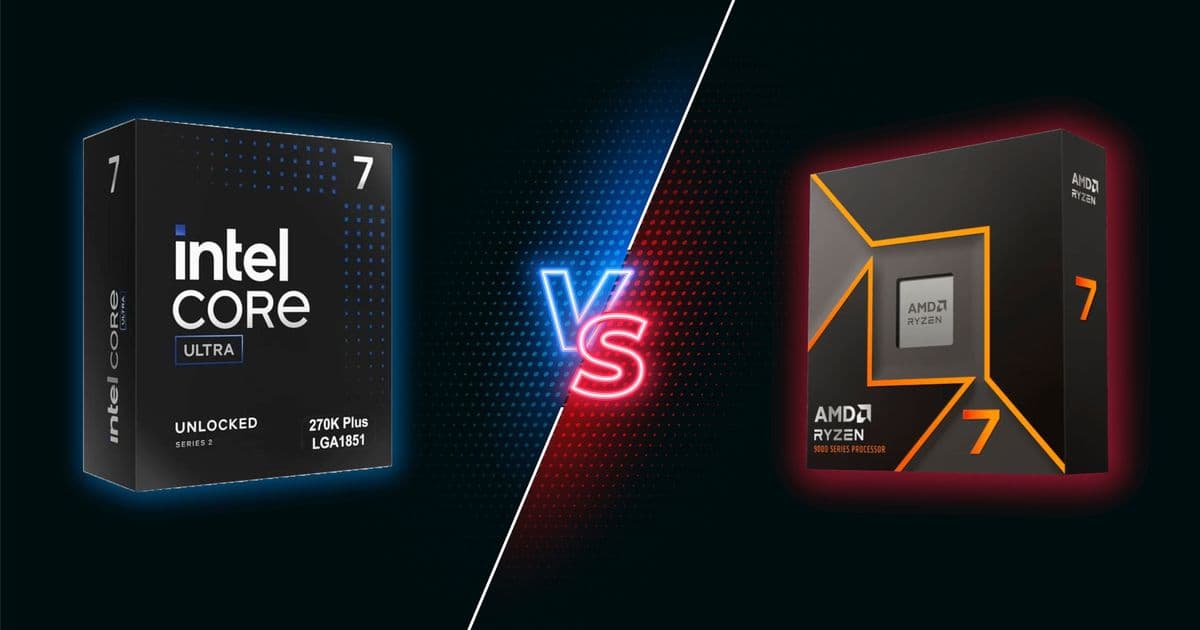
Intel's new Core Ultra 7 270K Plus delivers exceptional productivity performance at $300, dominating AMD's Ryzen 7 9700X in multithreaded workloads while maintaining competitive gaming capabilities despite higher power consumption.
Intel's Arrow Lake platform launched to disappointment, barely competing with its predecessor in gaming while AMD's X3D CPUs dominated the market. The Core Ultra 7 265K struggled to find its footing, but Intel has responded with the Core Ultra 7 270K Plus—a $300 CPU that's $100 cheaper than its predecessor's launch price while delivering significant performance gains across both gaming and productivity workloads.
This faceoff against AMD's Ryzen 7 9700X, which sits in the same $300-$350 price bracket, reveals whether Intel has successfully redeemed its Arrow Lake platform or if AMD still maintains its midrange supremacy.
Features and Specifications
Intel Core Ultra 7 270K Plus
- Architecture: Arrow Lake Refresh (3nm TSMC)
- Cores/Threads: 24/24 (8 P-cores + 16 E-cores)
- Base/Boost: 3.7 / 5.4 GHz (P-cores), 3.2 / 4.7 GHz (E-cores)
- Cache: 76MB total (40MB L2 + 36MB L3)
- Memory Support: DDR5-7200
- PCIe Lanes: 20 Gen 5
- TDP: 125W (up to 250W MTP)
- Socket: LGA 1851
AMD Ryzen 7 9700X
- Architecture: Zen 5 (4nm TSMC)
- Cores/Threads: 8/16
- Base/Boost: 3.8 / 5.5 GHz
- Cache: 40MB total (8MB L2 + 32MB L3)
- Memory Support: DDR5-5600
- PCIe Lanes: 24 Gen 5
- TDP: 65W (up to 105W extended)
- Socket: AM5
Intel's 24-core design with its P-core and E-core hybrid architecture provides massive multithreaded performance potential, while AMD's 8-core, 16-thread design relies on its proven chiplet architecture. The Core Ultra 7 270K Plus supports faster memory and has more cache, but AMD offers more PCIe lanes and significantly lower power consumption.
Winner: Intel Core Ultra 7 270K Plus
Intel dominates most specification categories, though AMD's advantages in PCIe lanes and efficiency are noteworthy.
Gaming Benchmarks
Testing at 1080p with an RTX 5090 to minimize GPU bottlenecks revealed an interesting dynamic between these two CPUs.
Overall Gaming Performance
- Core Ultra 7 270K Plus: 162.2 FPS average
- Ryzen 7 9700X: 157.4 FPS average
- Difference: 2.4% in favor of Intel
1% Low Performance
- Core Ultra 7 270K Plus: 6.1% better than Ryzen 7 9700X
The gaming results show these CPUs trading blows across different titles. The Core Ultra 7 270K Plus led in Cyberpunk 2077 (8% faster), Hitman 3 (13% lead), and Hogwarts Legacy (12.4% advantage). However, the Ryzen 7 9700X dominated in F1 2024 (13% lead) and Minecraft (33% advantage).
Both CPUs delivered essentially tied results in Monster Hunter Wilds, Final Fantasy XIV, TES Oblivion Remastered, and Baldur's Gate 3.
Power Consumption While Gaming
- Core Ultra 7 270K Plus: 107.7W
- Ryzen 7 9700X: 87.8W
- Difference: 18% higher for Intel
Despite higher power draw, the Core Ultra 7 270K Plus achieved 2.6% better efficiency in FPS-per-watt calculations.
Value Analysis
- Core Ultra 7 270K Plus: $300
- Ryzen 7 9700X: $305
- FPS-per-dollar: Intel leads by 5.5%
Winner: Intel Core Ultra 7 270K Plus
Intel's slight gaming performance advantage, combined with its lower price point, gives it the edge in this round despite higher power consumption.
Productivity Performance
This is where the Core Ultra 7 270K Plus truly distinguishes itself from the competition.
Multi-Core Performance Geomean
- Core Ultra 7 270K Plus: 77% faster than Ryzen 7 9700X
- Core Ultra 7 265K: 3.3% faster than predecessor
Individual Benchmark Results
- Cinebench 2024 Multi-Core: 90% lead for Intel
- POV-Ray: 127% higher score for Intel
- Blender Junkshop: 74% lead for Intel
- V-Ray 6: 92% lead for Intel
- HandBrake x265 10-bit: 73% lead for Intel
Single-Core Performance Geomean
- Core Ultra 7 270K Plus: 10% faster than Ryzen 7 9700X
- Core Ultra 7 265K: 3.3% improvement
Individual Single-Core Results
- Cinebench 2024 Single-Core: 5.4% lead for Intel
- Cinebench 2026 Single-Core: 7.8% lead for Intel
- POV-Ray: 36.2% lead for Intel (outlier)
- Lame Extended Audio Encoder: 3% faster for Intel
The massive core count advantage of the Core Ultra 7 270K Plus (24 cores vs 8 cores) translates directly into overwhelming productivity performance. Even accounting for the E-cores' typically lower performance in some workloads, the raw core count proves decisive in multithreaded applications.
Winner: Intel Core Ultra 7 270K Plus
Intel's productivity performance is simply dominant, delivering nearly double the performance of the Ryzen 7 9700X in multithreaded workloads.
Overclocking
Both CPUs feature unlocked multipliers, but they take different approaches to performance optimization.
Intel Core Ultra 7 270K Plus
- Die-to-Die Frequency: 900MHz bump over 265K (now standard)
- Memory Support: Official DDR5-7200 overclocking
- Core Overclocking: Full multiplier control
- Uncore Control: Die-to-die and fabric frequency tuning
- Platform: Requires Z890 motherboard for full features
AMD Ryzen 7 9700X
- Precision Boost Overdrive 2 (PBO2): Automated frequency scaling
- Curve Optimizer: Per-core voltage offset tuning
- Memory Support: DDR5 overclocking capabilities
- Platform: Works with B-series and higher motherboards
Intel offers more granular control and traditionally provides greater overclocking headroom, though results vary by silicon quality. AMD's PBO2 and Curve Optimizer provide excellent automated performance gains with less manual tuning required.
Winner: Intel Core Ultra 7 270K Plus
Intel's more comprehensive overclocking toolkit and greater flexibility give it the edge, though both platforms offer strong tuning capabilities.
Power Consumption, Efficiency, and Cooling
This category reveals the Core Ultra 7 270K Plus's significant weakness.
Idle Power Consumption
- Core Ultra 7 270K Plus: 29W
- Ryzen 7 9700X: 22W (31% lower)
- Core Ultra 7 265K: 25W (270K Plus uses 4W more)
Active Idle (YouTube Playback)
- Core Ultra 7 270K Plus: 38W
- Ryzen 7 9700X: 26W (52% lower for AMD)
All-Core Workload Power Consumption
- y-cruncher AVX Test: Intel uses 198% more power
- Cinebench 2024 Multi-Core: Intel uses 160% more power
- Blender - Monster: Intel uses 151% more power
- HandBrake x265: Intel uses 145% more power
- HandBrake SVT_AV1: Intel uses 161% more power
- Blender Classroom: Intel uses 179% more power
Performance-per-Watt Analysis
- HandBrake x265: Ryzen 7 9700X 29% more efficient
- Linpack: Ryzen 7 9700X 10% more efficient
- Cinebench 2024: Ryzen 7 9700X 20% more efficient
The scatter plot analysis shows that while the Core Ultra 7 270K Plus delivers superior performance, it requires significantly more power to achieve these results. In tasks like Blender Classroom, the efficiency gap is particularly pronounced.
Cooling Requirements
- Core Ultra 7 270K Plus: High-end dual-tower air cooler ($100-120) or 360mm AIO ($150-250)
- Ryzen 7 9700X: 240mm AIO sufficient ($80-150), though 360mm recommended
Winner: AMD Ryzen 7 9700X
The Ryzen 7 9700X's dramatically lower power consumption and superior efficiency make it the clear winner in this category.
Pricing and Platform Costs
CPU Pricing
- Core Ultra 7 270K Plus: $300 (down from $400 for 265K)
- Ryzen 7 9700X: $305 (street price)
Platform Cost Comparison
Memory (Shared Cost)
- 32GB DDR5-6000 CL36 kit: $350-$400
Motherboards
- Intel Z890: $200-300 (basic) to $600+ (high-end)
- AMD X670E: $150-200 (basic) to $300-400 (high-end)
- AMD B-series: More affordable option with full 9700X functionality
Cooling
- Core Ultra 7 270K Plus: High-end air or 360mm AIO required
- Ryzen 7 9700X: 240mm AIO sufficient, 360mm recommended
Total Platform Considerations
- Intel: Higher motherboard costs, more expensive cooling, higher power supply requirements
- AMD: More affordable motherboard options, lower cooling costs, lower power requirements
Platform Longevity
- Intel LGA 1851: Dead-end platform (Nova Lake coming, no future support)
- AMD AM5: Supported until at least 2027
Winner: AMD Ryzen 7 9700X
While the Core Ultra 7 270K Plus has a slight CPU price advantage, the total platform cost heavily favors AMD, especially considering platform longevity.
Bottom Line
Swipe to scroll horizontally
| Category | Intel Core Ultra 7 270K Plus | AMD Ryzen 7 9700X |
|---|---|---|
| Features and Specifications | ✅ | ❌ |
| Gaming | ✅ | ❌ |
| Productivity Applications | ✅ | ❌ |
| Overclocking | ✅ | ❌ |
| Power Consumption, Efficiency, and Cooling | ❌ | ✅ |
| Pricing | ❌ | ✅ |
| Total | 4 | 2 |
With a decisive 4-2 victory in our six-round gauntlet, the Intel Core Ultra 7 270K Plus emerges as the superior CPU overall. Intel has successfully addressed many of Arrow Lake's shortcomings with this refresh, delivering exceptional productivity performance at a compelling price point.
The Core Ultra 7 270K Plus's productivity performance is simply unmatched in this price bracket, delivering nearly double the multithreaded performance of the Ryzen 7 9700X. Gaming performance is competitive, with slight advantages in most titles despite higher power consumption.
However, the power consumption issue cannot be ignored. The Core Ultra 7 270K Plus requires significantly more power and cooling than the Ryzen 7 9700X, which impacts total system cost and efficiency. The dead-end nature of the LGA 1851 platform also raises concerns about long-term value.
For users prioritizing productivity performance and willing to invest in adequate cooling and power delivery, the Core Ultra 7 270K Plus represents exceptional value. For those seeking efficiency, lower total platform cost, and future upgradeability, the Ryzen 7 9700X remains a compelling option.
Final Winner: Intel Core Ultra 7 270K Plus
Intel's productivity dominance and competitive gaming performance, combined with aggressive pricing, make the Core Ultra 7 270K Plus the new midrange CPU champion, despite its power consumption and platform limitations.
Comments
Please log in or register to join the discussion