Intel launches budget-friendly Arrow Lake refresh with up to 24 cores, undercutting AMD's Ryzen 9000 pricing while promising significant performance gains.
Intel has fired back at AMD with a bold pricing strategy for its latest Core Ultra 200S Plus desktop processors, offering up to 24 cores for under $300 in a direct challenge to AMD's Ryzen 9000 lineup. The new chips represent a significant value proposition for PC builders, with the Core Ultra 7 270K packing 24 cores (8 performance + 16 efficiency) for just $289, while the Core Ultra 5 250K delivers 18 cores (6 performance + 12 efficiency) at $189.
This aggressive pricing puts Intel in a position to undercut AMD's current offerings substantially. AMD's Ryzen 7 9700X and Ryzen 5 9600X, both priced at $299 and $199 respectively, offer only 8 and 6 cores. It's a complete reversal of the strategy AMD employed when it first challenged Intel's dominance, where the company emphasized core count as a key differentiator despite individual core performance gaps.
The Core Ultra 200S Plus lineup consists of three variants: the Core Ultra 7 270K, Core Ultra 5 250K, and the Core Ultra 5 250KF (which omits the integrated GPU). Interestingly, Intel's flagship Core Ultra 9 won't receive the same refresh treatment, though both new SKUs do gain four additional efficiency cores compared to their predecessors.
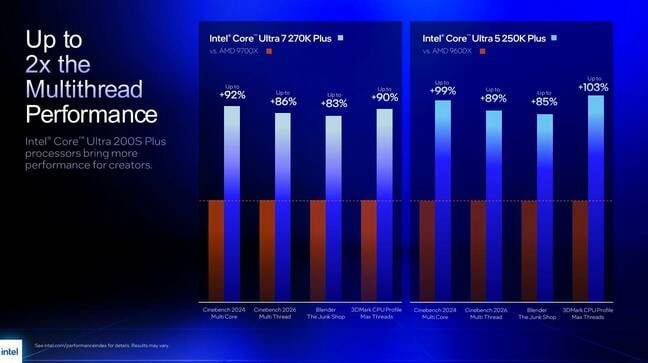
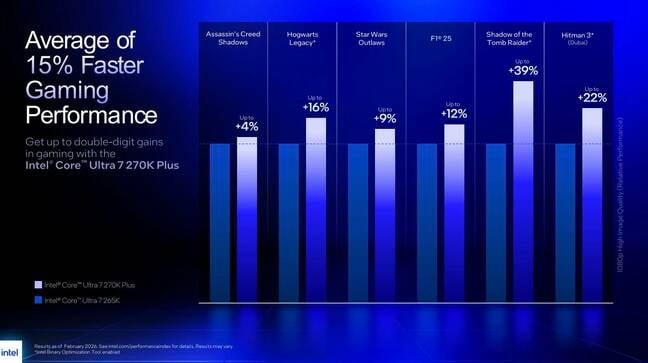
Performance-wise, Intel claims the new chips deliver an impressive 83-103% multi-threaded performance advantage over AMD's Ryzen 5 9600X and Ryzen 7 9700X in rendering and synthetic benchmarks. The company also touts a 13-15% performance uplift over the previous generation Core Ultra 5 and 7 processors.
However, there's a notable omission in Intel's marketing: gaming performance comparisons with AMD. Given AMD's significant lead in gaming thanks to its 3D V-Cache technology, it's curious that Intel chose to avoid this comparison entirely. This silence speaks volumes about where each company's strengths currently lie.
Both new processors benefit from several technical improvements. They feature a 900 MHz bump in die-to-die clock speed, which helps reduce latency from Intel's switch to a chiplet architecture. The memory controller has also been improved, supporting DDR5 7,200 MT/s out of the box with overclocking potential up to 8,000 MT/s.
A particularly interesting addition is support for CUDIMM (Clocked Unbuffered DIMM) memory modules. These integrate the clock timer for greater stability at higher speeds and now support 4-rank memory modules with up to 128 GB per module. While this high-capacity memory will cost several times the price of the processors themselves, it's a welcome option for content creators and professionals.
Intel is also introducing a new Intel Binary Optimization Tool alongside these processors. This tool leverages Intel's compiler and profiler IP to reduce execution overheads and boost instructions per clock cycle for x86 binaries at runtime, regardless of the original compilation platform.
The timing of this launch is particularly interesting given the current PC market conditions. With skyrocketing memory prices making PC builds more expensive, Intel's value-focused approach could resonate with budget-conscious consumers. The company is clearly trying to win back market share it has lost to AMD in recent years.
For context, the Core Ultra 7 270K's 24-core configuration bears a striking resemblance to a slightly de-tuned Core Ultra 285K, potentially offering similar performance at a significantly lower price point. The 270K launched at $589 in late 2024 and currently retails for $549, making the new 270K an extremely compelling upgrade option.
Both the Core Ultra 7 270K and Core Ultra 5 250K are scheduled to hit store shelves on March 26, 2026. Whether this strategy will be enough to shift the balance in the ongoing CPU wars remains to be seen, but Intel has certainly made a compelling case for core count enthusiasts on a budget.
The battle between Intel and AMD continues to evolve, with each company finding different ways to appeal to various segments of the market. While AMD maintains its gaming advantage, Intel's aggressive pricing and core-count strategy could prove attractive for users focused on productivity, content creation, and multi-threaded workloads. As always in the CPU market, the best choice depends heavily on individual use cases and budget constraints.
Comments
Please log in or register to join the discussion