Intel's Linux thermal daemon now has an ARM path, turning a once Intel-specific laptop tuning tool into a cross-platform test bed for power limits, trip points, and sustained performance.
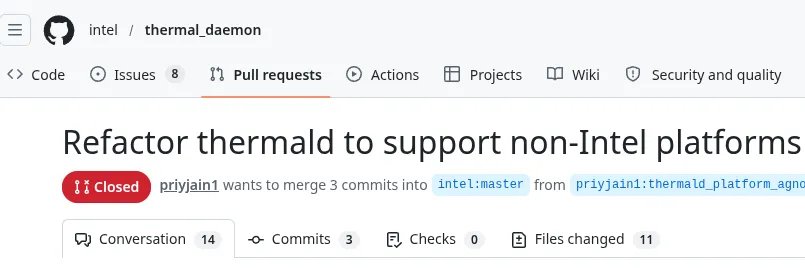
Intel Thermald 2.5.12 is not a headline-grabbing CPU launch, but for anyone who keeps power logs next to benchmark runs, this is an unusually interesting release. The Intel thermal daemon, long associated with Intel laptops and desktops on Linux, now has initial ARM support after refactoring work that adds a more platform-neutral backend.
That matters because thermal management is one of the least glamorous parts of system performance, yet it is often the difference between a laptop that wins a 30-second benchmark and a machine that holds clocks through a 30-minute compile, a Plex transcode, or a Kubernetes node rebuild. Thermald sits in the user-space layer that watches Linux thermal zones, cooling devices, firmware tables, and power limits, then reacts before the hardware falls into ugly last-resort throttling.
The surprise in 2.5.12 is not only that ARM support landed. It is that the work reportedly came through Qualcomm-oriented development rather than a fork. A Qualcomm engineer refactored pieces of Thermald so non-Intel platforms can plug into the daemon instead of building a separate thermal control stack from scratch. For Linux laptop builders watching Snapdragon X-class systems and other ARM client machines mature, that is the part worth measuring.
Product: What Thermald 2.5.12 Adds
Thermald 2.5.12 expands the daemon in several practical directions. The upstream release notes in the thermal_daemon repository list ARM backend support, Intel platform refactoring, additional CPU IDs including Nova Lake variants, generic operating-system and data-vault path improvements, feature enable and disable controls via configuration, RAPL changes, parser fixes, and security hardening.
The short version: Thermald is becoming less hardwired to one CPU family while still gaining support for Intel's next client platforms. That combination is odd at first glance, but it makes engineering sense. If the daemon has cleaner backend boundaries, Intel-specific logic can stay Intel-specific, while generic thermal-zone handling can be reused by other architectures.
{{IMAGE:2}}
Thermald's traditional Intel job is tied to a stack of Linux kernel interfaces. The project README calls out Intel RAPL, Intel P-state, Intel power clamp, INT340X drivers, and RAPL MMIO support as important pieces on supported systems. The Linux kernel's thermal sysfs documentation describes the lower-level model: thermal zones expose current temperatures and trip points, while cooling devices expose throttle states. User-space software can then make policy decisions using those sensors and controls.
The 2.5.12 release also tightens adaptive behavior. Adaptive mode is now limited to Nova Lake and newer Intel CPUs, according to the release summary. That is a compatibility clue: Intel appears to be narrowing automatic policy behavior to platforms where the firmware, tables, and kernel interfaces are expected to line up with current assumptions. For older systems, that may reduce the risk of overly aggressive or mismatched thermal policy.
Performance Data: What Changed, And What Still Needs Testing
There are no public benchmark numbers in the release announcement, and I would not invent them. Thermal daemons do not improve peak IPC or memory bandwidth by magic. They change the operating envelope: how quickly a system reacts to heat, how long it holds package power, how often it hits trip points, and how much performance it gives back once temperatures recover.
For a homelab builder, the right question is not whether Thermald 2.5.12 makes a CPU faster in isolation. The right question is whether it produces a better sustained performance curve under a controlled load.
| Area | What 2.5.12 Changes | Performance Signal To Measure |
|---|---|---|
| ARM backend | Adds initial non-Intel platform support | Sustained clocks, thermal-zone behavior, workload completion time |
| Intel Nova Lake IDs | Adds more CPU identification coverage | Correct policy selection, fewer unsupported-platform fallbacks |
| Adaptive mode gating | Limits adaptive mode to Nova Lake and newer Intel CPUs | Fewer policy mismatches on older machines |
| RAPL handling | Improves register store and restore on exit, plus safer power-limit logic | PL1 and PL2 stability before, during, and after daemon restarts |
| Parser and data-vault fixes | Adds checks around malformed firmware-sourced data | Fewer bad-policy cases from broken OEM tables |
| Security hardening | Tightens D-Bus validation, sysfs path handling, XML validation, and symlink-related behavior | Lower risk from local control-plane inputs |
Power consumption is where this release deserves special attention. On Intel systems, Thermald interacts with RAPL-style controls. The kernel power capping framework exposes zones, energy counters, and power constraints under sysfs. For Intel RAPL, package and subzone counters can expose energy in microjoules, while constraints define power limits and time windows.
That gives us a sane measurement path. Run the same workload with the previous Thermald and with 2.5.12. Log package energy, wall power, thermal zones, CPU frequency, fan state if exposed, and benchmark score. The result should not be a single Geekbench number. It should be a curve.
A useful test matrix would look like this:
| Test | Duration | Metric | Why It Matters |
|---|---|---|---|
| Kernel compile, all threads | 20 to 30 minutes | Time to complete, average package power, max temperature | Shows sustained CPU throughput under real load |
stress-ng --cpu 0 |
15 minutes | Clock decay, trip point crossings, cooling state changes | Finds thermal policy aggressiveness |
| AV1 or x265 encode | 30 minutes | Frames per second per watt | Captures long-running mixed integer and vector behavior |
| Idle after load | 10 minutes | Cooldown time, fan ramp-down, idle package power | Shows whether policy releases limits cleanly |
| Daemon restart during load | 5 minutes | RAPL limits before and after restart | Tests the improved restore path |
| Laptop battery run | 30 minutes | Energy consumed, skin temperature trend | Measures the mobile case Thermald was built around |
For ARM systems, the first pass is compatibility before performance. Initial ARM support means builders should expect rough edges, missing board-specific policy, and platform differences in what sysfs exposes. ARM laptops and development boards often rely on device tree or vendor firmware descriptions for thermal zones. If those zones are named differently, report odd trip points, or lack usable cooling-device links, Thermald may start but have little authority.
That is not a failure of the idea. It is the normal mess of thermal plumbing. A daemon can only control what the kernel exposes, and the kernel can only expose what board firmware, drivers, and silicon telemetry make available.
Compatibility: Intel Still Gets The Most Complete Path
Thermald 2.5.12 should still be treated primarily as an Intel Linux thermal daemon with a new ARM opening. Intel systems have the mature path: RAPL, P-state integration, INT340X, DPTF-derived configuration, and years of OEM quirks baked into testing. ARM support is new, and the Qualcomm angle suggests the first serious target is likely modern Qualcomm Linux client hardware rather than every random ARM board in the parts bin.
| Platform Class | Expected 2.5.12 Readiness | Builder Notes |
|---|---|---|
| Current Intel laptops | High | Best match for adaptive policy, firmware tables, RAPL controls, and distro packaging |
| Intel desktops and mini PCs | Medium to high | Useful when thermal zones and power limits are exposed cleanly, less useful if firmware handles everything internally |
| Nova Lake development systems | Emerging | New CPU IDs and adaptive-only behavior make this release relevant for early enablement |
| AMD x86 systems | Low | The release does not turn Thermald into a general AMD thermal daemon |
| Qualcomm ARM laptops | Experimental but significant | Initial ARM backend work appears aimed at making this class testable upstream |
| Generic ARM SBCs | Unknown | Depends heavily on kernel thermal-zone and cooling-device exposure |
This is where the open-source path becomes more interesting than the feature bullet. A fork would have created a Qualcomm-only thermal daemon with its own bugs, packaging, and policy language. Refactoring Thermald keeps the work closer to an existing Linux user-space tool, with Intel maintainers still owning the project and ARM contributors able to test what Intel engineers cannot.
That arrangement is not friction-free. Thermal policy is competitive. Sustained performance on thin laptops is a product feature, and power behavior affects benchmark results, fan noise, chassis temperature, and battery life. But shared infrastructure is usually better for Linux users than five vendor daemons fighting over sysfs.
Build Recommendations
For Intel laptop owners already using Thermald from a distribution package, I would wait for the distro update unless you are chasing a specific bug or testing Nova Lake enablement. Thermal policy sits close enough to system stability that I prefer packaged builds on daily-driver machines. If you do build from source, use the upstream instructions in the Intel thermal_daemon README, keep your old package version handy, and capture baseline logs first.
For lab machines, 2.5.12 is worth testing immediately. The improved RAPL handling alone makes it interesting for anyone who restarts services during automated power tests. Before upgrading, capture these baselines: systemctl status thermald, /sys/class/thermal/thermal_zone*/temp, /sys/class/thermal/cooling_device*/cur_state, /sys/class/power_cap/intel-rapl*/**/energy_uj, CPU frequency over time, and wall power from a meter if you have one. After upgrading, repeat the exact workload with the same ambient temperature and fan profile.
For ARM laptop testers, treat this as enablement work, not a finished tuning layer. First confirm that the daemon starts cleanly. Then inspect what it can actually see under /sys/class/thermal. A useful ARM test report should include kernel version, board or laptop model, thermal zone names, cooling devices, trip points, whether Thermald changes any cooling state under load, and whether workload performance changes compared with no daemon running.
For server and homelab use, I would be conservative. Rack servers usually have BMC-managed fans, firmware power caps, and platform-specific control loops. Thermald can still be useful on mini PCs, NUC-style nodes, and dense edge boxes where Linux controls the CPU package directly, but it should not be dropped onto production nodes without watching for clock collapse or unexpected power-limit changes.
The larger pattern is clear. Linux thermal management is becoming a cross-architecture problem because client hardware is no longer just Intel x86 with a familiar firmware stack. ARM laptops need sustained-performance policy. Intel needs clean support for Nova Lake and newer platform behavior. Users need tools that expose what is happening instead of hiding every decision in firmware.
Thermald 2.5.12 is not a benchmark win by itself. It is a new measurement point. If the ARM backend matures and the Intel refactoring keeps reducing platform-specific assumptions, this daemon could become a more useful common layer for Linux systems where thermals, power limits, and real sustained throughput are all part of the same spreadsheet.
Comments
Please log in or register to join the discussion