A single-line change to Intel's ANV Vulkan driver enables compute BTI prefetch by default, potentially delivering up to 3% performance gains in select games.
Intel's open-source Vulkan driver team has merged a seemingly trivial one-line change to the ANV driver that could deliver meaningful performance improvements for gamers and graphics professionals alike. The change, which landed in Mesa 26.1 Git, enables compute BTI (Base Table Index) prefetch by default—a feature that Intel's own hardware documentation has long recommended but was previously disabled in the open-source driver.
The One-Line Performance Boost
The change itself is remarkably simple: enabling the DRI_CONFIG_INTEL_FORCE_COMPUTE_SURFACE_PREFETCH feature. According to the merge request, this was previously disabled due to what the developers describe as a "performance regression," though the exact nature of this regression isn't detailed in the brief commit message.
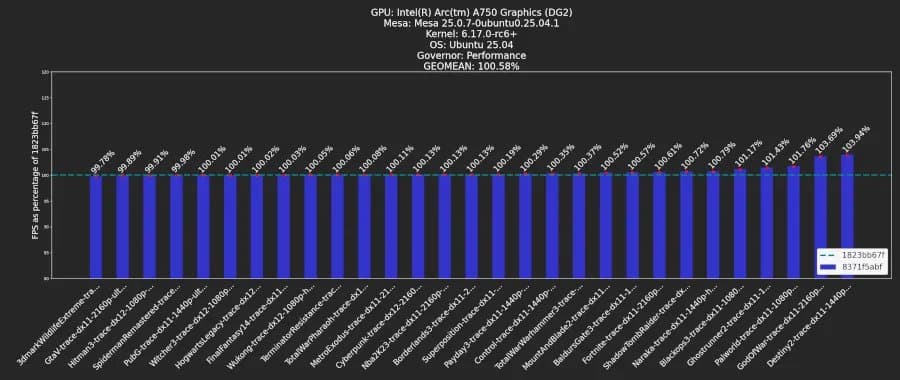
Despite its simplicity, testing has shown measurable benefits. Frame-rate improvements were observed across various game traces, with results showing:
- Average improvement: ~0.5% across all tested games
- Typical gains: 1% frame-rate increase in many scenarios
- Best cases: 3-4% performance boost in specific titles
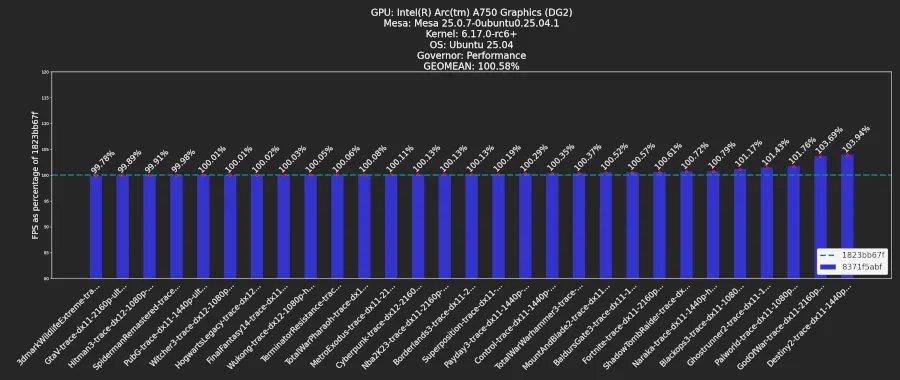
The most significant improvements were noted in God of War and Destiny 2 game traces, where the performance gains reached the upper end of the observed range. While these percentages might seem modest, they represent free performance that requires no user intervention or system configuration changes.
Why This Matters for Intel Graphics
This change is particularly noteworthy given Intel's ongoing efforts to close the performance gap between their open-source Linux drivers and their proprietary Windows counterparts. The ANV driver, which serves as Intel's Vulkan implementation, has been steadily improving but still lags behind in certain scenarios.
Every percentage point of performance matters in competitive gaming and professional graphics workloads. A 3% improvement might be the difference between a playable and unplayable experience at the edge of hardware capabilities, or it could mean the difference between meeting and missing frame-rate targets for content creators.
Technical Context
BTI prefetch is a hardware optimization feature that allows the GPU to anticipate and prepare data access patterns more efficiently. By enabling this feature by default, Intel is aligning their open-source driver behavior with what their hardware documentation has recommended all along.
The fact that this feature was disabled previously suggests there may have been compatibility issues or edge cases where the prefetch behavior caused problems. The developers' decision to re-enable it indicates they've either resolved these issues or determined the performance benefits outweigh the potential drawbacks in most use cases.
Broader Implications
This change exemplifies the incremental nature of driver optimization work. While not as headline-grabbing as a major architectural overhaul, these small, targeted improvements accumulate over time to deliver meaningful performance gains.
For Linux gamers and professionals using Intel integrated or discrete graphics, this update will be included in Mesa 26.1 and subsequent releases. Users won't need to take any action to benefit from the improvement—it will be enabled automatically.

The open-source nature of this development is also worth noting. The transparency of the merge request process allows the community to understand exactly what changes are being made and why, fostering trust and collaboration between Intel's driver developers and the broader Linux graphics ecosystem.
Looking Forward
While a half-percent average improvement might not seem revolutionary, it's part of a larger pattern of continuous optimization in the Intel ANV driver. Combined with other recent improvements and those planned for future releases, these incremental gains contribute to making Intel graphics an increasingly viable option for Linux users.
For those interested in the technical details, the full merge request is available for review, providing insight into the development process and the specific code changes involved in this optimization.
Comments
Please log in or register to join the discussion