Intel’s Xeon 6+ pitch is interesting because the most practical feature may not be another core-count chart, but hardware telemetry that tells operators where their watts are actually going.
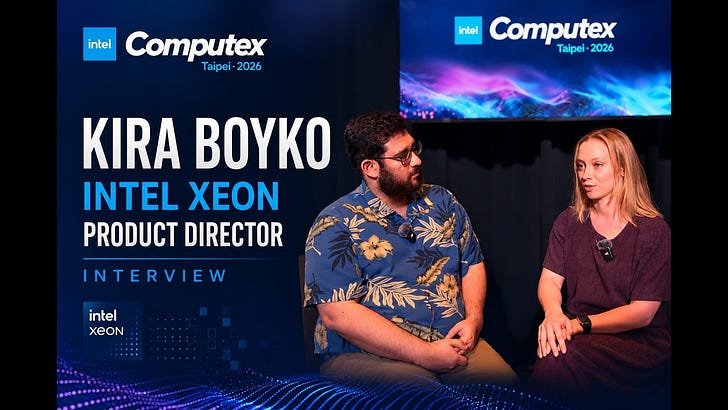
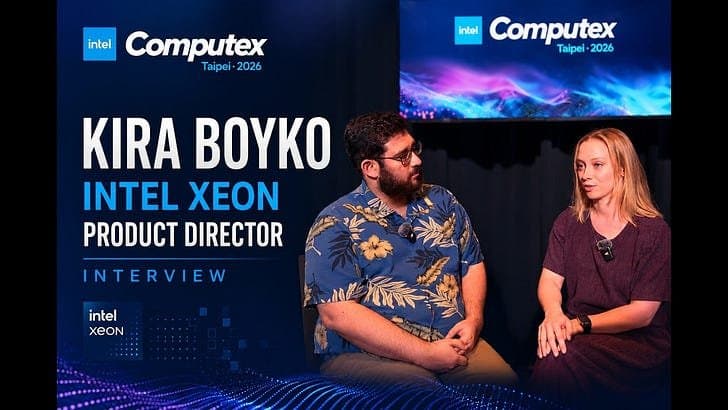
Intel’s Computex 2026 discussion around Xeon 6+ is easy to file under the usual server CPU launch routine: more cores, new process node, a longer SKU table, and a few carefully selected comparisons against AMD EPYC. The more useful reading is narrower. In an interview with Kira Boyko, product director for Intel Xeon 6+, the most technically relevant claim was not simply that Intel has a new many-core server part. It was that Xeon 6+ introduces Intel Application Energy Telemetry, or AET, a hardware-level mechanism for tracking workload energy use down to the core level as software moves across cores.
That matters for AI infrastructure, but not in the vague sense that every datacenter chip now has to be described as an AI product. Large language model serving, retrieval pipelines, embedding jobs, batch inference, vector database maintenance, and CPU-side preprocessing all burn power in uneven ways. GPU utilization gets most of the attention, but the CPU still handles orchestration, networking, compression, tokenization, data loading, scheduling, storage paths, and plenty of smaller inference workloads where a GPU is either unavailable or inefficient. If Intel’s AET data is accurate enough and exposed cleanly through Linux tooling such as perf, it gives operators a better chance of assigning energy cost to actual workloads instead of package-level averages.
The claim is straightforward: Xeon 6+ can report energy use at a hardware core level, and that telemetry follows a workload as it moves from core to core. Boyko described it as a hardware hook into the core, not just a software estimate. She also said it is available across the Xeon 6+ SKU stack and compatible with Intel’s tooling. That is the part to watch. Marketing around server efficiency often compresses a messy operational problem into a single performance-per-watt number. AET is more interesting because it targets measurement granularity, not just peak throughput.
What is actually new is not that CPUs can expose energy counters. Intel’s RAPL interface, platform power telemetry, and performance monitoring infrastructure have existed for years. Cloud providers and hyperscalers already model energy use with varying degrees of precision. The new claim is finer attribution at the workload level, with hardware support that can help account for energy as threads migrate. In a modern scheduler, work does not politely stay pinned unless the system forces it to. That makes per-process or per-container energy accounting difficult. If AET can reduce the gap between modeled power and measured power, it becomes useful for chargeback, placement, workload shaping, and carbon-aware scheduling.
For AI operators, the practical applications are not exotic. A cloud provider could compare two inference services running Llama 3.1, Qwen2.5, or Mixtral-style workloads and see which one wastes CPU-side energy during tokenization, request routing, or post-processing. An internal platform team could attach energy budgets to Kubernetes namespaces. A SaaS company running retrieval-augmented generation could separate GPU-heavy generation cost from CPU-heavy ingestion and embedding preparation. A telecom deployment using Xeon for vRAN and edge inference could make placement decisions based on measured power instead of assuming that all integer-heavy services behave the same.
That is the strongest interpretation of AET: it is not a magic efficiency feature. It is instrumentation. Instrumentation only pays off when the software stack knows what to do with the signal. Better counters do not automatically reduce watts. They let operators find avoidable waste, enforce policies, and validate whether scheduling changes helped. If the telemetry lands in standard Linux paths and does not require proprietary dashboards for serious use, it has a better chance of becoming operationally relevant.
The rest of the Xeon 6+ story is more conventional, but still important. Reporting on the launch describes Clearwater Forest as an E-core-only Xeon 6+ family built for dense scalar throughput, with the top Xeon 6990E+ reaching 288 cores. Tom’s Hardware reported Intel claims including up to 30 percent better per-thread performance than AMD’s 192-core EPYC 9965, a 2.26x performance gain over Xeon 6780E, and average performance-per-watt gains around 55 percent. Those are vendor-selected numbers, so they should be read as claims until independent benchmark suites cover real workloads such as Redis, NGINX, ClickHouse, PostgreSQL, Kafka, OpenSearch, vLLM CPU-side paths, and mixed container density tests.
The model names tell part of the positioning. Xeon 6990E+ appears to be the flagship, with lower SKUs such as Xeon 6960E+ filling out the stack. Boyko’s comments suggest Intel is trying to simplify Xeon segmentation, which would be welcome if it holds. Xeon naming has been difficult to parse for years, and server buyers care less about branding than about memory channels, socket compatibility, accelerator availability, power limits, and whether the SKU they qualified will be obtainable in volume.
The E-core emphasis is also a real architectural trade-off. Dense E-core Xeons make sense for scale-out scalar workloads: web services, control planes, microservices, edge workloads, lightweight inference services, network functions, and CPU-heavy background jobs. They are less obviously suited for code that wants wide vector units, high single-thread performance, or large per-core caches. If a workload depends on AVX-512, AMX, or high floating-point throughput, an E-core Xeon is not the obvious first choice. That matters for AI because the phrase “AI workload” covers everything from JSON routing around an LLM endpoint to matrix-heavy inference kernels. A CPU can be central to the former and secondary to the latter.
AET could help expose those differences. Integer-heavy request handling, floating-point preprocessing, compression, encryption, memory-bound retrieval, and cache-sensitive ranking do not consume power in the same way. Package-level telemetry can hide that. Core-level or workload-following telemetry can show when a supposedly cheap service is burning energy through poor locality, frequent migrations, or inefficient batching. That is useful even when the GPU remains the main accelerator.
There are limitations. The interview does not provide enough detail to judge sampling rate, counter precision, software overhead, virtualization behavior, tenant isolation, or how AET behaves under simultaneous multitenant scheduling. Those details matter more than the acronym. If the telemetry is too coarse, noisy, privileged, or awkward to consume in containerized environments, it becomes a demo feature. If it integrates with Linux perf events, orchestration layers, and cloud billing systems cleanly, it becomes part of the operational toolbox.
There is also a benchmark problem. Intel’s comparative figures against EPYC and prior Xeons are useful only as starting points. Server CPUs rarely win or lose universally. AMD EPYC parts may still lead in memory capacity, certain throughput workloads, platform economics, or software-tuned deployments. Arm server CPUs may be competitive in power-sensitive scale-out fleets. GPUs and specialized accelerators remain dominant for large matrix math. Xeon 6+ needs independent testing across real production mixes, not just narrow launch charts.
The more sober takeaway is that Xeon 6+ is trying to compete on two fronts. The first is familiar: dense core counts, better process technology, and enough platform throughput to keep Intel credible against AMD and Arm in cloud and edge deployments. The second is more operational: energy visibility at a level that maps better to how modern software is billed and scheduled. For AI systems, that second front may be more consequential than another headline core count.
A practical AI stack is rarely just a model running on an accelerator. It is a pipeline: ingress, auth, routing, retrieval, tokenization, batching, generation, safety filters, logging, billing, evaluation, and storage. The CPU touches much of that path. If Xeon 6+ can make the energy cost of those pieces visible with enough fidelity, Intel has a credible infrastructure argument. Not a claim that CPUs replace GPUs for frontier model inference, but a narrower and more defensible one: better telemetry can make AI services cheaper to operate and easier to account for.
Relevant resources include Intel’s Xeon processor family, Intel’s process technology overview, the Linux perf documentation, and launch coverage from Tom’s Hardware.
Comments
Please log in or register to join the discussion