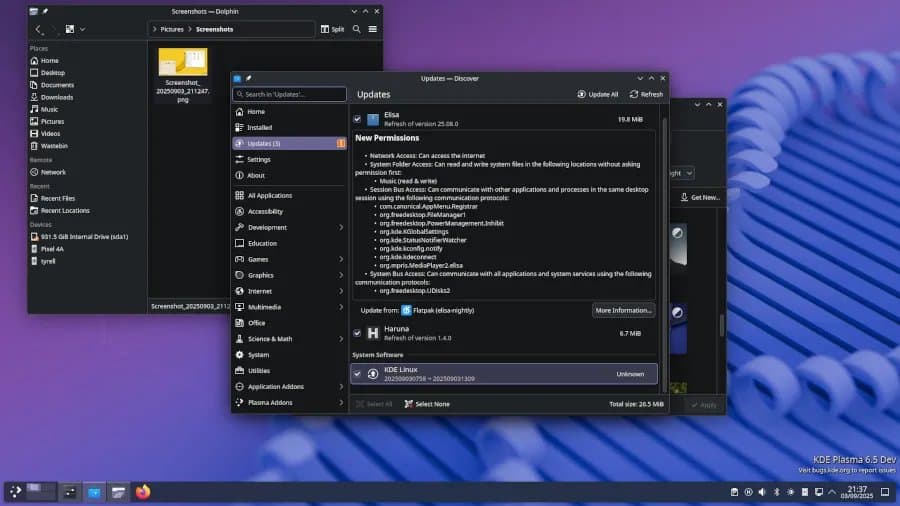
KDE Linux adds Apple APFS file-system support and implements AMDGPU driver workaround to address persistent system freeze problems affecting AMD GPU users.
KDE Linux continues to evolve as a reference platform for showcasing the KDE Plasma desktop, with recent updates bringing Apple APFS file-system support and a critical AMDGPU driver workaround to address persistent system freeze issues.
Enhanced APFS Support
The latest KDE Linux release now includes native support for Apple's APFS (Apple File System) through the installation of the linux-apfs-rw-dkms package. This out-of-tree kernel module provides read/write capabilities for APFS, which is the default file system on modern Apple devices and macOS systems.
The APFS support comes via the linux-apfs-rw module, which remains experimental, particularly for write operations. However, by pre-installing this package, KDE Linux aims to provide a smoother experience for users who need to interact with data from Apple devices. The DKMS (Dynamic Kernel Module Support) approach ensures the module can be rebuilt when kernel updates occur, maintaining compatibility.
AMDGPU Driver Workaround
One of the most significant additions addresses a frustrating issue that has plagued AMD GPU users for months. KDE Linux now implements a kernel command line parameter to work around a total system freeze problem affecting many AMD systems.
The issue, tracked in the upstream AMDGPU driver repository, causes complete system freezes that require hard reboots. The problem stems from a page-flip timeout issue leading to display freezes. Since a fix has been elusive despite months of development, KDE Linux has opted to implement a workaround.
The solution involves adding amdgpu.dcdebugmask=0x10 to the kernel command line, which disables panel self-refresh functionality. While this change results in slightly higher power consumption, developers determined it was a worthwhile trade-off to prevent system freezes and the need for hard reboots.
Additional Improvements
Beyond these major features, KDE Linux has also enhanced its Flatpak application support by pre-installing more languages. This improvement ensures better localization and accessibility for users worldwide who rely on Flatpak packages for their applications.
The distribution has also added Kup, KDE's backup software, as a pre-installed application. This provides users with a GUI-driven solution for backing up their systems to off-device storage, enhancing data protection capabilities out of the box.
Availability
These improvements are available in the latest KDE Linux release, which can be downloaded from KDE.org. As a reference platform for the KDE Plasma desktop, KDE Linux continues to refine the user experience and address compatibility issues that affect real-world usage scenarios.
For users with AMD GPUs, the new workaround should provide immediate relief from the frustrating freeze issues, while Apple device users will appreciate the enhanced APFS support for seamless data transfer and management between platforms.
Comments
Please log in or register to join the discussion