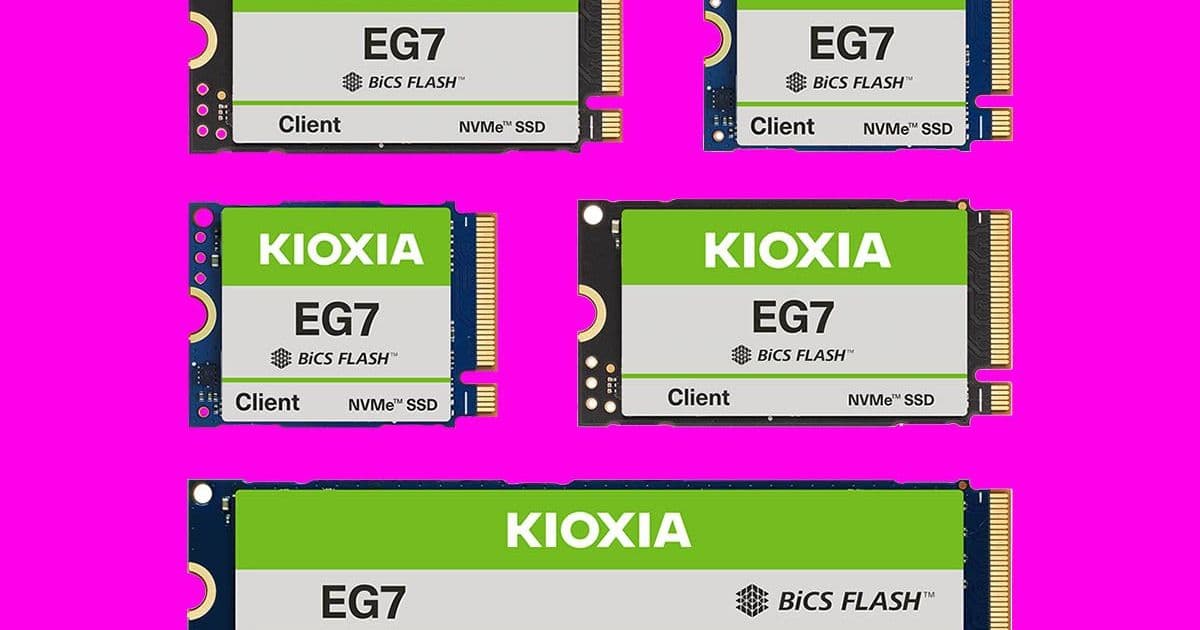
Kioxia announces EG7 Series SSDs, their first client drives using BiCS FLASH gen 8 QLC technology, offering performance comparable to TLC drives at potentially lower cost points for value-oriented systems.
Kioxia has today unveiled the EG7 Series of solid state drives, marking a significant milestone as the company's first client storage solution to implement BiCS FLASH generation 8 QLC (quadruple-level cell) technology. These DRAM-less SSDs are specifically engineered to provide affordable storage solutions for value-oriented slim laptops, commercial notebooks, and consumer desktops, positioning themselves as Kioxia's budget alternative to their TLC-based BG7 drives.
Technical Specifications and Architecture
The EG7 Series leverages Kioxia's 218-layer BiCS FLASH generation 8 with CBA (CMOS directly Bonded to Array) technology, which enables higher bit densities compared to previous generations. This architectural advancement is crucial for achieving competitive performance metrics while maintaining cost efficiency.
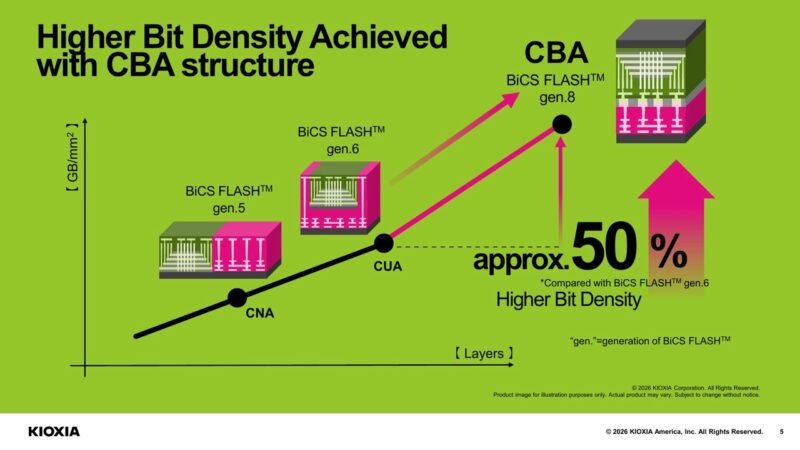 Figure: Kioxia EG7 BiCS FLASH Gen.8 architecture with CBA technology
Performance specifications across the EG7 lineup include:
| Capacity | Sequential Read | Sequential Write | Random Read | Random Write |
|---|---|---|---|---|
| 512 GB | 6,400 MB/s | 5,000 MB/s | 550,000 IOPS | 850,000 IOPS |
| 1024 GB | 7,000 MB/s | 6,000 MB/s | 850,000 IOPS | 950,000 IOPS |
| 2048 GB | 7,000 MB/s | 6,200 MB/s | 1,000,000 IOPS | 1,000,000 IOPS |
Notably, Kioxia markets these specifications as matching the high-level performance of their TLC-based BG7 Series, potentially offering OEMs similarly-performing drives with a lower cost-per-GB. However, this claim warrants careful examination, as QLC NAND typically exhibits lower performance than TLC NAND built on the same manufacturing process.
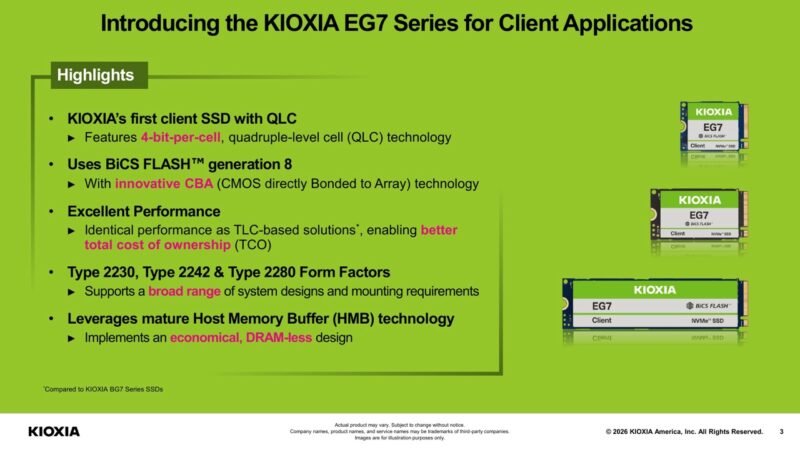 Figure: Kioxia EG7 performance highlights
The performance figures likely represent the drives' pseudo-SLC cache performance, which would be similar to the BG7 series since both use the same generation of NAND. The critical consideration is the significant performance drop-off that QLC-based drives experience once this cache is exhausted, a characteristic that becomes apparent in sustained workloads.
Design and Implementation Details
The EG7 Series encompasses all three major M.2 form factors: Type 2230, Type 2242, and Type 2280. The inclusion of the 2242 form factor is particularly noteworthy, as this intermediate length has gained adoption in compact systems where space constraints necessitate shorter drives while still offering more capacity than the 2230 variant.
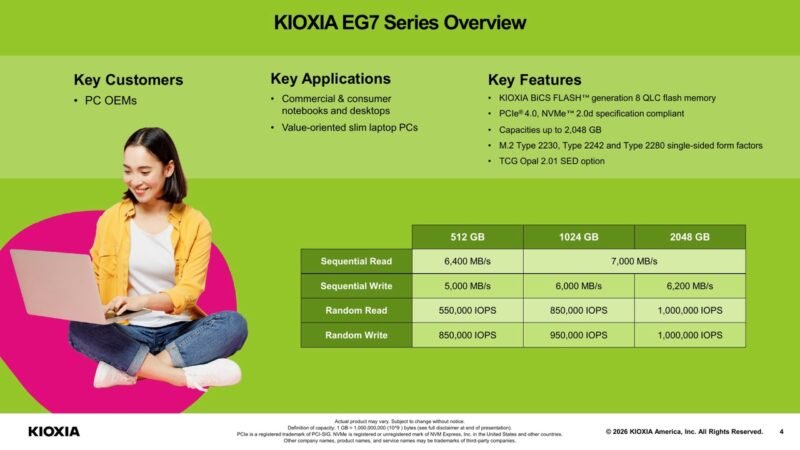 Figure: Kioxia EG7 Series overview showing form factor options
Like the adjacent BG7 series, the EG7 employs a DRAM-less design utilizing Host Memory Buffer (HMB) technology. This approach allocates a portion of system memory to maintain performance while reducing component costs and power consumption—a critical consideration for battery-powered devices. For security-conscious deployments, Self-Encrypting Drive (SED) options based on TCG Opal 2.0 are available.
The drives are PCIe 4.0 compliant and support the NVMe 2.0d specification, ensuring compatibility with modern platforms while maintaining backward compatibility with earlier generations.
Market Implications and Real-World Considerations
The EG7 Series represents Kioxia's strategic entry into the QLC client storage market, a space previously dominated by TLC technology in performance-oriented segments. By offering QLC technology with specifications that mirror their TLC drives, Kioxia aims to address the growing demand for cost-effective storage without completely sacrificing performance.
However, potential adopters should carefully evaluate their workload patterns. The EG7's performance characteristics make it well-suited for bursty workloads common in consumer applications—web browsing, office productivity, and media consumption—but may struggle with sustained write operations that would quickly exhaust the pseudo-SLC cache. For workloads involving large file transfers, video editing, or database operations, the performance degradation would be more pronounced.
The EG7 Series is currently sampling with PC OEM customers, with systems expected to ship in Q2 2026. While pricing has not been announced, the QLC-based design should enable more affordable configurations in value-oriented laptops and desktops. As with other DRAM-less SSDs in this segment, the EG7 is expected to be primarily deployed in OEM systems rather than sold directly to consumers.
For more information about Kioxia's storage solutions, visit their official product page or explore the technical documentation for deeper insights into their BiCS FLASH technology.
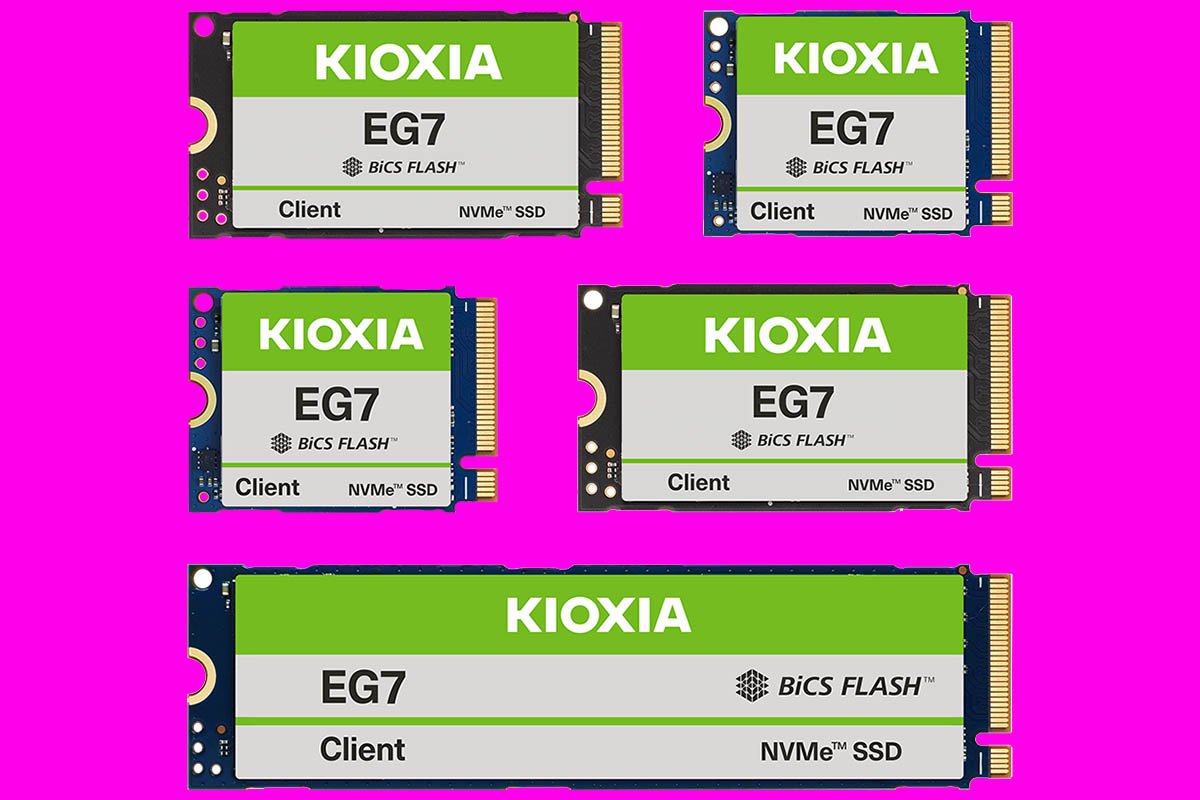 Featured image: Kioxia EG7 Series announcement
Comments
Please log in or register to join the discussion