Dependency upgrades break test suites in ways that are expensive to triage by hand. LibX answers with a staged three-loop repair agent that starts narrow, widens only when it has to, and escalates to humans on a hard ceiling instead of retrying forever. The interesting part isn't the AI patching. It's the bounded design.
A version bump is never just a version number. When a library updates, it can alter method signatures, deprecate APIs your code still calls, and quietly change the return-type contracts your test assertions were written against. The test suite that fails afterward isn't failing because your logic is wrong. It's failing because it carried implicit assumptions about how a dependency behaves, and the upgrade invalidated them without telling anyone.
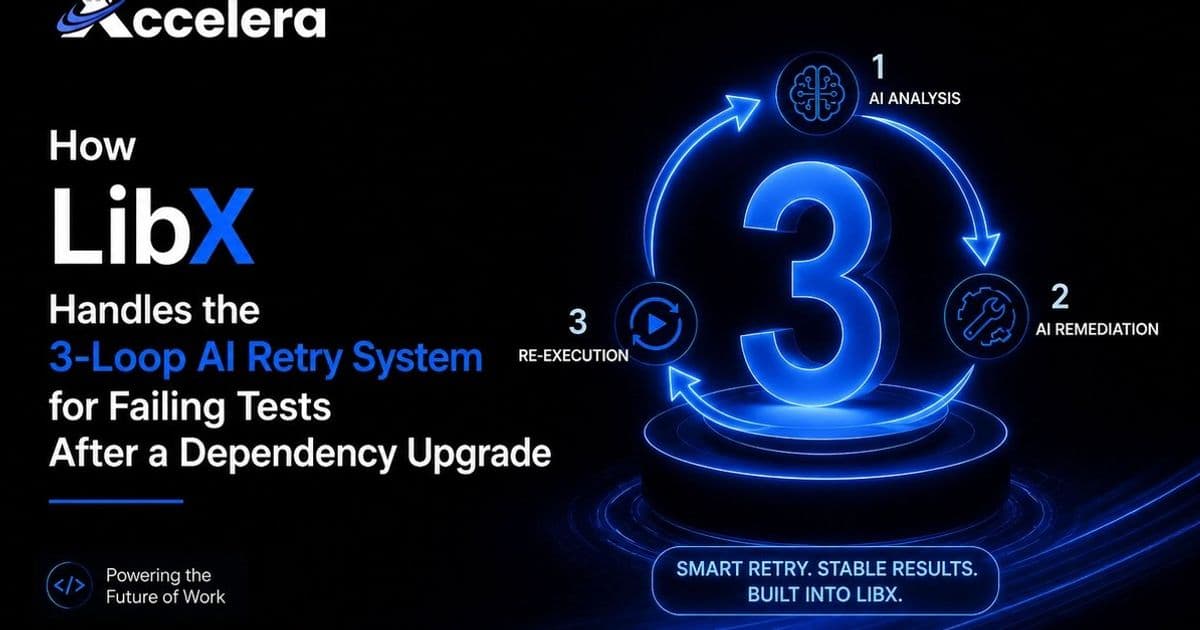
That is the problem LibX targets with a three-loop AI retry architecture built specifically for test failures triggered by dependency changes. The system is worth examining less for the fact that it uses an LLM to write patches, which is now common, and more for a design decision that runs against the grain of most autonomous-agent pitches: it caps itself at three attempts and then hands the problem back to a human.
Why dependency upgrades break tests downstream
The failure modes split along a line that matters for any repair system. Compile-time failures surface immediately and point more or less directly at the breakage. Runtime test failures are quieter. They show up as a red assertion three layers removed from the change that caused them, and they are far more expensive to trace by hand.
Transitive dependencies make this worse. When a direct dependency pulls in an updated version of one of its dependencies, the breakage originates two levels deep. The failure signature you see in CI looks disconnected from the upgrade you actually made, which is exactly the situation where manual triage burns the most time. The article cites an average of 23 minutes of recovery per engineer per triage cycle, with 73% of pipeline failures falling into categories that are, in principle, automatable. Whether those exact numbers hold across your codebase is less important than the shape they describe: the cost is in the diagnosis, not the fix.
The staged architecture
LibX does not fire a single patch and wait for review. It runs a three-stage reasoning pipeline where each loop applies progressively deeper diagnostic logic before escalating. The governing principle is to start narrow and expand only when necessary, so compute isn't spent on retry cycles that have already shown they can't resolve the failure without more context.
Loop 1 is the cheap shot. On test failure, the agent isolates the failing assertion, traces it to the specific dependency version change responsible, and generates a targeted patch aimed at the most common failure pattern for that error signature. For straightforward signature mismatches and deprecated method calls, this closes the loop with no human involvement. The agent here is not trying to be comprehensive. It is making the highest-probability fix for the lowest-complexity failure class. If the patch passes, the pipeline continues. If it fails validation, the system moves on rather than retrying the same idea, which is the part that distinguishes a staged design from a naive retry counter.
Loop 2 adds context. When the first patch doesn't pass, the agent parses the dependency changelog between the old and new version, maps every affected call site across the codebase, and regenerates a patch informed by that broader picture. The failed first attempt becomes an input signal rather than a dead end: the specific assertion failures from Loop 1 narrow the repair hypothesis before the second patch is generated. This matches what research into LLM-based dependency repair has found, that feeding in version diffs and failure-line mapping meaningfully outperforms single-shot zero-context attempts.
Loop 3 widens the blast radius. The third loop scans connected modules for regression spread, checking whether the upgrade broke tests that were passing before but are now failing as downstream side effects. If this attempt produces a clean suite, the loop closes. If not, the system escalates with a structured payload: the original failure, every patch attempted across all three loops, the agent's reasoning at each stage, and the tests that remain red.
What the agent reads before it writes anything
Patch quality is bounded by input quality, and LibX front-loads its context gathering. Before any loop runs, it ingests the dependency diff between versions, the full test output down to assertion-level detail, the affected module dependency graph, and historical patch-success patterns from prior upgrades on the same codebase.
Each of these does a specific job. The dependency diff sets the initial repair scope. The module graph is the safeguard against the classic agent failure where a patch resolves one test and silently breaks a connected component, the regression-for-a-fix trade that makes autonomous tooling untrustworthy. The historical patterns let the system recognize a failure signature it has resolved before and lead with that validated approach instead of rediscovering it from scratch. That last point is the consistency story: a repair agent that doesn't remember its own prior fixes will relitigate the same upgrade every release.
The ceiling is the feature
The most defensible decision in the whole design is the hard three-loop limit. Unbounded retry logic is an operational liability for reasons anyone who has watched a retry storm take down a service already knows. Every unnecessary retry triggers another execution cycle, consumes compute, and adds latency to a pipeline that is already blocked. A failing dependency patch that retries indefinitely does not eventually succeed through repetition. It compounds noise, masks the root cause, and makes the post-mortem harder.
So the ceiling forces escalation rather than indefinite autonomous action, which is the correct behavior once a failure exceeds the confidence threshold of automated repair. Framing escalation as the designed outcome, not a failure state, is the right mental model. An agent that knows when to stop is more useful than one that always tries.
The other half of the safety story is reversibility. No patch is committed until it passes the validation suite, so production stays untouched throughout the retry process. The engineers reviewing an escalation are reading clean diagnostic context rather than inheriting a codebase that three failed repair attempts have partially rewritten. That property, keeping the working tree pristine until a candidate is proven, is what makes the autonomous loops safe to run unattended in the first place.
Where this fits
LibX positions itself for teams running active Python dependency upgrade cycles, integrating into existing CI/CD pipelines as a self-hosted workflow rather than asking you to restructure your toolchain. The pitch is that you stop losing sprint capacity to dependency triage and ship on the upgrade cadence your security posture demands, which for anyone tracking CVE-driven bumps is the real pressure.
The broader pattern here is one worth watching across the agentic-tooling space. The systems that earn trust in production are not the ones that promise unlimited autonomy. They are the ones that bound their own actions, keep state reversible, and escalate with enough context that a human can finish the job in minutes instead of starting the investigation from zero. A three-loop ceiling is a small design choice that encodes exactly that discipline.
Comments
Please log in or register to join the discussion