
A new Nature study estimates yearly migration flows across 230 countries by blending neural networks with traditional statistical models and pulling signals from Facebook. The result fills a gap demographers have complained about for decades, but it also raises familiar questions about training AI on incomplete, proxy-heavy data.
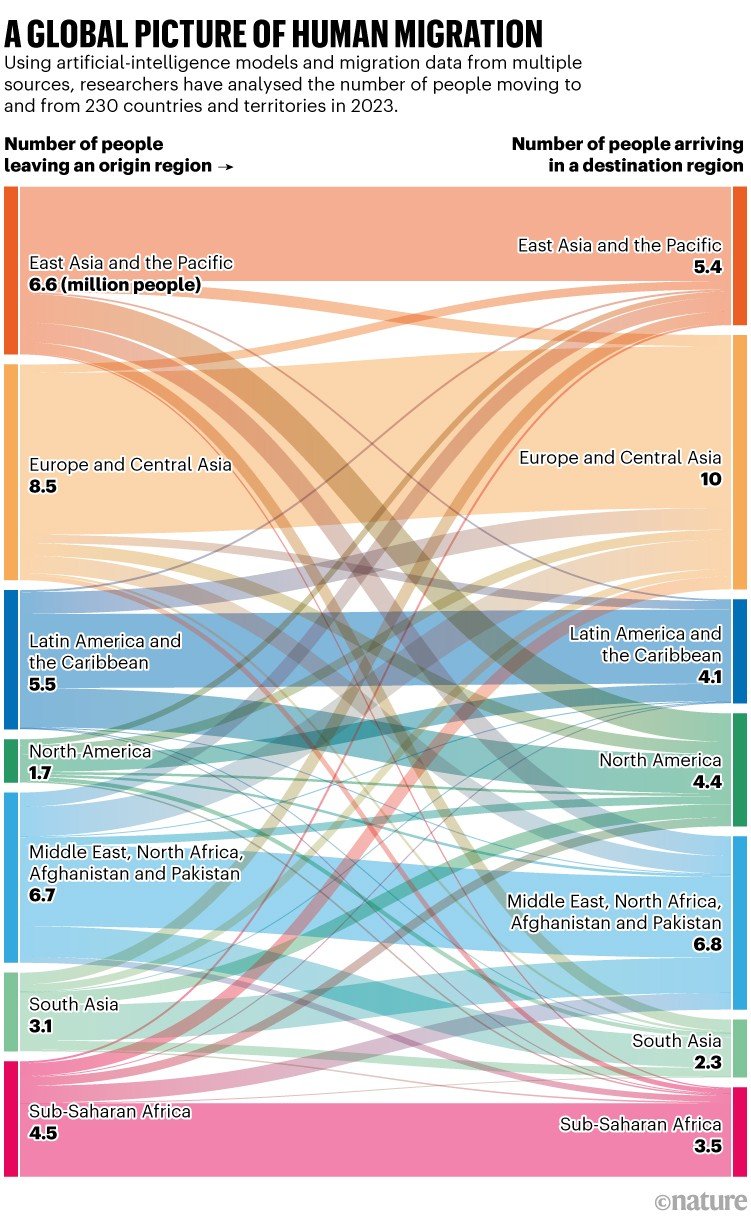
A pair of researchers just published what they call the most detailed maps of global human migration in 33 years, and the part worth paying attention to is not the headline number. Yes, annual migration rose from roughly 13 million people in 2000 to around 35 million in 2023, according to the study published in Nature on 10 June. But the more interesting story for anyone who works with models and messy data is how Thomas Gaskin and Guy Abel got those numbers at all.
Migration data has a reputation among demographers, and it is not a good one. Wolfgang Lutz, a demographer at the Wittgenstein Centre in Vienna who was not part of the study, put it bluntly: migration figures have "been notoriously the least reliable" of the inputs that go into understanding how populations change. Births and deaths get recorded with reasonable consistency. Migration does not. Some countries track people arriving but not leaving. Others publish nothing for years. The United Nations and World Bank data sets that researchers usually lean on come out only at five- and ten-year intervals, which means a person who moves abroad for two years and returns home essentially never existed as far as the official record is concerned.

That sparse, irregular, partially-missing input is exactly the kind of problem that tends to attract a machine-learning solution, and the team's response fits a pattern showing up across scientific computing right now.
A hybrid, not a pure neural net
The approach Gaskin and Abel describe is a hybrid one, and that detail is doing a lot of work. Rather than throwing a deep network at the data and hoping it learned the right structure, they combined classical mathematical models of migration flow with deep-learning networks. The neural component ingested dozens of features that influence whether people move: economic status, trade volume between country pairs, religious similarity, active wars and conflicts, colonial history, and even the number of speakers of shared languages across nations.
This is the same instinct behind physics-informed neural networks and other scientific ML methods that have gained traction over the past few years. You keep the parts of the problem where you already have a defensible theory, the mathematical model of how flows behave, and you let the network handle the high-dimensional, fuzzy relationships that resist clean equations. The classical model constrains the output so it stays demographically plausible. The network supplies the flexibility to fit signals no formula captures well.
The payoff the authors emphasize is temporal resolution. "With the annual resolution that we are estimating, we gain a lot of additional insight that you wouldn't get over the five- or ten-year intervals that are done currently because they will mask a lot of what happens," Abel said. The model recovers events that interval-based snapshots smooth away, including the largest single migration in the data: nearly 950,000 people moving from Rwanda to the Democratic Republic of the Congo in 1994, after the Rwandan civil war.
The Facebook question
Among the inputs, one stands out: the social-media platform Facebook. Alongside UN figures and national statistics, the team used Facebook data to help estimate flows. For developers who have worked with platform-derived population signals, this is both clever and a little uncomfortable.
Clever, because social platforms capture movement that official statistics miss entirely. Account location changes, network ties that cross borders, and self-reported migration give a near-real-time view of where people actually are, not where a census placed them years ago. Uncomfortable, because that data carries the platform's own biases baked in. Facebook penetration varies enormously by country, age, and income. A model that leans on it risks seeing the world's connected, younger, more urban migrants clearly while underrepresenting everyone else. When the training signal is itself a non-random sample of humanity, the model inherits that skew no matter how sophisticated the architecture.
The authors are candid that they are estimating, not measuring. The whole project exists because direct measurement is impossible at this resolution. That honesty is the right posture, but it also means the maps are model output, not observation, and the distinction tends to blur once a number gets cited a few times. A figure like "35 million migrants in 2023" reads as a fact. It is closer to a best estimate produced by a system trained on proxies.
What the consensus gets wrong, and what to watch
Lutz, despite not being involved, called it "a much more complete picture of global migration streams than we had any time before," and praised its value for practical planning around schooling, social benefits, and labour markets. That endorsement matters because it comes from someone whose field has been burned by unreliable migration data for decades.
The accompanying Nature coverage flags some counterintuitive findings that the better data supports, including the claim that border restrictions don't reliably reduce crossings and that migration overall is not increasing in the way public debate often assumes. Those are politically loaded conclusions, and they will be tested hard. A model that produces a convenient or an inconvenient narrative deserves the same scrutiny: how sensitive are these results to the choice of features, the weighting of the Facebook signal, and the structure of the classical prior?

There is a broader pattern here that goes beyond demography. Across fields where ground truth is expensive or impossible to collect, researchers are increasingly publishing AI-generated estimates as datasets that other people then build on. The migration maps, available to explore on the researchers' website, will feed into downstream analyses, policy models, and probably a few more papers. Each layer inherits the assumptions of the layer below, and the original caveats have a way of falling off. The methodology paper says "estimate." The third citation says "data."
None of this makes the work less impressive. Filling a 33-year gap in one of demography's hardest measurement problems is a genuine contribution, and the hybrid design is a sensible answer to a real constraint. The thing worth holding onto is that the maps are an argument about migration, built from incomplete evidence and a model's best guesses, rather than a direct readout of where humanity moved. Treating them that way, as a strong hypothesis open to revision, is how the field gets the value without importing false certainty. The reference for anyone who wants to check the math is Gaskin & Abel, Nature 2026.
Comments
Please log in or register to join the discussion