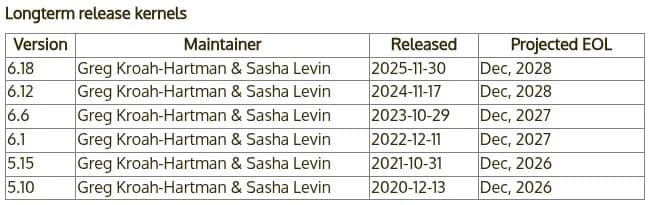
Greg Kroah-Hartman has extended the support timelines for three major Linux LTS kernel series, with Linux 6.18 now supported until at least December 2027, Linux 6.12 until 2028, and Linux 6.6 until the end of 2027.
Greg Kroah-Hartman, the lead maintainer of the Linux stable kernel tree, has announced significant extensions to the support periods for three major Long Term Support (LTS) kernel series. The Linux 6.18, 6.12, and 6.6 LTS kernels will now receive security updates and bug fixes for longer than originally planned, providing enterprise users and embedded systems developers with extended stability windows.
Extended Support Timeline Changes
The most notable change affects Linux 6.18 LTS, which was initially planned for a three-year support window. According to Kroah-Hartman's commit message, this has been extended by one year to December 2027, with the possibility of further extension depending on community demand and corporate backing. This flexibility in the timeline reflects the growing importance of having predictable, long-term kernel support for enterprise deployments.
Linux 6.12 LTS receives an even more substantial extension, jumping from its original December 2026 end-of-life to December 2028 - a full two-year extension. This move suggests strong adoption of the 6.12 series in production environments where organizations need guaranteed stability for their infrastructure.
Linux 6.6 LTS, which was originally scheduled to reach end-of-life in 2026, will now be maintained until the end of 2027. This four-year support window aligns with the extended timelines for the newer LTS releases and provides a smoother transition path for organizations still running the 6.6 series.
Corporate and Community Input
Kroah-Hartman's decision appears to be driven by extensive discussions with various companies and groups, as well as coordination with other stable kernel maintainers. This collaborative approach ensures that the extended support periods align with real-world deployment needs rather than arbitrary timelines.
The maintainer's commit message outlines the new support strategy across multiple kernel series:
- Linux 5.10: 6 years of support
- Linux 5.15: 5 years of support
- Linux 6.6: 4 years of support
- Linux 6.12: 4 years of support
- Linux 6.18: At least 3 years of support
This graduated approach balances the need for long-term stability with the practical realities of kernel development and maintenance resources. Older kernels that have proven their stability in production environments receive the longest support, while newer releases have shorter initial support windows that may be extended based on adoption patterns.
Impact on Enterprise Deployments
These extended support periods provide several benefits for organizations running Linux in production:
Reduced Migration Costs: Longer support windows mean fewer kernel upgrades over time, reducing the operational overhead and testing requirements associated with major version transitions.
Extended Hardware Lifecycle: Organizations can continue using existing hardware configurations without worrying about kernel compatibility issues, potentially extending the useful life of their infrastructure investments.
Stability for Embedded Systems: For embedded and IoT deployments where kernel changes can be particularly disruptive, the extended support provides a more predictable maintenance schedule.
Security Assurance: Longer support periods ensure that security vulnerabilities in these kernel versions will continue to be addressed, protecting systems that cannot easily be upgraded.
Looking Ahead
The possibility of further extending Linux 6.18's support beyond December 2027, contingent on sufficient interest and demand, demonstrates the flexible nature of the LTS program. This approach allows the kernel community to respond to real-world needs rather than being locked into predetermined schedules.
For organizations currently evaluating which kernel version to standardize on, these extended timelines provide additional data points for decision-making. The four-year support commitment for both Linux 6.6 and 6.12 makes them particularly attractive for enterprise deployments, while the at-least-three-year commitment for Linux 6.18 provides confidence for those looking to deploy the newer features and improvements it offers.
As the Linux kernel continues to evolve with each release, these extended support periods ensure that organizations have the flexibility to choose between cutting-edge features and long-term stability based on their specific requirements.
Comments
Please log in or register to join the discussion