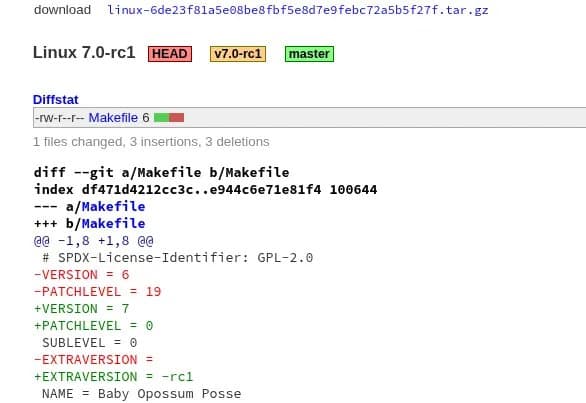
The inaugural release candidate for Linux kernel 7.0 introduces enhanced support for next-gen Intel and AMD processors, significant file-system optimizations, and hardware enablement across multiple architectures.

Linus Torvalds has officially released the first release candidate of the Linux 7.0 kernel, marking the closure of the merge window for this major version update. Despite Torvalds' characteristically understated mailing list announcement describing the version bump as purely numerical convenience, this iteration packs substantial technical upgrades relevant to hardware enthusiasts and homelab builders.
Hardware Enablement Extensions
Intel CPU support sees significant forward-looking additions with preliminary enablement for upcoming Nova Lake and Diamond Rapids server processors. AMD's Zen 6 architecture receives additional groundwork, while ARM platforms gain expanded support through Qualcomm Snapdragon X2 upstreaming efforts. Graphics drivers include new AMD GPU support for unreleased products and reactivated large page allocation for Nouveau drivers, directly benefiting the open-source NVK Vulkan driver's performance.
Storage and peripheral enhancements include:
- Apple USB Type-C PHY controller support
- Multi-lane SPI host controller interfaces
- Octal DTR (Double Data Rate) mode for SPI NAND flashes
- Extended sensor monitoring coverage for ASUS motherboards
- Non-blocking timestamp infrastructure
Performance-Critical Updates
Database workloads stand to gain significantly from NUMA-aware optimizations targeting AMD EPYC systems, with PostgreSQL benchmarks in internal testing showing measurable throughput gains. File-system improvements deliver tangible speedups:
| File-System | Improvement | Impact |
|---|---|---|
| exFAT | Optimized sequential read paths | Higher throughput for removable media |
| F2FS | Enhanced write efficiency | Better NAND endurance and reduced latency |
| EXT4 | Concurrent direct I/O write handling | Reduced contention in multi-threaded operations |
Additional performance boosts come from memory management refinements, scheduler scalability work, and Intel TSX memory transaction extensions now enabled in auto-mode by default. The Rust infrastructure transitions from experimental to officially supported status, signaling long-term commitment to the memory-safe language for future kernel development.
Build Recommendations and Availability
Homelab operators should note this kernel's expected adoption in Ubuntu 26.04 LTS and Fedora 44. For testing environments:
- Clone the 7.0-rc1 tree for early validation
- Prioritize testing on systems with new Intel/AMD hardware or NVMe-over-Fabrics configurations
- Verify sensor telemetry on ASUS X670/B650 platforms
- Benchmark PostgreSQL deployments on EPYC Rome/Milan systems
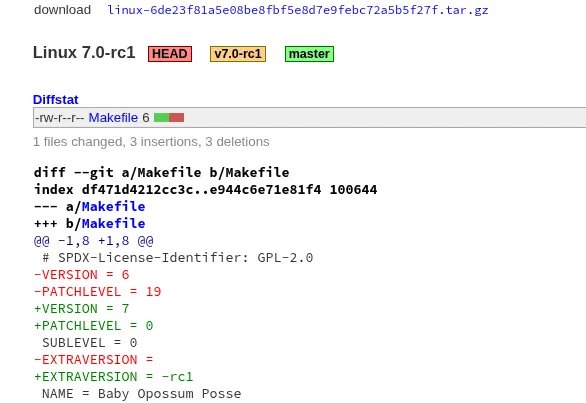
Linus Torvalds' announcement emphasized the routine nature of the release cycle while downplaying the major version significance.
Comprehensive performance benchmarks covering power consumption, storage throughput, and database scalability will follow in upcoming Phoronix analysis. Production deployments should await stable release, but enthusiasts can immediately evaluate hardware compatibility and performance characteristics in controlled environments.
Comments
Please log in or register to join the discussion