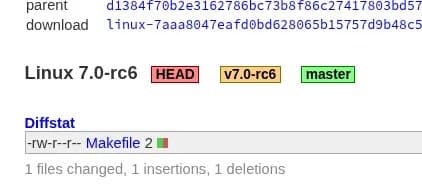
The sixth release candidate for Linux 7.0 arrives with an unusually high volume of fixes, particularly in filesystems and drivers, as developers work toward the mid-April stable release.
Linux 7.0-rc6 was just released as development continues toward the stable Linux 7.0 release scheduled for mid-April. This marks another busy week with numerous bug fixes still flowing into the kernel tree, maintaining the heavy pace of fixes that has characterized the entire 7.0 development cycle since the merge window.
This release candidate brings a substantial number of EXT4 file-system fixes, addressing various edge cases and stability issues that have emerged during testing. The x86 architecture received targeted fixes for Intel TDX and AMD SEV-SNP virtual machines, improving compatibility and security for these emerging virtualization technologies. Audio hardware received particular attention this week, with numerous quirks and fixes especially for laptop configurations where sound subsystems often encounter unique hardware combinations.
Beyond the core fixes, the release includes several new device ID additions to x86 platform drivers, primarily targeting Intel and AMD laptop configurations. These additions help ensure better out-of-the-box support for newer hardware as it reaches consumers.
In his release announcement, Linus Torvalds noted that the expectation of rc5 calming things down was premature, with rc6 bringing back a higher-than-normal volume of fixes. "It's not like anything in here looks particularly alarming," Torvalds wrote, "but the fact that the rc's this release has been pretty consistently bigger than normal doesn't exactly give me the warm and fuzzies."
Torvalds observed that while rc1 was average in commit count, the subsequent release candidates have consistently contained more small fixes than typical. The diffstat reveals filesystems as a standout category, with EXT4 and XFS leading the way, though the fixes span the entire kernel tree. Drivers still represent about a third of the changes, covering GPU, RDMA, networking, sound, and hardware monitoring subsystems.
Additional fixes touched core networking, architecture updates, RCU (Read-Copy Update) mechanisms, tooling, and memory management. Torvalds characterized most changes as "very small and none of it strikes me as being very scary" - describing them as real but trivial fixes. He speculated that improved AI tools might be contributing to the higher volume of fixes, though this remains uncertain.
Despite the unusual volume of fixes, Torvalds doesn't currently feel the situation warrants extending the release schedule. The plan remains for rc7 to ship next Sunday (April 5th) with the final Linux 7.0 stable release on April 12th. However, if the high volume of fixes continues, a 7.0-rc8 could be necessary, potentially delaying the final release to April 19th.
For those interested in the scope of changes coming in Linux 7.0, our comprehensive Linux 7.0 feature list provides detailed coverage of all the major improvements and new capabilities. The release will be among the first to ship with Ubuntu 26.04 LTS, which is scheduled to release in April with Linux 7.0 as its default kernel.
The Linux 7.0 development cycle demonstrates the ongoing challenge of balancing rapid innovation with stability, particularly as hardware ecosystems become more complex and testing uncovers edge cases that weren't apparent during initial development. Whether this represents a temporary anomaly or a new normal for kernel development remains to be seen, but the community continues to work toward delivering a stable, feature-rich release for users worldwide.

For more details on the Linux 7.0-rc6 release and to track ongoing development, visit the official Linux kernel Git repository.
Comments
Please log in or register to join the discussion