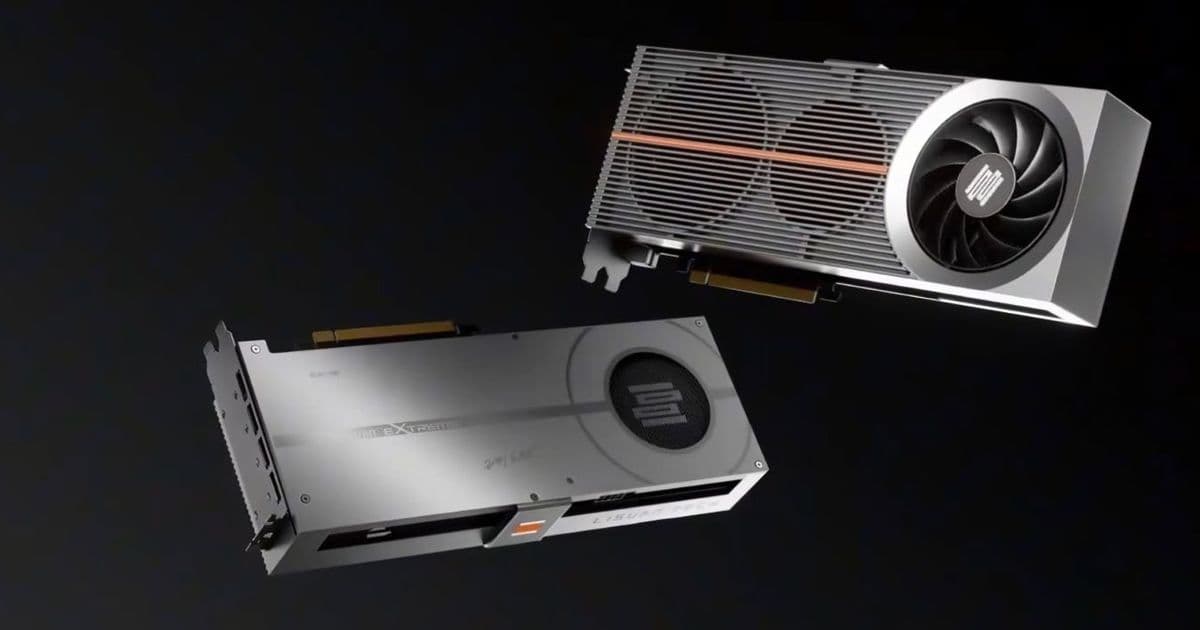
Lisuan Tech announces June 18 launch of homegrown 6nm G100 series GPUs with up to 12GB VRAM, targeting AMD and Nvidia's dominance while supporting modern APIs and Chinese processors.
Lisuan Tech, a rising Chinese semiconductor company, has announced the official launch date for its G100 series discrete GPUs on June 18, marking a significant milestone in China's push for technological self-reliance. The company unveiled the lineup at AWE 2026, a major tech conference in China, where it also revealed professional-grade variants alongside the gaming-focused LX 7G106.
Gaming GPU Targets Mid-Range Performance
The flagship gaming model, Lisuan Extreme LX 7G106, features 12GB of GDDR6 VRAM, 192 texture units, and 96 ROPs. With an FP32 throughput of up to 24 TFLOP/s, early benchmarks suggest performance comparable to Nvidia's RTX 4060. The GPU supports modern graphics APIs including DirectX 12, Vulkan, OpenCL, and OpenGL, enabling compatibility with popular titles like Cyberpunk 2077, Black Myth: Wukong, and Resident Evil 4 Remake.
What sets Lisuan apart is its "TrueGPU" architecture, which the company claims was built entirely from scratch. This means the instruction set, compute core, and software stack are all in-house developments, representing a complete departure from licensing existing architectures.
Professional Variants Expand Market Reach
Lisuan also announced three professional SKUs: LX Ultra, LX Pro, and LX Max. The LX Max features 12GB GDDR6 memory, while both LX Pro and LX Ultra offer 24GB configurations. Notably, the LX Ultra includes ECC support and employs a blower-style cooler, distinguishing it from the other models that share similar designs.
Industry analysts speculate that the LX Ultra and LX Pro likely utilize the G7105 server GPU, while the LX Max may repurpose the G7106 gaming chip or use a cut-down G7105 variant. All models maintain compatibility with both mainstream and locally developed Chinese processors.
Manufacturing and Technical Specifications
The G100 series GPUs are manufactured on a 6nm process node, representing a significant achievement for Chinese semiconductor manufacturing capabilities. This process technology enables the balance of performance and power efficiency required for modern gaming and professional workloads.
The GPUs' support for Windows-on-Arm represents a unique selling point, as neither AMD, Intel, nor Nvidia currently offer robust Arm compatibility for their consumer graphics cards. This positions Lisuan to potentially capture niche markets in the growing Arm ecosystem.
Market Implications and Future Prospects
Lisuan's entry into the discrete GPU market directly challenges the AMD-Nvidia duopoly that has dominated the space for years. The company's success will largely depend on real-world performance validation once independent reviews become available following the Chinese release.
A potential global launch remains uncertain, as it will be heavily influenced by the GPUs' actual performance relative to competing options from established players. The G100 series represents China's most ambitious attempt yet at creating a complete GPU ecosystem independent of Western technology.
Industry Context and Significance
The G100 series launch occurs against the backdrop of increasing technological decoupling between China and Western nations. Lisuan's achievement in developing a competitive GPU architecture entirely in-house demonstrates the maturing capabilities of China's semiconductor industry.
For consumers in China, the availability of domestically produced GPUs offers an alternative to imported options that may face supply chain uncertainties or geopolitical restrictions. The June 18 launch date and March 17 preorder opening provide concrete timelines for interested buyers to evaluate this new option in the discrete GPU market.
As Lisuan Tech continues to develop its TrueGPU architecture and expand its product lineup, the company's trajectory will be closely watched by industry observers as a barometer of China's progress toward semiconductor independence.
Comments
Please log in or register to join the discussion