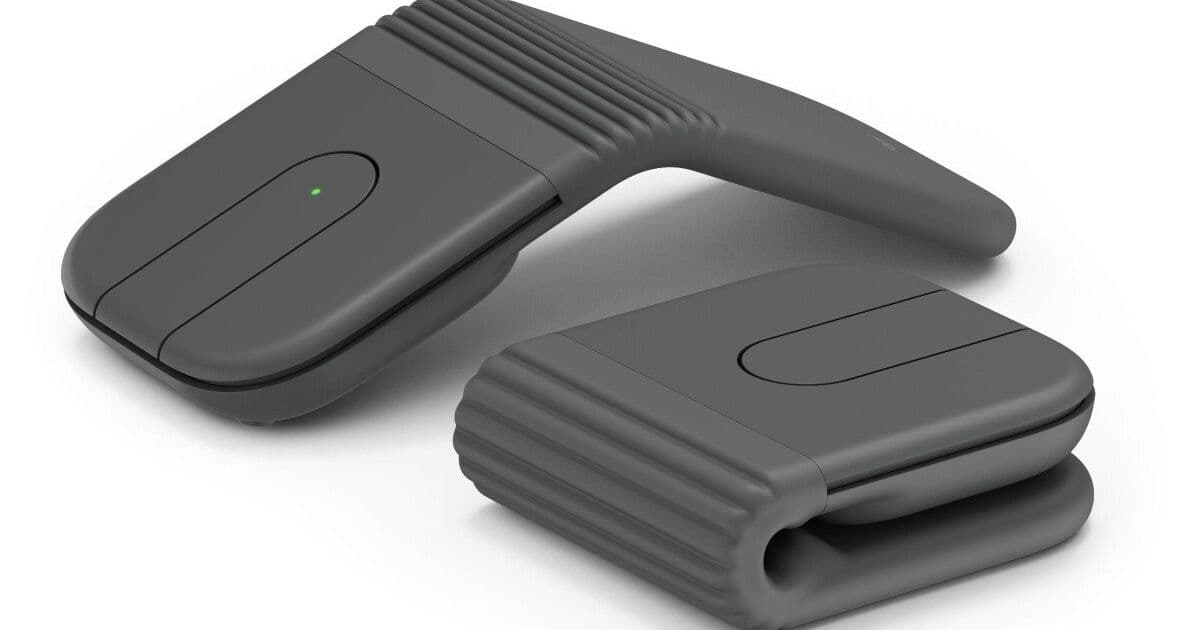
Logitech's first foldable mouse is a competent travel companion that closes like a flip phone. The odd part isn't the hinge, it's the company's insistence that an on-device AI model handles a job a microswitch has done for decades.
Logitech has shipped its first foldable mouse, the Mobi Fold, and the device itself is exactly what you would expect from a company that has been making pointing devices for four decades. It folds flat like a '90s flip phone, weighs 79 grams, and snaps open into something that looks a lot like Microsoft's old Surface Arc mouse. It costs £69.99 ($79.99). It works. The interesting story isn't the hardware at all. It's the sentence Logitech used to describe how the thing turns itself off.
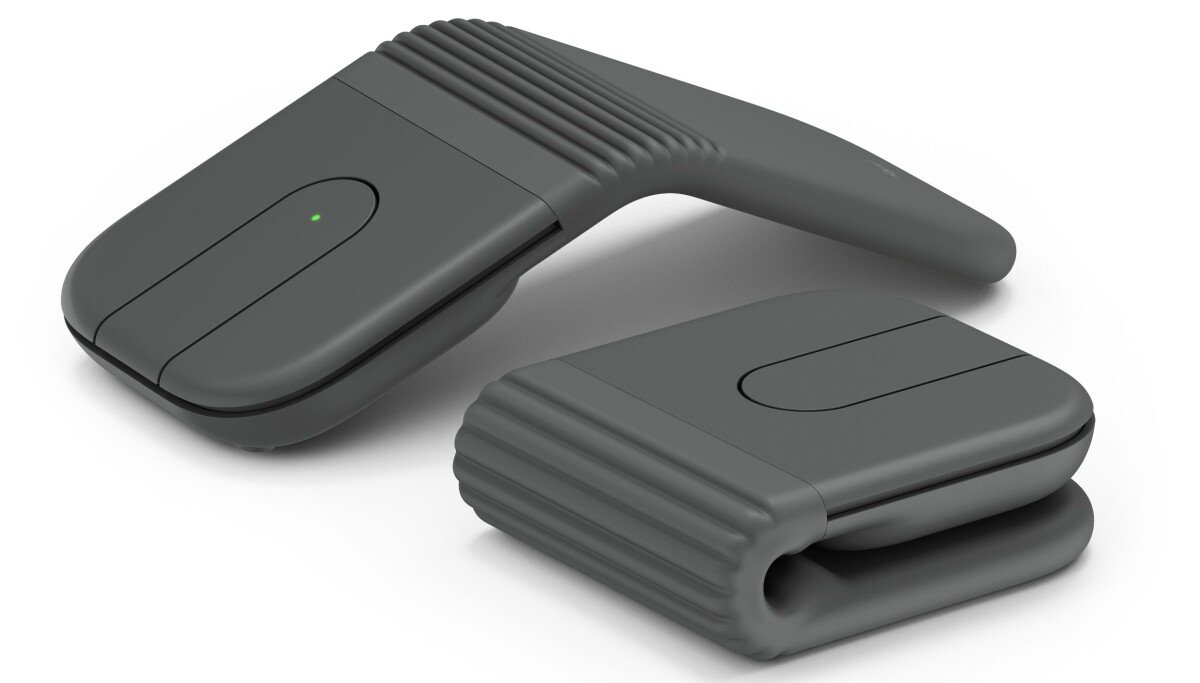
According to the company, folding the Mobi Fold shut kills the mouse by way of an "on-device AI model." Open it, it wakes. Close it, it sleeps. The Register's Richard Speed put it bluntly: a simple microswitch would have performed more than adequately. That observation is hard to argue with, and it points at a pattern worth watching across consumer hardware right now.
When everything becomes AI
There is a detectable shift in how vendors describe ordinary functions. A capacitive touch sensor becomes "AI gesture recognition." A noise gate on a microphone becomes "AI voice isolation." A lid sensor that has existed since the laptop was invented becomes, apparently, an "on-device AI model" governing power state. The function hasn't changed. The vocabulary has.
Part of this is genuinely defensible. Plenty of modern devices do run small neural networks locally for tasks like wake-word detection or motion classification, and "on-device" is meaningful shorthand for processing that never touches a server. Privacy-conscious buyers have legitimate reasons to prefer it. The distinction between cloud inference and edge inference matters, and a vendor calling out the local part isn't automatically being dishonest.
But a folding mouse detecting whether it is folded is not a problem that needs inference. It needs a closed circuit. Logitech almost certainly knows this, which is what makes the framing telling rather than scandalous. The company is reading the same market signals everyone else is: in 2026, attaching the letters A and I to a product feature is perceived as adding value, or at least avoiding the appearance of being left behind.
The community reaction splits predictably
Developer and hardware-enthusiast forums have settled into two camps on language like this, and both have a point.
The skeptics see marketing inflation that erodes trust. When a power switch gets rebranded as AI, the term loses meaning, and the next time a vendor claims AI for something that genuinely required machine learning, buyers have been trained to roll their eyes. There's a real cost to crying wolf. Several commenters on the original Register piece reached straight for the obvious joke about microswitches, and that reflex is itself the problem: the claim invites mockery rather than confidence.
The more sympathetic view is that consumers helped build this incentive. If shoppers reward "AI-powered" listings with clicks and conversions, and they demonstrably do, then a publicly traded company is behaving rationally by using the phrase wherever it can be defended with a straight face. Logitech's own chief executive has previously warned that ill-conceived AI gadgets can backfire, which makes the Mobi Fold framing read less like conviction and more like hedging against irrelevance. No vendor wants to be the one product page that doesn't mention AI when every competitor's does.
There is also a quieter counter-argument that deserves space: maybe none of this matters. The mouse works. The fold is satisfying. The battery lasts a month and tops up 22 hours of use from a one-minute charge over USB-C. If the marketing copy is silly, the silliness costs the buyer nothing and the device costs no more for the adjective. Outrage about a word on a spec sheet can be its own kind of performance.
The actual hardware, briefly
Stripped of the framing, the Mobi Fold is what Logitech tends to produce: aggressively competent. The hinge is rated for 15 years, though the EMEA warranty covers two. It comes in Graphite, Lilac, and Off White, with the Graphite finish pitched as the more durable option. There's no scroll wheel; touch scrolling and two customizable buttons live on the touch panel, configured through Logi Options+. It pairs over Bluetooth with three switchable profiles, or via an optional USB-C dongle for anyone who distrusts the protocol named after a 10th-century Danish king. The battery sits under a magnetic cover and looks straightforward to replace, a small but genuine nod toward repairability that more vendors should copy.
It is symmetrical, so left-handers are served as well as right-handers, a side effect of the flat folding shape rather than a deliberate inclusivity feature. People who want a heavy mouse studded with buttons should look elsewhere. People who want something to flatten into a laptop bag and move a cursor accurately will find it does the job.
The pattern under the product
The Mobi Fold arrives during what The Register has taken to calling the RAMpocalypse, with memory prices pushing component costs up across the board, so an £69.99 travel mouse already sits at the spicier end of reasonable. That economic pressure makes the marketing choices more interesting, not less. When margins tighten and buyers get cautious, the temptation to differentiate through language rather than engineering grows stronger.
What the Mobi Fold demonstrates, almost accidentally, is that the AI label has reached the saturation point where it attaches to things no reasonable person would call intelligent. That's not unique to Logitech and not even a criticism of this specific, perfectly good mouse. It's a market-wide tell. When the descriptor stops carrying information, the useful signal moves elsewhere, to teardowns, to repairability scores, to whether the hinge actually survives five years of being shoved in and out of a bag. The buyers who learn to ignore the adjective and read the spec sheet underneath will be the ones who keep getting their money's worth, and the vendors who keep stretching the term may find that the people most likely to buy a premium pointing device are exactly the people least likely to be impressed by it.
Comments
Please log in or register to join the discussion