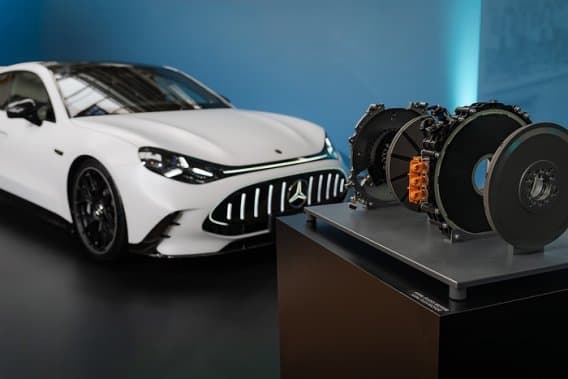
Five years after buying Oxford spinout YASA, Mercedes-Benz has started large-scale production of axial flux motors in Berlin. The acquisition story is more instructive than the horsepower numbers: a niche university spinout's technology is now rolling off seven production lines, and the hard part was never the physics.
Mercedes-Benz announced on June 9 that it has started large-scale production of its electric axial flux motor at the Berlin-Marienfelde plant, with the drive system making its production debut in the new Mercedes-AMG GT 4-Door Coupe. The headline is an EV that hits 100 km/h in 2.1 seconds. The more interesting story, for anyone watching how deep-tech startups actually reach scale, is how a small British motor company ended up inside one of the largest automakers in the world, and what it took to turn its lab prototype into something that ships in volume.
The company behind the technology
Axial flux motors did not originate at Mercedes. The core work came from YASA, an Oxford University spinout founded in 2009 around the doctoral research of Tim Woolmer. YASA spent over a decade as a specialist supplier, selling its unusually flat, high-torque motors into hypercars and aerospace projects where weight and packaging mattered more than price. It was the classic deep-tech position: a genuinely differentiated product, real engineering credibility, and a long, capital-hungry road to manufacturing scale.
Mercedes-Benz acquired YASA outright in 2021, turning it into a wholly owned subsidiary. For a startup, an acquisition by a strategic buyer is one of two or three realistic endgames, and for hardware companies whose differentiation is a physical product rather than software, it is often the only path to volume that does not require building a factory yourself. YASA had the technology. Mercedes had 30,000 square metres of production space, a 120-year manufacturing site, and the balance sheet to fund the industrialisation problem that kills most hardware startups.
The problem they solve
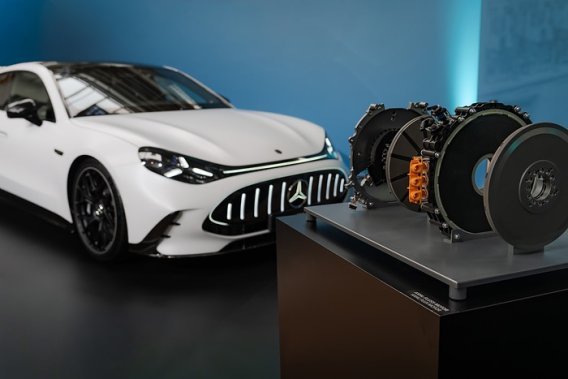
Most electric motors are radial flux designs, where the magnetic field runs perpendicular to the axis of rotation. An axial flux motor turns that geometry sideways: the magnetic flux runs parallel to the axis, and the components sit in a disc-shaped stack, with two rotors sandwiching a stator between them. The practical payoff is power and torque density. You get more output from a smaller, lighter package.
The numbers from Marienfelde make the packaging advantage concrete. The motor on the front axle of the new AMG GT is just under nine centimetres wide. The two rear motors are around eight centimetres each. Each one spins past 15,000 rpm. That compactness buys engineers freedom in how they lay out a drivetrain, which is exactly the kind of constraint that matters when you are trying to fit serious performance hardware into a road car.
The trade-off, and the reason axial flux motors stayed niche for so long, is manufacturing. The geometry that makes them compact also makes them brutally hard to build at volume.
Why scaling was the hard part
Mercedes describes the production process as 98 steps, 65 of them used for the first time at the company and 35 new worldwide, with more than 30 patent applications filed on the manufacturing methods alone. That ratio is the real story. The patents are not on the motor concept. They are on how to make it repeatably.
Consider the copper coils. To pack maximum copper into the stator, Mercedes uses rectangular wire instead of round wire, which fits more conductor into the same space. But rectangular wire has to be bent into tight radii at speed without creasing, cracking the insulation, or thinning the cross-section. Connecting the coil ends inside a cramped stator without thermally damaging the adjacent plastic required a laser welding process that puts minimal energy into the joint.
Then there is final assembly, which the team calls the "wedding." The stator gets positioned between two magnet-bearing rotor discs that pull on each other with forces up to 9 kilonewtons, roughly 900 kilograms. The stator has to stay centred within a tolerance under 0.1 millimetres while those forces are acting on it. A control algorithm corrects the position in the final half-second using high-frequency impulses. AI-based optical inspection checks the laser joints in real time.
None of this is glamorous, and none of it shows up in a spec sheet. But it is the entire reason axial flux motors were considered barely feasible for mass production until now. The lesson for hardware ventures is familiar: the prototype proves the concept, and then the next several years and most of the capital go into the unglamorous problem of making it a thousand times over without defects.
Traction and positioning
Mercedes is using Berlin-Marienfelde, its oldest plant, founded in 1902, as the center of excellence for these motors. The site has also hosted the company's Digital Factory Campus since 2022, built on its MO360 production software, which gives some sense of why this location rather than a greenfield plant. The bet is that combining high-performance drive units with digital production tooling produces a process other Mercedes sites can copy.
The three motors per car are bundled into what Mercedes calls High Performance Electric Drive Units, each pairing a motor with a planetary gearbox in one housing. The company also points to a 2025 endurance run at Nardò, where the CONCEPT AMG GT XX technology demonstrator covered more than 40,000 kilometres in seven days and set 25 long-distance records, as evidence the technology holds up under sustained load rather than just sprint conditions.
Where this nets out for the broader market is worth watching with some skepticism. Axial flux motors are launching in a six-figure AMG halo car, which is the right place to absorb the cost of 35 brand-new manufacturing processes. Whether the economics carry down into mainstream EVs, where price sensitivity is unforgiving, is the open question the press materials understandably do not answer. The German government is talking up the announcement as a signal of industrial strength, and the political framing is doing some work here. The engineering achievement is real regardless.
For YASA specifically, this is the validation an acquired deep-tech startup hopes for and rarely gets so cleanly: the technology you built reaching genuine volume production under a parent that committed the capital to industrialise it, rather than quietly shelving it after the deal closed. That outcome is common enough that it deserves naming. This one went the other way.
Comments
Please log in or register to join the discussion