
OnePlus just dropped two affordable phones in China that punch well above their price class, led by an enormous 8,000mAh silicon-carbon battery in the Pro model. Expect both to resurface globally as Nord devices.
OnePlus has made the OnePlus Turbo 6X series official in China, and the headline number is hard to ignore: the Turbo 6X Pro packs an 8,000mAh battery. For context, most flagship phones today still hover around 5,000mAh, so OnePlus is using newer silicon-carbon (Si-C) cell chemistry to cram far more capacity into the same physical space. Both phones are China-only for now, but the naming and positioning strongly suggest they will return to global markets rebadged under the OnePlus Nord lineup, which is exactly what happened with previous Turbo-series devices.

Battery and charging lead the pitch
The Turbo 6X Pro's 8,000mAh Si-C battery supports 80W SuperVOOC wired charging, and notably it also tops out at 55W with third-party chargers. That second figure matters more than it sounds. Proprietary fast-charging standards often collapse to a slow trickle when you plug into a generic USB-PD brick, so 55W on third-party hardware means you are not chained to OnePlus's own charger to get a meaningful top-up.
The standard Turbo 6X steps down to a 7,000mAh cell with 45W SuperVOOC speeds. That is still a large battery by any measure, and paired with the efficiency of a mid-range chip, both phones should comfortably clear a full day of heavy use with margin to spare.
Silicon-carbon batteries are the reason these numbers are possible. By replacing part of the traditional graphite anode with silicon, manufacturers increase energy density, fitting more capacity into the same volume. The trade-off historically has been cycle longevity, though the technology has matured enough that brands like OnePlus, Honor and Xiaomi now ship it in mainstream devices.
Where the Pro pulls ahead
The display is the clearest dividing line between the two models. The Turbo 6X Pro gets a 6.78-inch M14 AMOLED panel at 1.5K resolution (1,272 x 2,772 pixels) with a 144Hz refresh rate, an in-display optical fingerprint reader, and a 16MP selfie camera. AMOLED brings deeper blacks, better outdoor brightness and the under-display fingerprint sensor that buyers generally expect on a more premium phone.
The non-Pro Turbo 6X uses a 6.72-inch LCD at FHD+ resolution, also running at 144Hz. It moves the fingerprint sensor to a side-mounted reader built into the power button, and drops the selfie camera to 8MP. LCD versus AMOLED is the most visible compromise here, but the 144Hz refresh rate on both means scrolling and animations stay smooth across the lineup.
Both phones run on MediaTek silicon. The Pro uses the Dimensity 7400 Super, while the standard model gets the Dimensity 7360 Super. Both ship with up to 12GB of RAM and 256GB of storage. These are solidly mid-range chips built on efficient process nodes, which is part of why the large batteries translate into genuinely long screen-on time rather than just compensating for a power-hungry processor.
Cameras and durability
Round the back, both devices share a 27mm-equivalent 50MP main camera. The Pro adds a useful 8MP ultrawide, while the standard model fills its second slot with a 2MP monochrome sensor, the kind of filler lens that rarely does much in practice. If versatility matters to you, the Pro's ultrawide is the more meaningful inclusion.
Durability also favors the Pro, which carries IP68/69K water and dust resistance. The IP69K portion means it can withstand high-pressure, high-temperature water jets, not just immersion. The standard Turbo 6X settles for IP64, enough to shrug off dust and splashes but not submersion.
Software and the ecosystem angle
Both phones ship with ColorOS 16 based on Android 16. In China, OnePlus and Oppo share the ColorOS software stack, which is why these devices sell through Oppo's official online store. For buyers outside China, the global versions would likely arrive running OxygenOS, OnePlus's international skin that sits on the same underlying codebase.
The ecosystem story is worth weighing if you are eyeing an eventual global release. OnePlus has been steadily improving cross-device interoperability, including recent work to bring AirDrop-style sharing to its phones via Quick Share. Buying into the OnePlus and Oppo family increasingly means features like synced clipboards, file transfer and accessory pairing work best when you stay within that walled garden. That lock-in is mild compared to some rivals, but it is a factor as these brands build out tablets, watches and earbuds designed to talk to each other first.
Pricing and availability
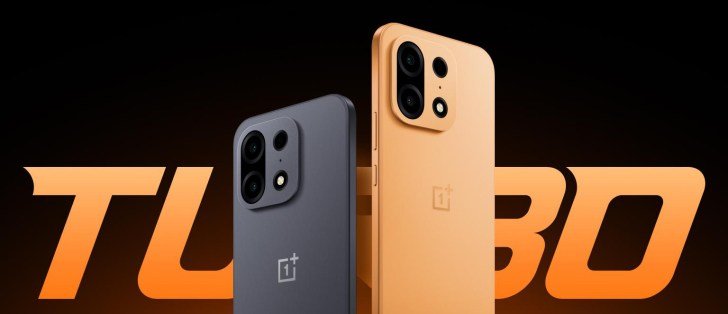
The Turbo 6X comes in black, green and white. It starts at CNY 1,899 (about $280 or 243 euros converted) for the 8/128GB configuration and rises to CNY 2,299 (about $340 or 294 euros) for the 12/256GB model.
The Turbo 6X Pro is offered in black and orange, starting at CNY 1,999 (roughly $295 or 255 euros) for 8/128GB and reaching CNY 2,399 (about $354 or 306 euros) for the 12/256GB trim.
Both go on sale through Oppo's official Chinese store with deliveries beginning June 15. Converted prices never map cleanly to global launches once taxes and regional positioning are factored in, but they signal OnePlus's intent to keep the Nord line aggressive on value. If these reach international shelves later this year, an 8,000mAh battery at a mid-range price would make the Pro one of the more compelling options for anyone who prioritizes endurance over a marquee chipset. You can track the official lineup and future Nord releases on the OnePlus website.
Comments
Please log in or register to join the discussion