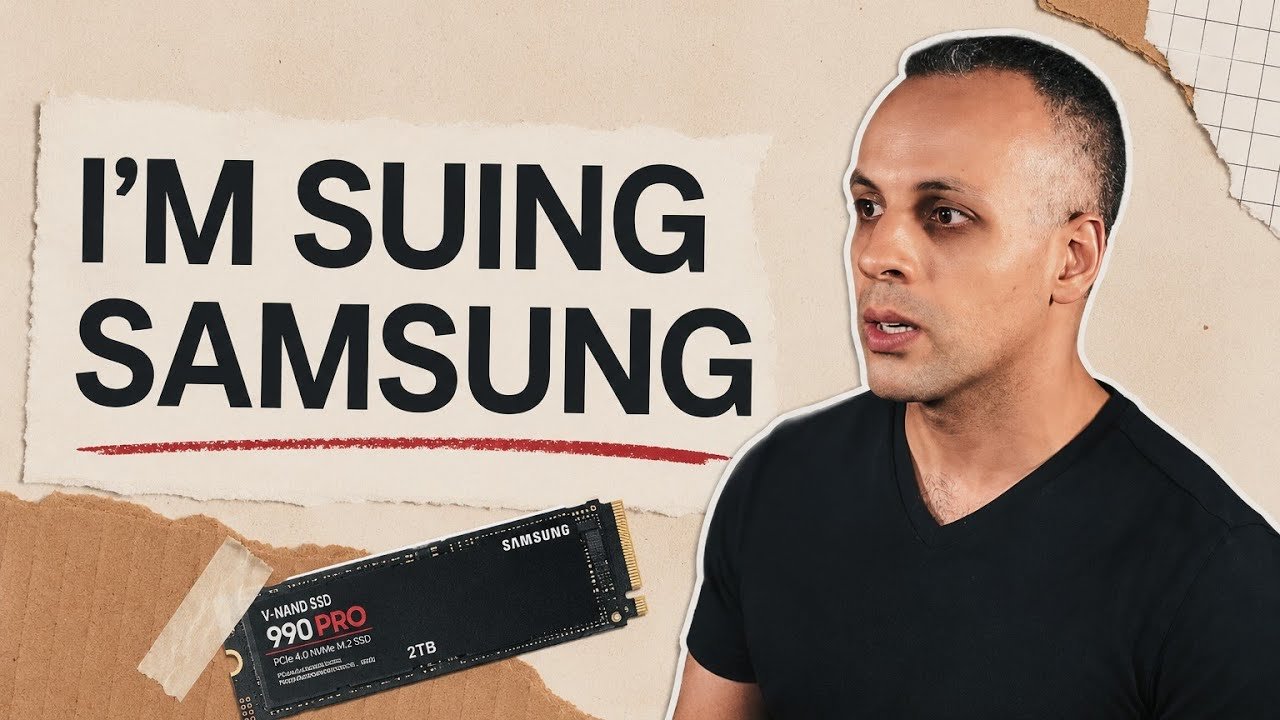
A failed 4TB 990 Pro inside a RAID 1 array has become a test case for warranty law. Samsung offered Rossmann a refund of the $330 he paid in 2023, citing no stock, while listing the same drive on its own Amazon storefront for $949. The dispute now heads to a Texas court.
Right to Repair advocate Louis Rossmann is preparing to sue Samsung after the company declined to replace a 4TB 990 Pro SSD that failed inside its warranty window, instead offering a cash refund of $330, the original purchase price, while the identical drive sat in stock on Samsung's own Amazon storefront for $949. The gap between those two numbers, nearly 3x, is the entire fight, and it exposes a structural tension in how SSD warranties are written and enforced.
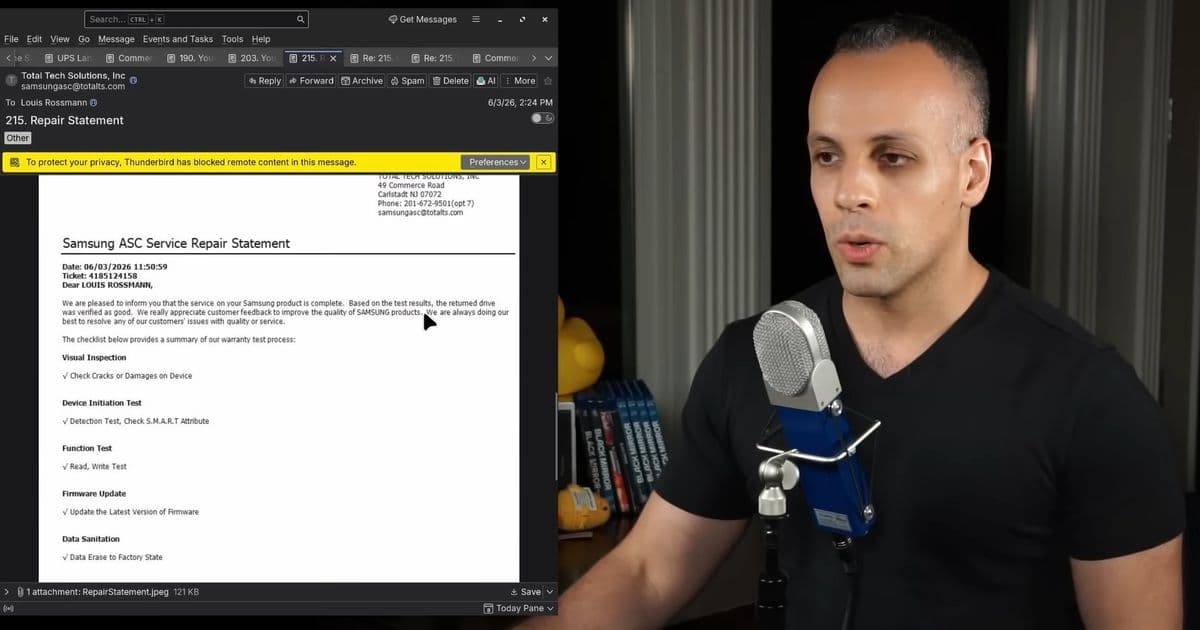
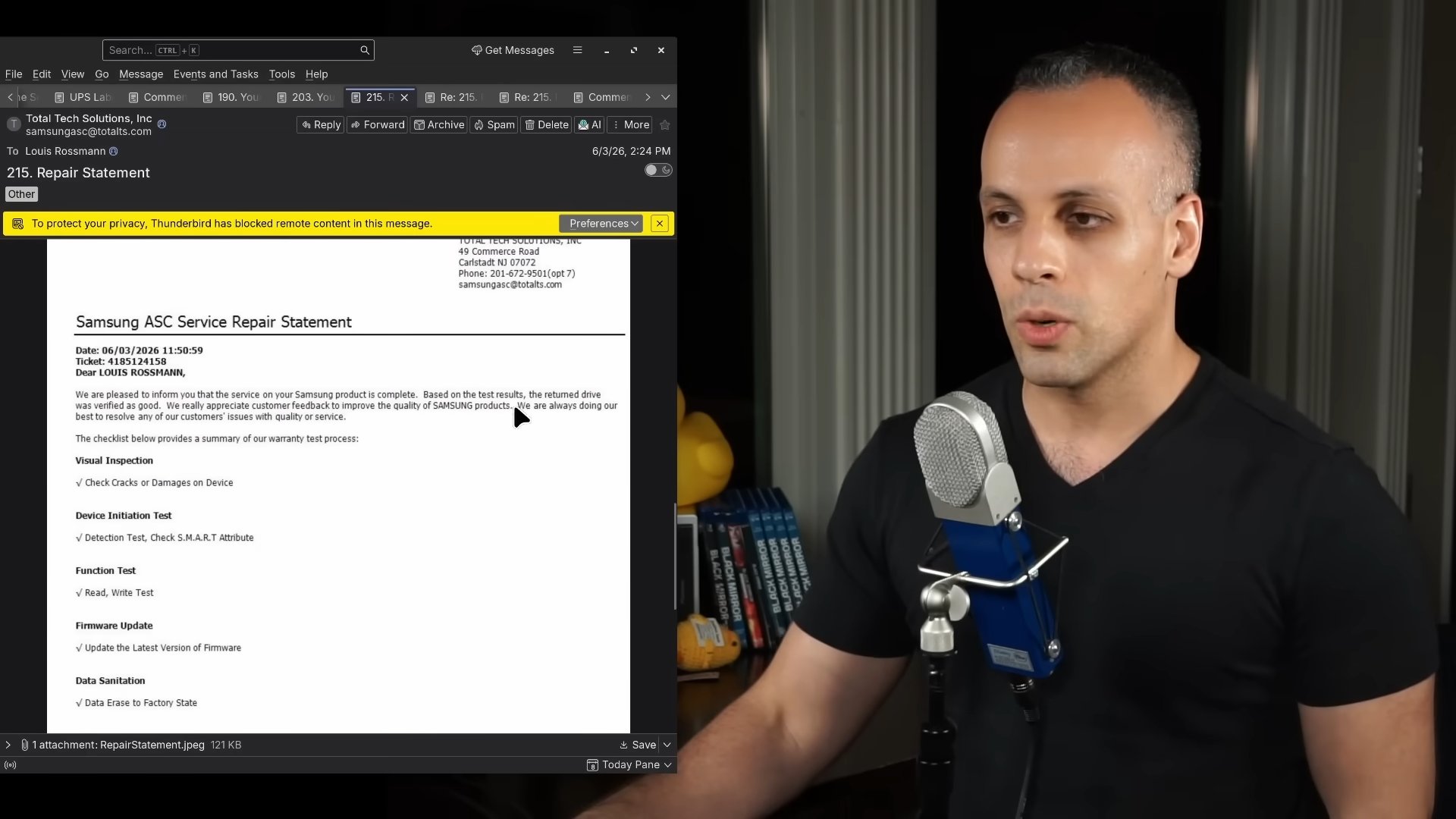
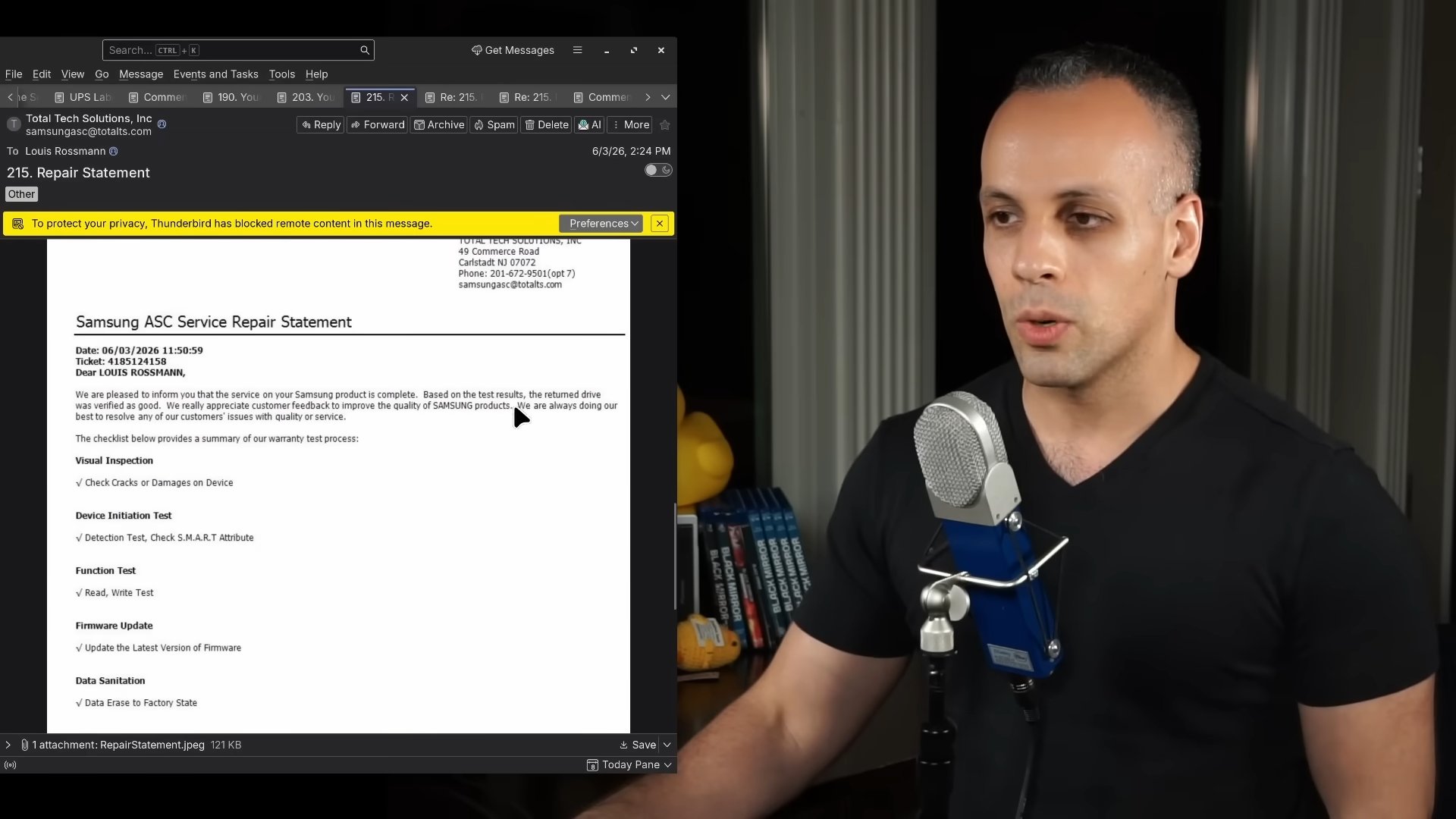
The details, laid out in a YouTube video where Rossmann published his email exchanges with Samsung support, are unusually clean for a warranty dispute. The drive was not abused. It operated under a heatsink cooled by two 80mm fans, which is well beyond what most consumers run, and it was part of a RAID 1 mirror, so no data was lost when it died. Rossmann submitted error logs, and Samsung's support team initially agreed the logs indicated a dead drive.
What the warranty actually says
The 990 Pro carries a standard five-year limited warranty, and the relevant clause is worth reading closely because it is the crux of the case. Samsung commits to, at its option, either "repair or replace the Product with new or refurbished Product of equal or greater capacity and functionality," or "refund the then current market value of the Product at the time the warranty claim is made to Samsung if Samsung is unable to repair or replace the Product."
Two phrases matter. "Then current market value" is not the same as the original purchase price. And the refund option is gated on Samsung being "unable to repair or replace." Rossmann's argument is straightforward: the drive is demonstrably available, in volume, at Samsung's own retail channel, so the company is not unable to replace it. If the refund route applies at all, the current market value is closer to $949 than $330.
Samsung's position appears to lean on a stock shortage, but the public listing undercuts that claim. The sequence got messier when Samsung's own bench testing reportedly returned the drive as healthy, contradicting the field logs, then shipped Rossmann's original unit back to him with a tracking number. He retested it on his own equipment and found it still non-functional.
The pricing context behind the $330 to $949 jump
The price delta is not arbitrary, and it tells you something about the NAND market. The 4TB 990 Pro launched in late 2022 into a market awash in oversupply, and NAND flash spot prices fell hard through 2022 and into 2023, dragging street prices for high-capacity TLC drives down with them. A $330 purchase price for a 4TB PCIe 4.0 drive reflects the bottom of that cycle.
The rebound since then has been steep. NAND makers cut wafer output to stem losses, and the subsequent supply discipline, compounded by HBM and enterprise SSD demand pulling capacity toward data center products, pushed consumer NAND pricing up sharply. A near-tripling of the listed price over roughly two and a half years is aggressive but not implausible against that backdrop. The 990 Pro uses Samsung's V-NAND with the in-house Pascal controller, and 4TB units sit at the top of the consumer stack, exactly the segment where constrained wafer allocation hits hardest.
That market movement is precisely why the warranty language is contested. A consumer who buys a depreciating component at a cyclical low and sees it fail years later, when the same part has appreciated, ends up worse off than someone whose product failed in a falling market. The "current market value" clause shifts that pricing risk in whichever direction favors the manufacturer at claim time.
Why this matters beyond one drive
For anyone running NAND storage, the practical lesson is the one Rossmann's setup already demonstrated: RAID 1 or equivalent redundancy is what saved his data, not the warranty. SSD warranties protect the hardware's replacement cost, not the contents, and they protect it on the manufacturer's terms, including endurance limits measured in terabytes written that can void coverage independently of calendar time.
The legal question is narrower but more interesting. Courts will have to weigh whether a publicly listed, in-stock product can be called unavailable for warranty purposes, and whether "current market value" can be quietly substituted with original purchase price when that substitution favors the seller. Rossmann intends to file in Austin, Texas, after the statutory 60-day notice period elapses. A ruling against Samsung would put pressure on every SSD vendor that uses similar market-value language, because the same clause appears across the industry and the same NAND price volatility applies to all of them.
Samsung has not publicly responded to the litigation threat beyond the support correspondence Rossmann published. The 990 Pro remains one of the more widely sold high-end consumer drives, which means the outcome here could touch a large installed base of owners who bought in during the cheap years and have no idea their replacement value clause cuts against them.

Comments
Please log in or register to join the discussion