
A new Binding Operational Directive from CISA compresses patching deadlines for federal civilian agencies, with the riskiest vulnerabilities demanding remediation in 72 hours. The directive replaces two older mandates and ties patching priority directly to how exposed, automatable, and damaging a flaw actually is.
The U.S. Cybersecurity and Infrastructure Security Agency has issued Binding Operational Directive 26-04, a sweeping update to how Federal Civilian Executive Branch (FCEB) agencies prioritize and apply security patches. The headline change is speed. For the highest-risk vulnerabilities, agencies now have as little as three days to remediate.
The directive consolidates and retires earlier guidance, superseding both BOD 19-02 and BOD 22-01, the 2019 and 2021 mandates that previously governed vulnerability remediation and the Known Exploited Vulnerabilities catalog. Rather than running parallel frameworks, CISA is folding everything into a single risk-based model that asks one practical question: how likely is this flaw to get an agency owned, and how fast.
What actually changed
The old model leaned heavily on CVSS severity scores and fixed windows. A critical-rated CVE got one deadline, a high-rated one got another, regardless of whether anyone was exploiting it in the wild. That approach treated theoretical severity and active exploitation as roughly equivalent, which they are not.
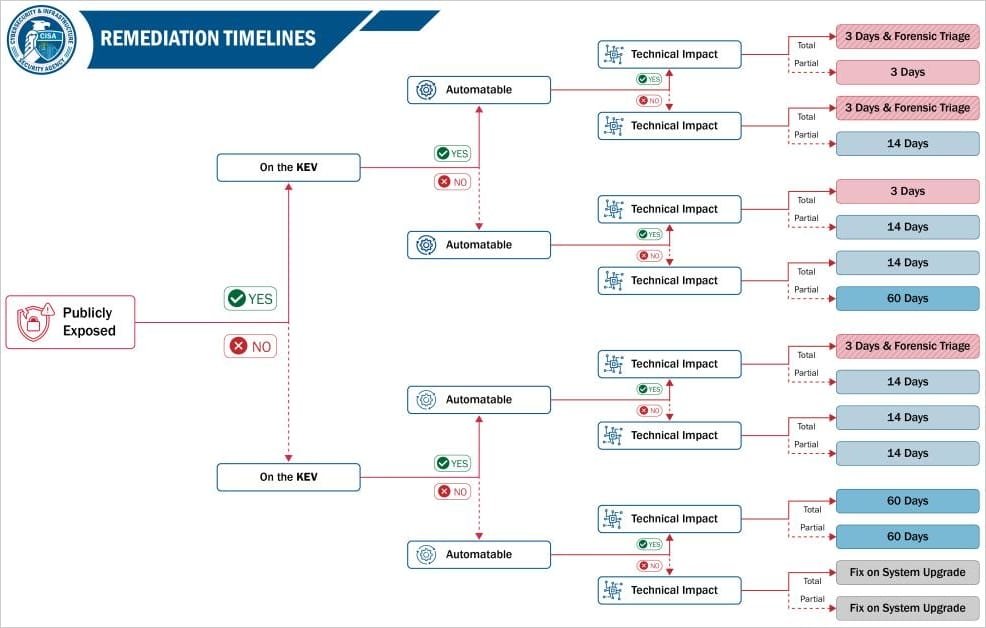
BOD 26-04 instead scores urgency against four considerations:
- Whether the affected asset is publicly exposed to the internet
- Whether the vulnerability appears in CISA's KEV catalog, meaning confirmed real-world exploitation
- Whether exploitation can be automated for large-scale, opportunistic attacks
- Whether successful exploitation grants attackers partial or total control of the system
Stack those factors and you get the deadline. A publicly exposed system with a KEV-listed flaw that can be mass-exploited and hands over full control lands in the three-day bucket. At the other end, a vulnerability that cannot be automatically exploited and yields only partial control gets a two-week window. The model maps the response time to the realistic blast radius instead of a single number on a severity chart.
This mirrors how mature security teams already triage. "The CVSS score tells you how bad a vulnerability could be in a lab. The KEV catalog tells you what's actually being used against people right now," is the distinction practitioners have pushed for years. CISA is now codifying that instinct into a federal mandate, and the KEV catalog becomes the operational center of gravity rather than a reference list.
Who it covers, and who it doesn't
The directive binds FCEB agencies and the information systems they operate, including the departments and agencies that make up most of the civilian government. It explicitly does not reach certain national security systems operated by the Department of War, private companies, Intelligence Community systems, or contractors.
Scope on the infrastructure side is broad. BOD 26-04 covers on-premise federal systems, third-party hosted systems, and both FedRAMP and non-FedRAMP cloud environments. That cloud coverage matters, because a large share of federal workloads now run on infrastructure the agency does not physically own. A directive that stopped at the data center door would miss most of the attack surface.
Even though private industry sits outside the mandate, these directives tend to set a tone the wider market follows. Vendors track what CISA prioritizes, and a flaw that triggers a three-day federal scramble becomes a de facto signal to everyone else that patching cannot wait for the next maintenance window.
The implementation runway
Agencies are not expected to flip a switch overnight, and the directive builds in a staged rollout.
Immediately, agencies should begin updating vulnerability management policies, refreshing asset inventories, and automating KEV status reporting. You cannot patch what you cannot see, so accurate, continuously updated asset inventory is the foundation the rest of the directive rests on.
Within 60 days, vulnerability management processes must be rebuilt to use CVE and KEV data as the basis for remediation decisions. This is the analytical shift, moving from severity-driven to exploitation-driven prioritization.
Within 180 days, all agencies must be operating under the new remediation timelines, continuously monitoring their environments and reporting detailed asset metadata back to CISA. The metadata reporting is what gives CISA visibility across the federal enterprise, turning hundreds of independent agency programs into something closer to a coordinated picture.
Practical takeaways beyond the federal scope
For security teams outside government, the directive is a useful template even though it carries no obligation. A few things translate directly.
First, three-day windows are only survivable with automation. Manual patch cycles, change advisory boards that meet weekly, and ticket queues measured in days will not keep pace. The agencies that hit these deadlines will be the ones that automated KEV ingestion and tied it straight into deployment pipelines.
Second, asset inventory is the real bottleneck. Every patching program eventually fails at the same point: unknown assets. The directive's heavy emphasis on inventory and continuous monitoring reflects that hard-won lesson.
Third, exposure plus automatability is the combination to fear. A flaw that is internet-facing and scriptable into mass exploitation is what turns a single CVE into a breach wave. Prioritizing that intersection, rather than chasing every critical-rated bug equally, is where limited patching capacity earns the most risk reduction.
Validation closes the loop. Patching a vulnerability and assuming the fix took is how teams end up with a false sense of coverage. Testing whether the remediation actually holds, and whether detection tooling would catch an exploitation attempt against an unpatched system, is the difference between a compliance checkbox and genuine resilience.

CISA has been steadily tightening the screws here, having recently ordered agencies onto similarly aggressive three-day clocks for actively exploited Ivanti and cPanel flaws. BOD 26-04 takes those one-off emergency directives and turns the underlying logic into standing policy. The emergency tempo is becoming the baseline, and the gap between when a flaw is weaponized and when defenders are expected to have closed it keeps shrinking.
Comments
Please log in or register to join the discussion