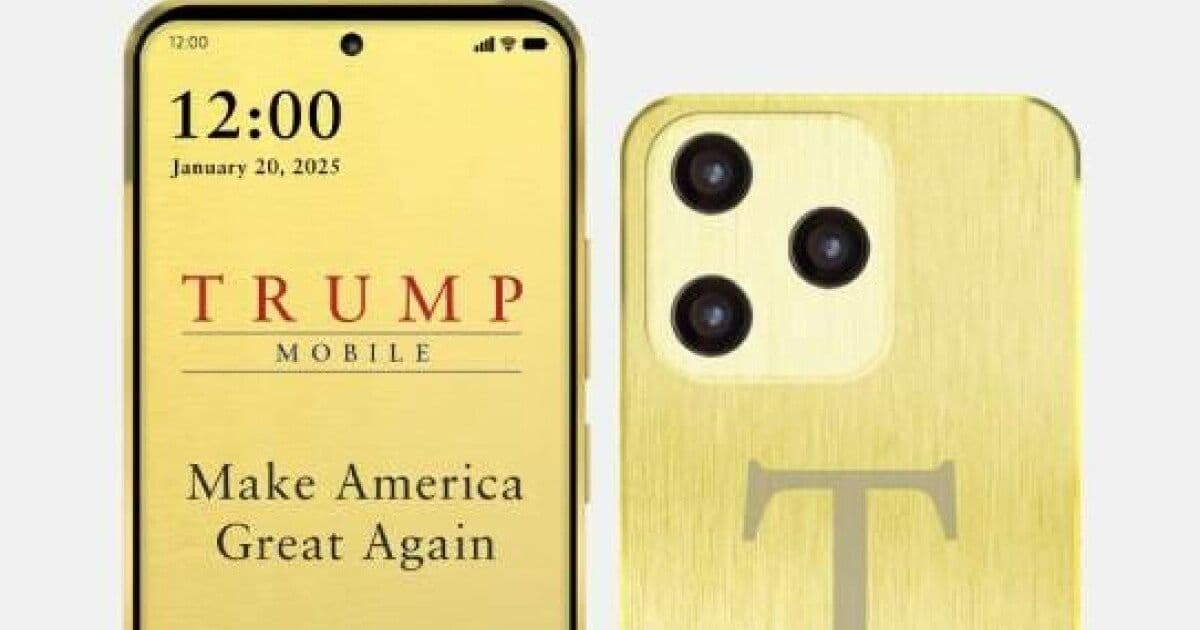
An iFixit teardown confirms the $499 "American-made" Trump T1 is essentially a two-year-old HTC U24 Pro built with Chinese parts. The bigger concern for buyers is what happened to their personal data when the Trump Mobile website reportedly exposed it to anyone who knew how to ask.
The long-promised Trump-branded smartphone has finally shipped, and a hardware teardown has put to rest the question of what is actually inside it. According to repair specialists at iFixit, the Trump Mobile T1 is, underneath its gold finish, an HTC U24 Pro that launched almost exactly two years ago. The marketing called it "proudly designed and built in the United States." The CT scanner told a different story.
For most coverage, the rebadging is the headline. For anyone who handed over money or personal information to pre-order one, the more consequential development is a reported data leak and a pending regulatory complaint. Those two threads matter more to your rights as a consumer than the silicon does, so this piece treats them as the main event.
What happened
The Trump Organization unveiled Trump Mobile, a cellular service, in June 2025, alongside the T1 Phone. The company described the device as a sleek, gold, American-engineered handset and began accepting $100 deposits to reserve one. The promised August delivery date came and went. The phone did not arrive until May 2026.
When it did arrive, iFixit ran the T1 and an HTC U24 Pro through a CT scanner side by side and found the internals were nearly an exact match. They went further, swapping the main board from the HTC into the Trump phone. It fit, and the device still worked. The only meaningful difference they noted was the memory and storage package, sourced from Micron in the T1 versus SK hynix in the HTC unit. The T1 runs Android 15 rather than the Android 14 that shipped on the HTC, and it is built on Qualcomm's Snapdragon 7 Gen 3, a mid-range platform. At a promotional $499, iFixit points out that buyers are not being overcharged for the hardware itself. The phone is assembled in Florida, but it was designed in China and most of its parts come from China.
The assembly claims and "Made in the USA" framing are what drew lawmakers' attention. Members of Congress urged the Federal Trade Commission to investigate Trump Mobile over what they characterized as deceptive marketing. Separately, and more serious from a privacy standpoint, a researcher claimed the Trump Mobile website was leaking thousands of people's data to anyone who sent a simple HTTP POST request.
The legal basis
Two distinct bodies of law are in play here, and it helps to separate them.
The "Made in USA" question falls under the FTC Act. The Commission's Made in USA Labeling Rule requires that products advertised as American-made be "all or virtually all" made in the United States. A device designed in China and assembled from predominantly Chinese components does not clear that bar by any ordinary reading. The FTC has authority to bring enforcement actions and seek civil penalties for violations, which is why the congressional referral matters rather than being merely symbolic.
The data exposure is the part that should worry customers most directly. If the website allowed unauthenticated requests to return other people's personal information, that is a textbook security failure. Under Section 5 of the FTC Act, failing to provide reasonable security for consumer data can itself be an "unfair" practice, and the FTC has used that authority repeatedly against companies that left customer records accessible. Customers in California gain additional standing under the California Consumer Privacy Act, which grants a private right of action when a business's failure to maintain reasonable security results in a breach of personal information. Damages there can run from $100 to $750 per consumer per incident, without the affected person having to prove specific financial loss.
For any European customers who interacted with the service, the General Data Protection Regulation sets a higher floor still. GDPR Article 32 obligates data controllers to implement appropriate technical measures to secure personal data, and an exposure triggered by an ordinary POST request is hard to reconcile with that duty. Article 33 would require notifying the relevant supervisory authority within 72 hours of becoming aware of a breach, and Article 34 may require telling the affected individuals directly. Penalties under GDPR can reach the greater of 20 million euros or 4 percent of global annual turnover.
Impact on users and the company
If you put down a $100 deposit or completed a purchase, the practical risk is not that you received a mediocre phone. It is that the name, address, payment details, and contact information you submitted may have been retrievable by strangers. That kind of exposure does not expire. Leaked personal data feeds phishing campaigns, SIM-swap attempts, and identity fraud for years after the initial incident, which is why breach notification laws exist in the first place. A name and a phone number tied to a known political affiliation is also a targeting vector in its own right.
The immediate steps for anyone affected are the ordinary breach hygiene ones. Watch payment statements, treat unsolicited messages referencing the order with suspicion, and consider a fraud alert or credit freeze if financial details were involved. California residents who believe their data was exposed should look closely at the CCPA private right of action, because it does not require demonstrating that money was actually stolen.
For Trump Mobile, the combined exposure is regulatory and reputational. A Made-in-USA referral and a data-security failure are the kind of pairing that invites a broader FTC inquiry rather than a narrow one. Companies that market aggressively while cutting corners on security tend to find that the marketing claims and the security failures get examined together.
What changes
The teardown changes the marketing story. A phone sold on the promise of American manufacturing turning out to be a relabeled, two-year-old Taiwanese-designed handset built with Chinese parts is a straightforward truth-in-advertising problem, and the FTC referral signals that regulators may treat it as one.
The data leak, if confirmed and acted on, could change more. Enforcement actions over unsecured customer data routinely end in consent orders that mandate years of independent security audits, and CCPA litigation can attach real per-record costs to a breach. None of that has been finalized yet, and the claims about the leak come from a researcher rather than from a regulator's findings. But the pattern is familiar enough to predict the shape of what comes next.
The broader lesson for buyers is the one privacy advocates repeat with every new branded gadget: the device is rarely the real product. The data you surrender to buy it is. A gold paint job and a patriotic pitch do not change the legal obligations a company takes on the moment it collects your personal information, and they do not change your rights when it fails to protect that information.
Reporting on the Trump Mobile data exposure was first surfaced by independent researchers and covered by The Register, and the full hardware teardown is documented at iFixit.
Comments
Please log in or register to join the discussion